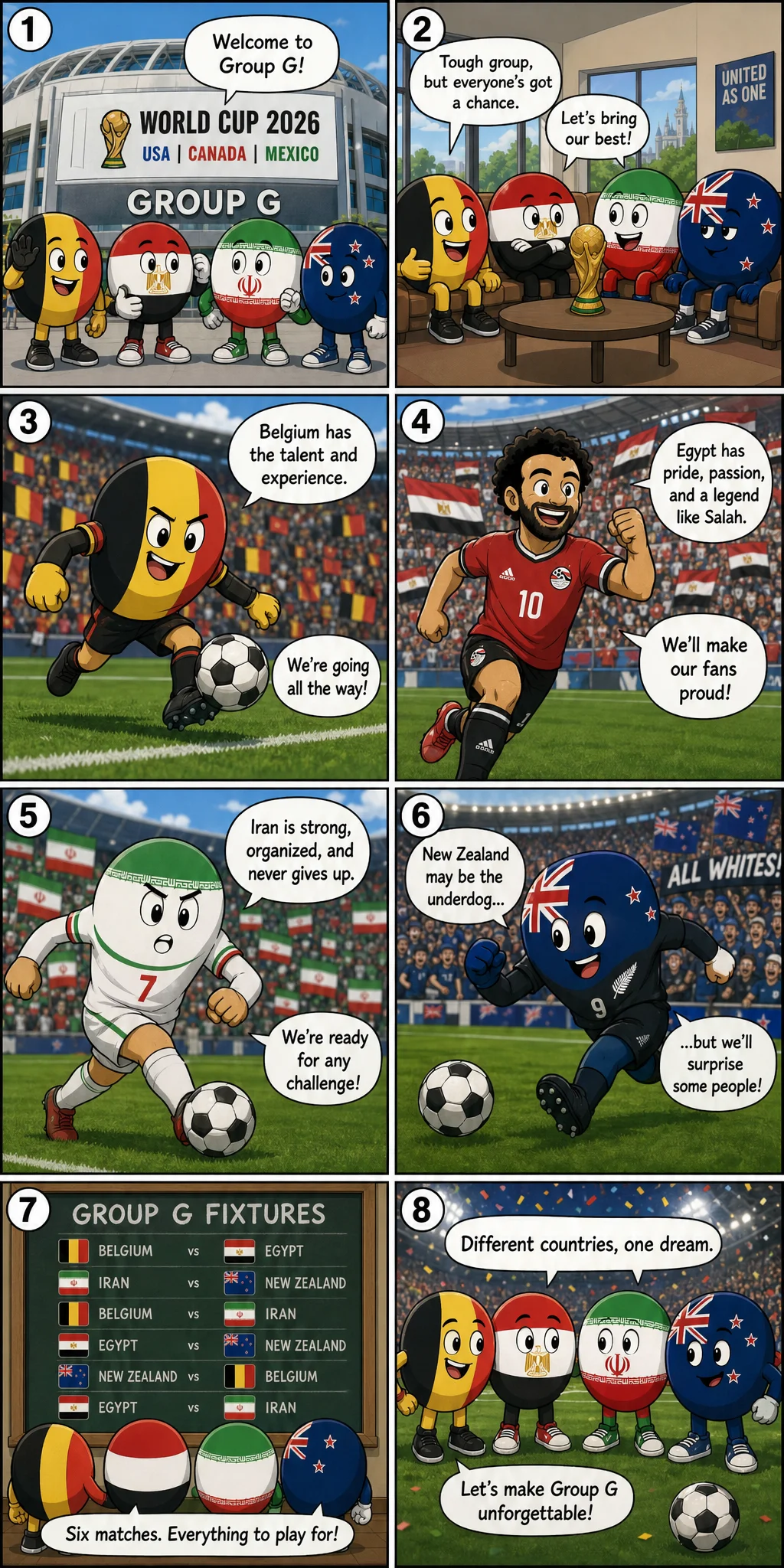
Group G Power Analysis: Belgium, Egypt, Iran, New Zealand
Group G: Belgium, Egypt, Iran, New Zealand. Belgium's golden generation last dance; Salah carries Egypt; Iran's defensive wall; New Zealand's Oceania pride
Published: June 8, 2026
In Group G of the 2026 World Cup, a picture that seems clear but is actually fraught with undercurrents unfolds. Belgium, Egypt, Iran, and New Zealand—four nations, each carrying vastly different football narratives, will stage a dialectic of gold, faith, walls, and pride amid Qatar's desert storms.
Belgium, once labeled the "Golden Generation," now bears a faint twilight hue. De Bruyne, Lukaku, Courtois—names that once made Europe tremble, yet never turned talent into a trophy. Their football is refined and rational, like Brussels' lacework, full of calculation and beauty, but prone to shattering in crucial moments due to a lack of grit. In 2026, this may be their last chance to challenge the World Cup under the "Golden Generation" banner. Their tactical core still revolves around De Bruyne's creativity; his vision and rhythm control are the team's soul. However, defensive concerns—especially the balance between attack and defense at full-back, and an over-reliance on Lukaku's physical presence up front—make their system fragile. If midfield control wanes, facing Egypt's swift counterattacks or Iran's defensive wall, they may find themselves unable to break through. This Belgian side is like a brilliant painter who can never finish the final stroke, with time urging him to submit his work.
Egypt, on the other hand, is an epic centered on one man. Mohamed Salah, the Liverpool legend, carries the hopes of the entire Nile Valley. His speed, dribbling, and finishing instinct are the totems of Egyptian football. But deeper still, the Egyptian national team symbolizes a quest for collective identity—in a turbulent society, football becomes one of the few languages that unites the people. Their tactics are simple and pragmatic: defend and counter, getting the ball to Salah as quickly as possible. Midfield workhorses like Elneny handle sweeping and interceptions, while the defense relies on experience and discipline. Yet this over-dependence on a single star is their biggest weakness. If Salah is tightly marked or off form, Egypt's attack stalls. Their tactical depth is far below Belgium's, but they possess a more primal drive: to fight for Salah, for the nation, for dignity. It's a gamble on whether one man's brilliance can illuminate the entire team.
Iran represents the extreme of another football philosophy. They are Asia's defensive masters, with a backline as resilient as a wall, forming the bedrock of their survival. Persian football is steeped in tactical discipline and collective sacrifice. Their tactical core is to compress space, disrupt rhythm, and wear down opponents with physicality and running. Azmoun and Taremi are the sharp blades on the counter, but their primary role serves the team's defense. This Iranian side is like a meticulously designed fortress, where every brick knows its place. Their weakness lies in a lack of attacking creativity; once behind, they have few variables to change the game. Against Belgium's technical play, they'll counter with muscle and will; against Egypt's speed, they'll rely on positioning and anticipation. It's a test of patience, seeing who blinks first.
New Zealand is the most unique presence in this group. They hail from Oceania, a fringe region of football's map, yet this "marginality" grants them a pure pride. Their football lacks Europe's complexity and Africa's passion but carries a rugged resilience from the South Pacific. Chris Wood, a striker with years in the Premier League, is their standard-bearer. His physicality and heading ability are New Zealand's most direct weapons. Their tactics are simple and effective: long balls, physical battles, and stubborn counterattacks. They know their technical shortcomings, so they make game intensity and stamina their core strengths. Their weakness is a one-dimensional tactical system, easily overwhelmed by technically skilled teams. But they possess a unique "dark horse" mentality: no pressure, every match is glory. For these warriors from an island nation, the World Cup itself is a victory.
Politics and football intertwine here. Belgium's French-Dutch linguistic divide, Egypt's tension between the military and civilians, Iran's struggle between religion and secularism, New Zealand's fusion of Māori culture and colonial history—all manifest on the pitch in another form. Belgium's "Golden Generation" symbolizes a modernity striving to transcend regional and linguistic barriers; Egypt's Salah represents a collective totem against loss and despair; Iran's wall is a metaphor for external pressure and internal dissent; New Zealand's pride is a steadfast hold on self-identity amid globalization.
Prediction: This is a match-up full of variables. Belgium's paper strength is undoubtedly the strongest, but their fragility and internal conflicts could let Egypt seize an opportunity. Iran's defense will be a spoiler, capable of taking points from any opponent. New Zealand is more of a dark horse, but their fighting spirit might spring surprises.
Ultimately, Belgium will top the group. Egypt and Iran will battle fiercely for second place. Iran's defense might hold Egypt to a draw, but Salah's individual brilliance will decide the outcome in crucial moments. Egypt will advance alongside Belgium by a narrow margin. New Zealand will return to the waves of the South Pacific with their pride and regrets. This group clash is not just about football victories but a collision of four different national destinies.