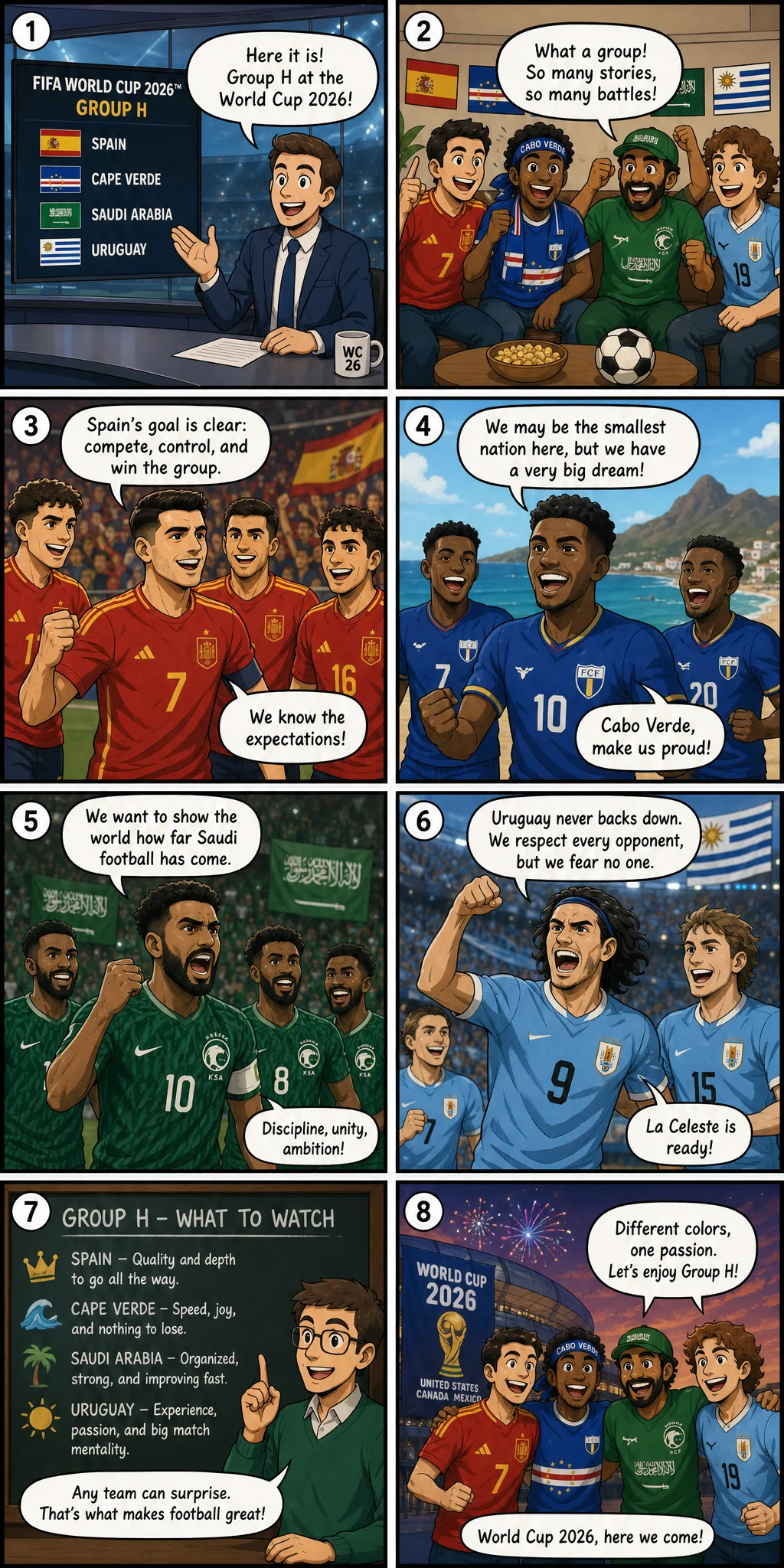
Group H Power Analysis: Spain, Cape Verde, Saudi Arabia, Uruguay
Group H: Spain, Cape Verde, Saudi Arabia, Uruguay. Spain's tiki-taka revival; Cape Verde's giant-killing dream; Saudi Arabia's billion-dollar project; Uruguay's Bielsa revolution
Published: June 8, 2026
The draw for Group H of the World Cup reads like a precise tactical proposition: traditional possession hegemony, emerging African counter-attacking force, oil-capital-driven system reconstruction, and South America's most extreme experimental revolution. The collision of these four teams is destined not to be a simple clash of strength and weakness, but a three-dimensional war of space contention and systemic confrontation.
Spain: Structural Revival of Tiki-Taka
After the possession impotence of the 2022 World Cup and the tactical transformation of the 2024 European Championship, Spain's attacking system is no longer mere lateral circulation. Luis de la Fuente's team retains the classic short-passing DNA, but the core operational logic has shifted from "control" to "disruption." Rodri, as the pivot in the backline, with his vertical passing and rhythm-switching ability, is the first key to unlocking compact defenses. The asymmetric midfield of Pedri and Gavi—the former responsible for horizontal orchestration and half-space penetration, the latter for vertical thrust and pressing—forms a dynamic triangular positioning. On the flanks, Lamine Yamal and Nico Williams provide the vertical striking capability that Spain has lacked most over the past decade; their presence forces opposing defenses to stretch horizontally, creating cutting lanes for the central short-passing unit.
However, Spain's structural weakness lies in defensive transitions. When opponents abandon midfield entanglement and directly target the space behind the center-backs with long balls, the speed deficiencies of Robin Le Normand and Aymeric Laporte are exposed. Against the rapid counter-attacks of Saudi Arabia or Uruguay, Spain's midfield recovery rate and full-back one-on-one defending ability will determine whether they can avoid unexpected point losses in the group stage.
Uruguay: South American Violent Aesthetics in Barcelona Style
Marcelo Bielsa's arrival has revolutionized Uruguay from the traditional "Garra Charrua" to a modern high-pressing system. This Uruguay no longer relies solely on Darwin Núñez's impact and Federico Valverde's long-range shooting but has established a complete "vertical pressing-flank stacking" tactic. The midfield duo of Valverde and Manuel Ugarte has a clear division of labor: Ugarte handles first-line tackles and horizontal coverage, while Valverde focuses on vertical dribbling and long-pass distribution during transitions. On the flanks, Ronald Araújo (if shifted to full-back) and Facundo Pellistri provide vertical thrust, combined with Núñez's diagonal runs into the left half-space, forming a dynamic switch between a "false 9" and a "true winger."
Bielsa's most dangerous weapon is forward pressing. Uruguay's front three will block opponents' center-back passing routes with high discipline, forcing the goalkeeper to go long and thus regaining possession. This "pressing from the goalkeeper" approach poses a fatal test to Spain's buildup play—if Uruguay can successfully cut off the connection between Rodri and the center-backs, Spain's possession advantage will turn into risk.
But Uruguay's concern lies in the stability of their defensive structure. Bielsa's system heavily relies on full-back overlaps, which exposes space behind them. Against the speed of Saudi wingers or the cutting inside of Spanish wingers, whether Uruguay's two center-backs—Diego Godín is aging, and Araújo is better suited to the flank—can complete cover shifts in lateral movement will be key to the outcome.
Saudi Arabia: The Key to System Transplantation
Saudi Arabia's "billion-dollar plan" is reflected not only in the transfer market but also in the comprehensive Europeanization of their tactical system. The departure of Hervé Renard and the arrival of a new coach (assumed to be in the style of Roberto Mancini) marks a shift from "disciplined defensive counter-attacks" to "active possession and positional penetration." Salem Al-Dawsari remains the attacking core, with his cutting inside and half-space passes being the most consistent threat. Midfielder Mohamed Kanno handles linking and horizontal distribution, while frequent full-back overlaps are the primary means for Saudi Arabia to break down compact defenses.
However, Saudi Arabia's structural flaw lies in defensive depth. When facing Uruguay's vertical passes or Spain's rapid horizontal switches, Saudi Arabia's four-man backline often leaves gaps due to slow lateral movement. Their center-backs lack experience in top European leagues and are prone to fouls when dealing with Núñez or Álvaro Morata's back-to-goal play. Additionally, Saudi Arabia's discipline in transition defense is insufficient; if they fail to press immediately after losing the ball, they will leave huge spaces for Spain or Uruguay's counter-attacks.
Cape Verde: The Space Utilization of Giant Killers
As the most underestimated team in the group, Cape Verde's core tactical logic is extremely clear: cede possession and use speed and stamina for vertical strikes. Their formation typically switches between 5-4-1 and 4-4-2, with center-backs tasked with destruction rather than organization. Wingers Ryan Mendes and Garry Rodrigues are the engines of counter-attacks, excelling at exploiting space behind opponents' full-backs with straight-line sprints.
Cape Verde's deadly weapon is set pieces. They boast excellent height and jumping ability, with striker Júlio Tavares' heading prowess being highly lethal in the group stage. Against Saudi Arabia or Spain, Cape Verde will deliberately drop deep, luring opponents forward, then use the goalkeeper's long balls to directly target the space behind the defense. This tactic of "abandoning the midfield and directly deciding the game in the box" places immense psychological pressure on any possession-based team.
However, Cape Verde's weakness lies in defensive sustainability and tactical discipline. They cannot maintain high-intensity pressing for 90 minutes; once stamina drops, their defensive line's lateral movement becomes sluggish. Against Uruguay's wide crosses or Spain's half-space penetrations, Cape Verde's five-man backline, if unable to stay compact, will be easily torn apart.
Group Stage Prediction:
The tactical battle in this group will revolve around "space compression and release." The clash between Spain and Uruguay is essentially a collision of two extreme possession philosophies—Spain seeks horizontal control, while Uruguay pursues vertical impact. Saudi Arabia and Cape Verde play the role of "spoilers," the former attempting to counter systems with systems, the latter using the most primitive speed and stamina to find vulnerabilities.
Spain's overall strength and tactical maturity still rank first in the group; they should secure wins against Saudi Arabia and Cape Verde and gain an edge over Uruguay through midfield control. Uruguay's Bielsa system has upset potential, but against Spain's possession drain and Cape Verde's counter-attacking impact, their defensive stability will be tested. The direct encounter between Saudi Arabia and Cape Verde will likely determine third place—Saudi Arabia's system is more complete, but Cape Verde's tactical specificity is stronger.
Final prediction: Spain first in the group, Uruguay second. Cape Verde and Saudi Arabia will show remarkable resilience in the group stage but will ultimately struggle to overturn the structural advantages of the two traditional powerhouses.