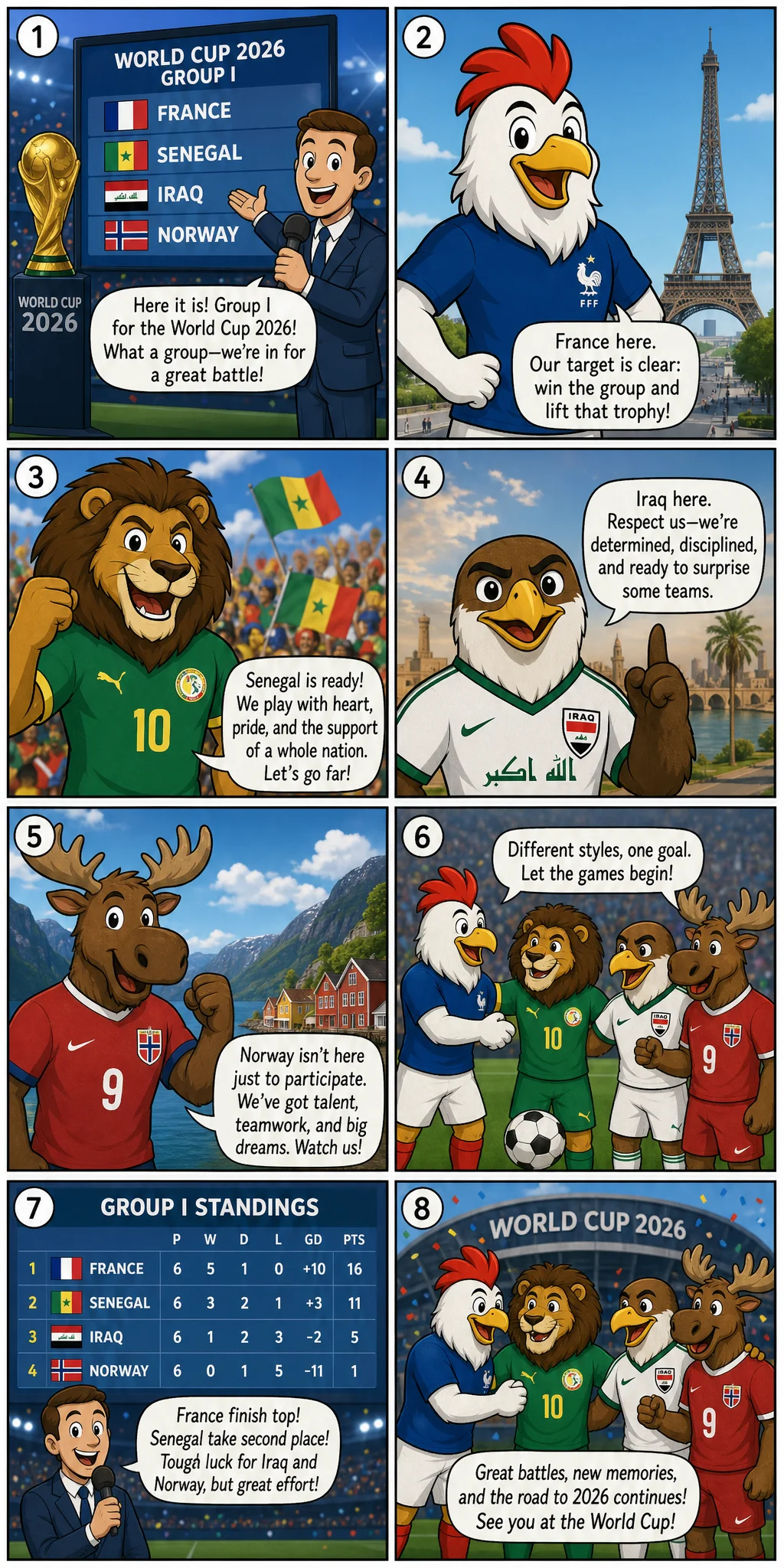
Group I Power Analysis: France, Senegal, Iraq, Norway
Group I: France, Senegal, Iraq, Norway. France defends deep; Senegal's Mane last dance; Iraq's 40-year return; Haaland's Norway finally arrives
Published: June 8, 2026
The World Cup group draw has been revealed, and the composition of Group I is a collision between archaeology and modern football. France, Senegal, Iraq, and Norway—each team carries different historical layers and tactical genes. This is not a simple group of strong versus weak, but a clash of four football philosophies across the dimension of time.
France, as the defending champion, has chosen a path distinctly different from the traditional Gallic Rooster. After the epic showdown in the 2022 Qatar World Cup final, Didier Deschamps' team seems to have undergone a tactical self-denial. They no longer seek absolute control in midfield but instead voluntarily cede space, utilizing Mbappé's deep thrusts and Griezmann's roaming connections for counterattacks. This is a modern evolution heavily infused with Italian-style chain defense genes, emphasizing defensive discipline and counterattack efficiency. The central defensive duo of Upamecano and Saliba is impeccable in physical duels and turning speed, but they need to be wary of the space behind them when facing agile forwards. France's weakness lies in the fact that when forced to become the dominant possession side, their midfield creativity and rhythm changes are somewhat monotonous; the double pivot of Tchouaméni and Rabiot leans more toward horizontal distribution than vertical penetration. Deschamps' tactics are essentially a gamble, betting on the fatal gaps left by opponents when they push forward.
Senegal, the African champions, are at a subtle transitional point in their era. Sadio Mané's "last dance" is not just a pursuit of personal glory but also the ultimate test of the team's tactical system. Aliou Cissé's team's core strengths lie in the explosive power on the flanks and defensive cohesion. Even as Mané ages, his off-the-ball movement instincts and cutting inside from the left flank for shots remain the first choice on the tactical board. However, Senegal's hidden worry is the technical roughness of their midfield and the control of rhythm after duels. The pairing of Gueye and Mendy covers an astonishing area but lacks an organizer who can calmly distribute the ball under pressure. Their attack often relies on quick transitions after tackles; once bogged down in positional play, they easily fall into a mire of physical battles. Senegal's defense is typical African-style high-intensity pressing, but the positioning and coordination of the defensive line may suffer fatal momentary lapses when facing a team like France, capable of sudden acceleration.
Iraq, returning to the World Cup after 40 years, is itself a piece of football archaeology. This team's tactical system bears a strong imprint of West Asian football: tough in duels, strict in tactical discipline, but slightly rough in technical details. Their core strength lies in midfield stifling ability and the richness of set-piece tactics. Crosses from the flanks by Adnan and Ali are Iraq's main attacking method. However, Iraq's biggest shortcoming is their backline's ability to play out from the back and their panic under high pressing. Their defense has almost no margin for error when facing Mbappé's straight-line sprints or Haaland's penalty-area poaching. Iraq's tactics are essentially a manifestation of combativeness and willpower; they will try to drag the game into a chaotic rhythm, using physical duels and foul tactics to disrupt the opponent's attacking flow. They are the "spoilers" of this group, but breaking through the group stage would require miraculous tactical execution and extraordinary goalkeeping.
Norway has finally ushered in their "golden generation," but this team's tactical structure has a clear era mismatch. Erling Haaland's arrival has made Norway's attacking system extremely simple and efficient: using wide crosses or long balls in counterattacks to directly target the finisher in the box. Ødegaard's midfield orchestration and ability to play threatening passes provide tactical support for Haaland. However, Norway's defense remains stuck in the traditional framework of Nordic football: tall, slow, and clumsy in turning. Their center-back pairing will face a catastrophic test against speed-oriented attackers like Mbappé or Diaby. Norway's tactics are essentially the ultimate manifestation of "top-heavy." Their matches often present two extremes: either Haaland single-handedly destroys the opponent's defense, or defensive errors squander the efforts up front. For Norway to advance, they must significantly improve their defensive coordination speed and positioning while maintaining attacking efficiency.
Four teams, four distinctly different football genes. France's conservatism and efficiency are the foundation of their title defense, but Deschamps' tactical gamble requires players' individual abilities to deliver at critical moments. Senegal's dependence on Mané is both their ceiling and their Achilles' heel. Iraq's return is a tribute to football history, but the harsh reality is that the gap between them and the world's top teams is comprehensive. Norway's Haaland is the most lethal weapon in this group, but football is ultimately an 11-man sport.
Advancement prediction: France will top the group with little suspense. The battle for second place will be between Senegal and Norway. Senegal's overall cohesion and tournament experience give them a slight edge. But Norway's Haaland possesses the individual ability to decide any match. Iraq will show their tenacity in the group stage but will ultimately only play a supporting role. Predicted final ranking: France, Senegal, Norway, Iraq.