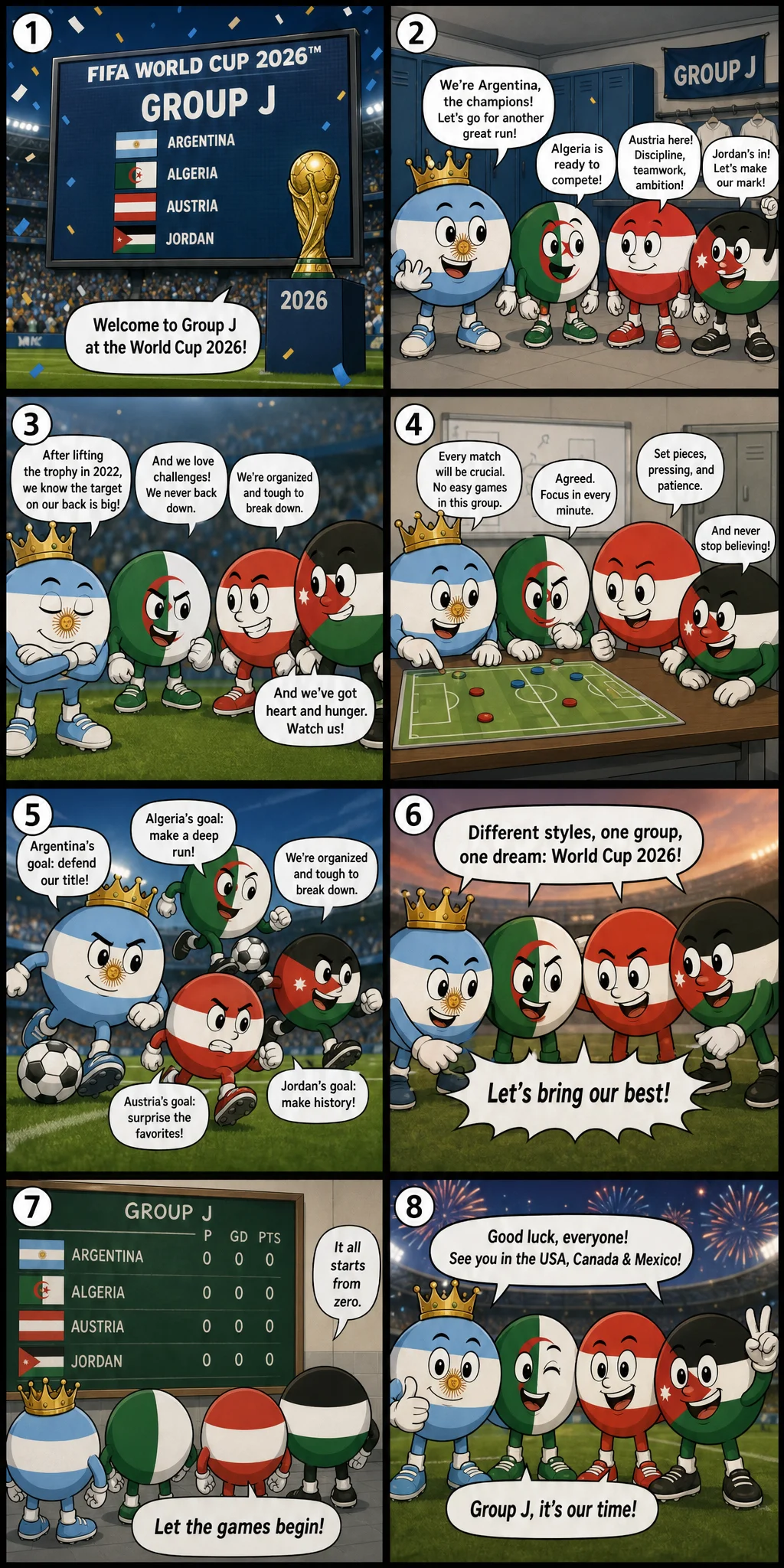
Group J Power Analysis: Argentina (champion), Algeria, Austria, Jordan
Group J: Argentina (champion), Algeria, Austria, Jordan. Messi defends the crown; Algeria's Mahrez generation; Austria under Rangnick; Jordan's historic debut
Published: June 8, 2026
The moment the draw results for Group J of the 2026 World Cup were announced, I was sitting in an old café in Buenos Aires called "El Viejo Almacén." Outside, the sound of traffic on Avenida 9 de Julio mingled with the melody of tango. The owner, María, turned up the TV volume, and when the word "Argentina" flashed on the screen, everyone in the shop raised their coffee cups simultaneously. In that moment, I suddenly understood—this is not just football; it is another awakening of the collective memory of the Argentine people.
Argentina, the defending champions. Messi is still there, but this is no longer the team that lifted the World Cup in Qatar. Scaloni's squad has undergone personnel changes after the World Cup: Di María's farewell match for the national team, and veterans like Paredes and Acuña gradually stepping back to the second line. But the resilience of Argentine football has never been built on individual stars. I once watched a youth training match at the Boca Juniors training ground in the suburbs of Buenos Aires. A sixteen-year-old dribbled past opponents in the rain, and the coach shouted from the sidelines, "Don't rush to pass; first feel the moisture of the grass." This is the philosophy of Argentine football: not confrontation, but feeling; not tactics, but instinct.
Lautaro Martínez's growth at Inter Milan is evident to all, and Álvarez's versatility gives Scaloni more options. But Argentina's true weapon is midfield control—the partnership of Mac Allister and Enzo Fernández allows the team to quickly form pressure after losing possession. The defense might be a concern: Otamendi's age and Romero's injury history make this Argentina seem less solid than two years ago. But don't forget, Messi's presence itself is a tactic. When he gets the ball on the right flank, defenders worldwide instinctively shift toward that side.
Algeria, the pride of North African football, is at a delicate turning point. I once got lost in the Casbah old town of Algiers, and a spice vendor recognized the "Riyad Mahrez" jersey on my chest. He grabbed my hand and said, "Mahrez is our poet." Indeed, the dribbling of this legendary Manchester City winger is as fluid and unpredictable as Arabic calligraphy. But Mahrez is 33 now; his speed is no longer as breathtaking as before. Algeria's golden generation is fading: Slimani, Feghouli, and Brahimi are all nearing the end of their careers.
Yet, Algerian football never lacks talent. Bentaleb, playing for Lille in Ligue 1, is the metronome of the midfield, with long passes as precise as GPS. Up front, AC Milan's Bennacer, though short in stature, possesses incredible balance, able to turn and shoot in tight spaces. Algeria's tactical core is rapid transition—from winning the ball in defense to counterattacking up front, they need only three or four passes. But the fatal flaw of this style is that when opponents choose to sit deep, Algeria often struggles in positional play. They rely on Mahrez's moments of brilliance in key situations, but this dependency is becoming a burden.
Austria, under Rangnick's leadership, is undergoing a silent revolution. I once interviewed an Austrian football journalist at Café Central in Vienna. Pointing to a portrait of Freud on the wall, he said, "We Austrians are always analyzing ourselves, including football." What Rangnick brings is precisely this "analysis"—high pressing, formation rotations, data-driven decisions. Sabitzer's stint at Manchester United may not have been a success, but in the Austrian national team, he is the undisputed core. His long-range shots, his runs, his understanding of the game's rhythm make Austria's midfield full of aggression.
Although Alaba is now in his early thirties, his experience at Real Madrid gives Austria's defense a commander. Laimer's growth at Bayern and Baumgartner's breakout at Bayer Leverkusen make this Austria look deeper than ever before. But the problem is that Rangnick's tactical system demands extremely high physical fitness. In the dense World Cup schedule, can Austria maintain 90 minutes of high-intensity pressing? Their bench lacks players who can change the game, and once the starters' stamina drops, cracks will appear in Austria's tactics.
Jordan—when this name appeared at the World Cup draw ceremony, the streets of Amman must have erupted. This is a historic moment for Jordanian football; they have never participated in the World Cup finals. I once met a Jordanian tour guide at Petra. Pointing to the Treasury, he said, "Two thousand years ago, the Nabataeans carved this city out of rock; today, our football team is carving a path to the World Cup on the Asian stage." Jordan's rise is thanks to their youth training system—at the Asian Cup, their U23 players have already shown remarkable maturity.
Forward Tamari is Jordan's soul, proving in the Belgian league that he can hold his own in Europe. Midfielder Haddad excels at organizing, while the defense lacks experience. Jordan's tactical core is team discipline—they won't rely on individual talent like Algeria, nor pursue flashy possession like Argentina. They prefer solid defense and seeking opportunities on the counter. But facing opponents like Argentina, Algeria, and Austria, Jordan's defense will be under immense pressure. Their goalkeeper, Abuleila, will be a decisive factor—his reaction speed and timing in coming off his line will determine whether Jordan can create a miracle in the group stage.
Predicting the group's advancement is like forecasting tomorrow's weather on the streets of Buenos Aires—full of variables. Argentina is undoubtedly the top favorite in the group. Messi's experience and Scaloni's ability to adjust make it almost impossible for them to stumble in the group stage. Algeria and Austria will battle for the second spot, a clash of contrasting styles: Algeria's individual talent versus Austria's team discipline. I lean toward Austria—Rangnick's tactical system often proves more effective in tournaments, while Algeria's reliance on Mahrez could be their fatal weakness.
Jordan, this Asian newcomer, should aim for a draw or a goal. In their historic debut, simply putting pressure on Argentina or Austria would be a huge victory. But the charm of football lies in the unexpected—just like Slovakia in 2010 or Iceland in 2018, teams considered "minnows" often write the most touching fairy tales.
When the World Cup whistle blows in the summer of 2026, the story of Group J will unfold on the pitches of Qatar, Saudi Arabia, and Egypt. Argentines will carry their faith in Messi, Algerians will sing their desert songs, Austrians will rely on their discipline and analysis, and Jordanians will bring their dreams carved out of rock. And I, in a café in some city, will continue my football pilgrimage. Because football is never just a game—it is a poem woven together by those running on the pitch and those watching from outside, a poem of hope and memory.