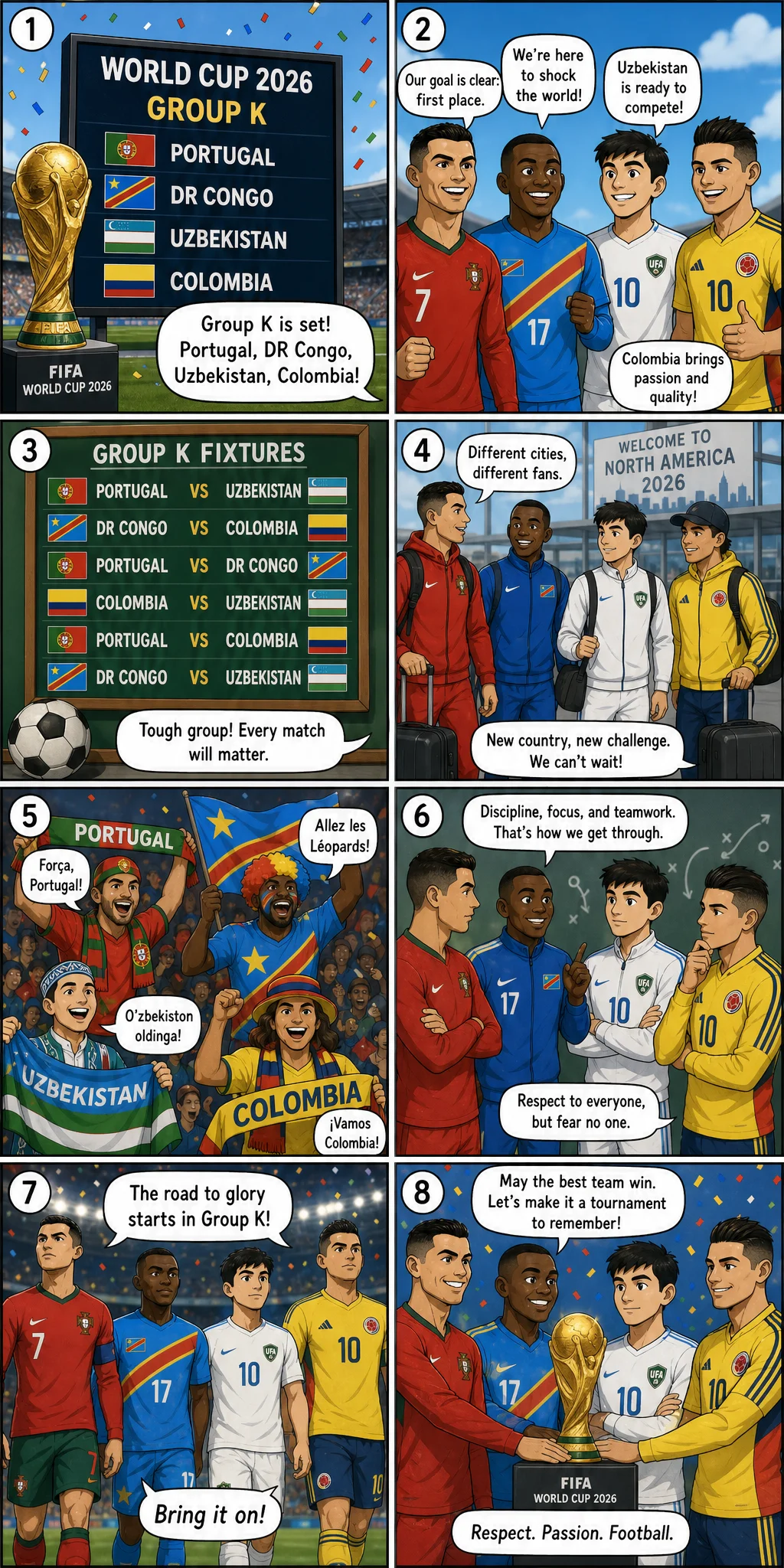
Group K Power Analysis: Portugal, DR Congo, Uzbekistan, Colombia
Group K: Portugal, DR Congo, Uzbekistan, Colombia. Portugal's golden generation; DR Congo's physical power; Uzbekistan's Asian rise; Colombia's attacking flair
Published: June 8, 2026
2026 World Cup Group K: Portugal, Democratic Republic of the Congo, Uzbekistan, Colombia. Intense and explosive, HERE WE GO.
Portugal: The Last Dance of the Golden Generation
This is not an ordinary Portugal. This is Cristiano Ronaldo, Bruno Fernandes, Bernardo Silva, Ruben Dias, Rafael Leão—the list goes on. The squad depth is terrifying. World-class competition in every position, with a bench that could form another European top-eight team. Manager Roberto Martinez offers tactical flexibility: a 4-3-3 for control or a 3-5-2 to strengthen the flanks, both functional.
Key figure: Cristiano Ronaldo. Forty-one years old? No problem. His goal-scoring instinct remains, and his leadership is invaluable. But the question arises: does the system rely too heavily on him? Bruno Fernandes' creativity is the engine, Bernardo Silva's off-the-ball movement is the lubricant. In defense, Ruben Dias partners with Gonçalo Inácio—solid, but their turning speed is a concern.
Tactical core: High pressing, quick transitions. Portugal likes to regain possession in the opponent's half, using wing speed (Leão, Nuno Mendes) to strike. Weakness? Against compact defenses, they sometimes fall into a passing maze, lacking direct penetration. Also, Ronaldo's age—can his stamina sustain the tournament's intensity? That's the suspense.
HERE WE GO: Portugal is the favorite to advance, but the group stage is no walk in the park. They need to prove the golden generation is more than just a name—it's championship material.
Democratic Republic of the Congo: The Physical Impact of an African Giant
Athleticism, power, physicality. The Democratic Republic of the Congo isn't here to play technical football. They're here to disrupt rhythms. The defensive line is towering, midfield tackling is fierce, and forwards are strong in duels. This is classic African power football, but with added organization.
Key figures: Forward Cédric Bakambu, experienced with sharp movement; midfielder Yannick Bolasie? No, a younger one—Mukoko, with excellent dribbling to break lines. But the real weapon is the overall physicality—every set piece is a threat, every duel feels like wrestling.
Tactical core: Defensive counterattacks, direct long balls to forwards. They don't chase possession but wait for opponent mistakes, then punish with speed and strength. Weakness? Lack of technical finesse. Under high pressing, their build-up from the back is limited, prone to errors. Discipline is also an issue—emotions can sometimes spiral.
HERE WE GO: The Democratic Republic of the Congo is a spoiler. They can make any opponent uncomfortable, especially against technical teams where their physical edge amplifies. But to advance? They need defensive stability and counterattack efficiency.
Uzbekistan: The Rise of a New Asian Force
Uzbekistan is no longer a pushover. They are Asia's football surprise, with a recent youth academy boom and strict tactical discipline. Players have solid stamina and fundamental skills, excelling in midfield grinding and quick counters. The head coach is local, but the tactical philosophy is modern, emphasizing high defense and pressing.
Key figures: Forward Eldor Shomurodov, with Serie A experience and sharp instincts; midfielder Jaloliddin Masharipov, the creative core with wide passing vision. The defensive line shows clear improvement in movement and coordination.
Tactical core: Disciplined defense, quick transitions. Uzbekistan doesn't chase flair but efficiency. They'll drop deep, wait for counter opportunities, and use Shomurodov's speed to strike. Weakness? Lack of big-stage experience, individual quality gaps against world-class stars. Also, can their stamina hold up for full-intensity matches? That's the question.
HERE WE GO: Uzbekistan is a dark horse candidate. They can steal points, but advancing requires a miracle—courage and luck to beat strong teams.
Colombia: The Flamboyant Impact of South American Attack
Colombian football always has passion. The attack line is loaded with talent: James Rodríguez, Luis Díaz, Duván Zapata—names that spell threat. In midfield, Wilmar Barrios and Gustavo Cuéllar provide grit and tempo control. The defense combines experience and speed, but consistency is an issue.
Key figures: Luis Díaz—a world-class winger with dribbling, speed, and finishing. James Rodríguez, the creative core, but his form fluctuates. Forward Duván Zapata, strong in duels and excellent in the air. Manager Néstor Lorenzo emphasizes possession and wing play, but defensive organization can be loose.
Tactical core: Possession-based, wing attacks. Colombia likes to control tempo through midfield, then use Díaz's speed to tear defenses. Weakness? Defensive focus lapses, especially against quick counters, leaving the backline exposed. Also, James' form—can he consistently contribute in key matches? That's the X-factor.
HERE WE GO: Colombia is a blend of technique and passion. They can beat anyone, but consistency is their biggest enemy.
Group Prediction:
Portugal, without doubt, finishes first. Overwhelming quality, terrifying squad depth.
The second spot is fiercely contested. Colombia's attacking talent, the Democratic Republic of the Congo's physical impact, Uzbekistan's discipline—all have a chance.
I predict: Colombia second. Their attack line can solve problems in key matches, and they have experience.
HERE WE GO: Portugal and Colombia advance together, but the Democratic Republic of the Congo will make the process intense and fiery. Uzbekistan, though valiant in defeat, lacks the star power to finish games.
This is Group K. Power, technique, passion, surprises—a microcosm of the World Cup. Ready?