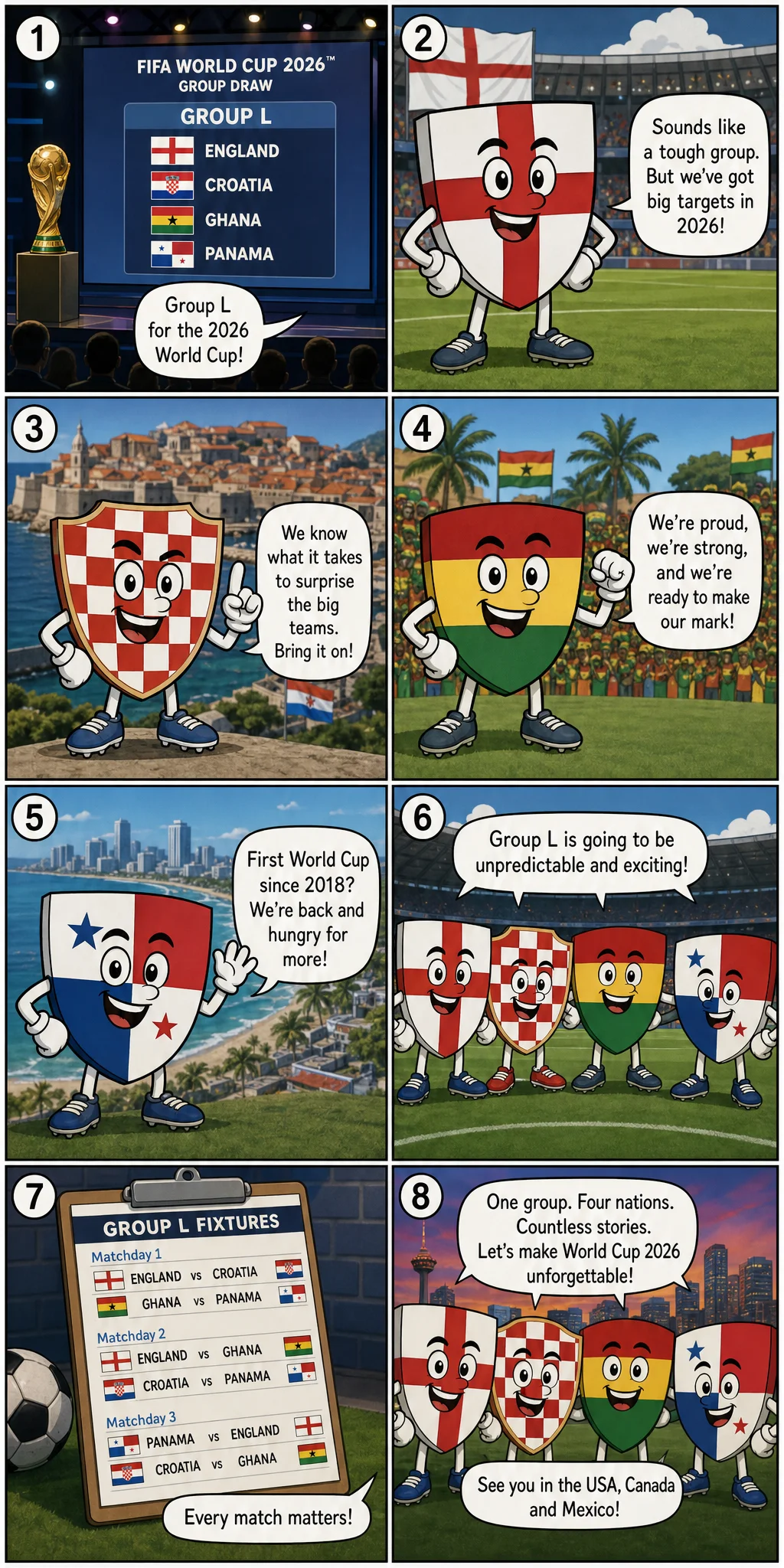
Group L Power Analysis: England, Croatia, Ghana, Panama
Group L: England, Croatia, Ghana, Panama. England's 60-year wait; Croatia's Modric farewell; Ghana's young lions; Panama's growing confidence
Published: June 8, 2026
England, Croatia, Ghana, Panama—these four teams have been cast by fate into the same group, forming the most narratively charged scene of the 2026 World Cup group stage. This is not merely a tactical contest, but a collision of histories, a struggle of identities, and a condensation of national emotions on the pitch.
England, the birthplace of modern football, carries a burden of sixty years of waiting. Since their home victory in 1966, every campaign has felt like a pilgrimage to past glory, yet time and again, penalty shootouts or critical errors have turned national hopes into sighs. This England side draws its core strength from the Premier League, the world's most commercialized and intense league. They boast Kane, a world-class striker who is not only a goal machine but a tactical fulcrum; Bellingham, a midfielder forged into a superstar at Real Madrid, capable in attack and defense, exuding leadership; and Saka, Foden, and other technically refined, creative wide attackers. Manager Southgate (or his eventual successor) typically builds on a solid four-man defense, relying on overlapping full-backs and midfield control. Their strengths are clear: astonishing squad depth and individual ability unmatched in the group. Yet their weaknesses are equally profound: they can fall into sterile possession against deep defenses, and their psychological resilience in key matches remains a Damocles' sword hanging over England. For England, advancing from the group is the bare minimum; they must prove they are no longer "tournament bottlers" but true contenders capable of converting talent into titles.
Croatia, a small Balkan nation of just four million, has created miracles far exceeding its size in the last two World Cups (runners-up in 2018, third in 2022). Their football is a banner of national identity, a resilience forged in the crucible of war. The soul of this team is undoubtedly Luka Modrić, approaching his World Cup farewell. This 38-year-old midfield maestro, with his relentless running, precise passing, and commander's vision, has defined Croatia's golden era. Around him are Brozović, Kovačić, and other equally seasoned top midfielders, forming the World Cup's most fluid midfield engine. Tactically, Croatia emphasizes controlling the tempo, wearing down opponents through midfield circulation, waiting for the killer blow. Their strengths lie in unparalleled tournament experience, team discipline, and mental fortitude in adversity. However, weaknesses follow: an aging squad, especially a lack of elite strikers, and an over-reliance on Modrić's creativity. When Modrić is tightly marked or fatigued, Croatia's attack stalls. This may be the swan song of the "golden generation," and they will expend every last ounce of energy to put a period on their legend.
Ghana, a traditional powerhouse of African football, represents the continent's passion and talent. Their football is a vessel of national pride, a stage for the younger generation to change their destiny. This Ghanaian team is at a critical juncture of transition. They carry the "Black Stars" tradition: outstanding physicality, lightning-fast transition speed, and attack brimming with individual heroism. The core of the squad is Kudus, plying his trade at West Ham, a technically complete, dribbling dynamo and a focal point in attack; and the Williams brothers of Athletic Bilbao, whose flank thrusts are a nightmare for any defense. Ghana's tactics are simple and direct: rapid transition from defense to attack, using the speed and individual skill of forwards to tear apart opposing backlines. Their strengths are youth, energy, and unpredictability. But their weaknesses are equally fatal: poor tactical discipline, often loose defensive organization, and susceptibility to lapses in concentration against top sides. For Ghana, the group stage is a chance to showcase the new generation of "Black Stars" to the world; their impact is enough to disrupt any opponent's plans.
Panama, an emerging football force from Central America, is undergoing a surge of confidence. Their football is the process of this small nation, bridging North and South America, finding its own voice after shaking off the shadow of larger powers. Making their debut in 2018, they lost all three matches but scored a goal, enough to ignite the nation. Now, they return with a more mature demeanor. Panama's football lacks superstars, but they boast strong team cohesion and pragmatic tactics. They rely on physicality, tenacious defense, and set-piece opportunities. Under coach Christiansen, they have learned to maintain tactical discipline in adverse situations. Their strengths are unity, abundant stamina, and a hunger for glory. Their weaknesses are limited overall quality, relatively rough individual technique, and a severe lack of chance creation against top teams. For Panama, the group stage's goal is not just to earn points but to prove they are no longer pushovers, but a team capable of competing on the World Cup stage.
This group is a microcosm of the football world. England represents the pressure and talent of a traditional powerhouse; Croatia embodies the epic of a small nation defying fate; Ghana symbolizes the youth and wildness of the African continent; Panama stands for the dignity and aspiration of an emerging force. This is not just a contest of skill, but a clash of four different national narratives, four national characters.
Prediction: England's squad depth and individual ability tower over the group, and they will advance as group winners. Croatia, with their vast tournament experience and Modrić's orchestration, can suppress Ghana and Panama in key matches, securing second place. Ghana's impact will trouble England and Croatia, but defensive fragility may ultimately leave them third. Panama's resilience commands respect, but the gap in quality makes it hard for them to disrupt the top three. When the group stage concludes, England and Croatia will advance together, but the journey will be far from smooth, every step laden with historical weight and emotional pull.