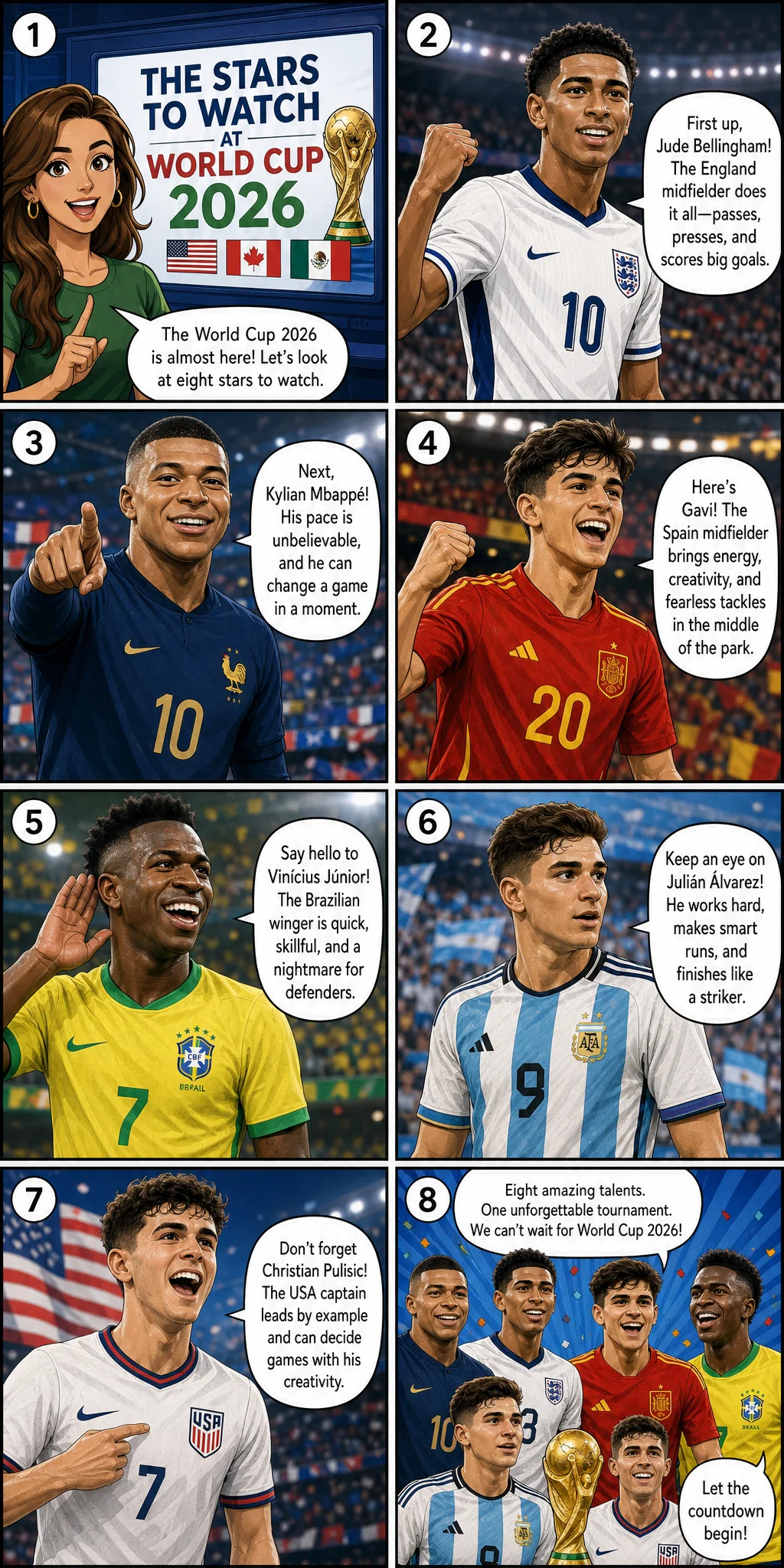
The Stars to Watch at World Cup 2026
Mbappe eyes a second title at 27. Haaland carries Norway into their first World Cup in 28 years. Vinicius Jr leads Brazil's redemption. Yamal at 18 and Bellingham at 21 chase immortality. And the unknown name that will define 2026.
Published: June 8, 2026
Focal Stars: Five Names, One Summer, and the Images That Will Be Forever Remembered
I was in a small bar in Madrid—not Milan, this time it was Madrid, but the coffee was just as bitter, and the photos on the walls were just as black-and-white—when I heard an old man say this: "The World Cup isn't about what you played. It's about what you're remembered for."
That sentence explains why the thirty-nine days from June to July 2026 will be, for some, just another tournament, and for others, the moment that defines a lifetime.
Mbappé: The Inheritance and Transcendence of an Empire
The first thing Kylian Mbappé did after the 2022 World Cup final—that 3-3 draw where he almost single-handedly dragged his team back, only to lose on penalties to Argentina—wasn't to cry. It was to stand still, hands on his hips, staring at the sky. That was the face of a man who knew he was just one penalty away from immortality.
In 2026, he's twenty-seven. His first full season at Real Madrid has just ended—a La Liga title, a Champions League, and a Golden Boot he's stopped counting. But all of that, in the shadow of the World Cup, is just a prelude. Mbappé finds himself in one of the rarest situations in football history: he doesn't need to "win the World Cup" to prove himself—he already won it in 2018—but he needs to prove, in the post-Didier Deschamps era (if this is Deschamps' last tournament), that France can survive in the age of Mbappé-before-the-next-Mbappé. It's a paradox: he is both the cornerstone of a dynasty and the future after that dynasty ends.
I've watched footage of him in training. He stands at the edge of the box, chips the ball over the goalkeeper's head, and catches it with his instep—just because he's bored. That kind of boredom belongs only to the apex predator: a lion yawning before it feeds.
Haaland: The Ghost of Twenty-Eight Years and the Weight of a Nation
Norway's last World Cup was 1998. Erling Haaland wasn't even born then. He's an oasis grown in the desert of his national team—at Manchester City, he has the best supply system in the world (Guardiola's wing-cross matrix), but with Norway, he has to create his own chances, press on his own, finish on his own. It's a completely different kind of solitude.
Haaland's goal rate—in World Cup qualifiers, 26 matches, 33 goals—sounds like a typo. But it isn't. He's a biological anomaly designed to end games: 194 centimeters tall, with the acceleration of a sprinter and a brain that sniffs out chances in the box (his father, Alf-Inge, was also a professional—some things are in the blood).
For Norway, it's not about "how far can they go"—it's about "how long can they enjoy this." When a nation has waited twenty-eight years, the moment the national anthem plays in their first match—no matter the score—they've already won.
Vinicius Júnior: Brazil's Prince and a Dynasty in Need of Restoration
Brazil has waited twenty-four years for a World Cup—an eternity for a country with five titles. Vinicius Júnior isn't the most senior player on the 2026 Brazil squad, but he's the attacker who repeatedly delivers decisive performances in Champions League finals for Real Madrid—that rare creature who grows calmer the brighter the spotlight shines.
Carlo Ancelotti—Brazil's Italian coach, a combination already steeped in historical metaphor—has built an entire attacking system around Vinicius' inside cut. That move from the left wing, cutting in to shoot with his right foot—one of football's most rehearsed actions—becomes unpredictable with Vinicius. He doesn't run a line. He runs infinite versions of that line.
The weight on Vinicius' shoulders isn't just one World Cup. It's the accumulated trauma of Brazil's five consecutive exits in the quarterfinals or earlier. The ghost of Pelé—who passed away in December 2022—still lingers behind every Brazilian attacker.
Yamal and Bellingham: Two Different Kinds of Eternity
Lamine Yamal is only eighteen in 2026. He's already the youngest-ever World Cup participant—a record from 2022—and now he's no longer "that kid." He's a starter in Spain's attack, a maturity that can't be explained by age. I watched him play once in Barcelona: he received a pass, didn't stop it, flicked it with his heel to a teammate behind him, and ran into the box waiting for the return. That's not an eighteen-year-old's judgment. That's something older.
Jude Bellingham—twenty-one, England—is another kind of eternity. He's not "young hope." He's the midfield core of Real Madrid, the tactical hub of England, and in that opening match against Iran in 2022—when he scored and celebrated with a pose that showed a man who knew exactly where he belonged—you saw it. Bellingham's style isn't typical English midfield—he's not a box-to-box physical monster. He's a European number ten wrapped in an English body—more rhythmic, more vertical, closer to Zidane's mold.
The Last Name: The One You Haven't Heard Yet
But the cruelest magic of the World Cup is this: all the names above—the ones we analyze in notebooks and argue about in bars until dawn—might not become the defining images of 2026. The World Cup always produces someone you can't predict: Zidane in 1998 (he was already famous, but those two headers in the final turned him from a player into a myth); Ronaldo in 2002 (resurrected from the disaster of the 1998 final); James Rodríguez in 2014 (a young Colombian in Brazil, four matches, one chest-control-and-volley, and then Real Madrid bought him).
In June 2026, on some training ground somewhere, a player whose name you've only seen in headlines but never truly imagined as the protagonist—is lacing up his boots. He might be twenty-two. He might be thirty-five. He might come from a club you can't point to on a map. But his name, thirty-nine days later, will become the next sentence from those old men in bars around the world: "Do you remember that summer of 2026?"
That old man—in the bar in Madrid—put down his coffee cup, glanced at Mbappé on the TV screen, and said something I didn't expect: "He's not the World Cup's protagonist. The first one hasn't appeared yet."
Then he smiled. In Spain, that smile means: Wait. You'll see.