Iran: Journey to 2026
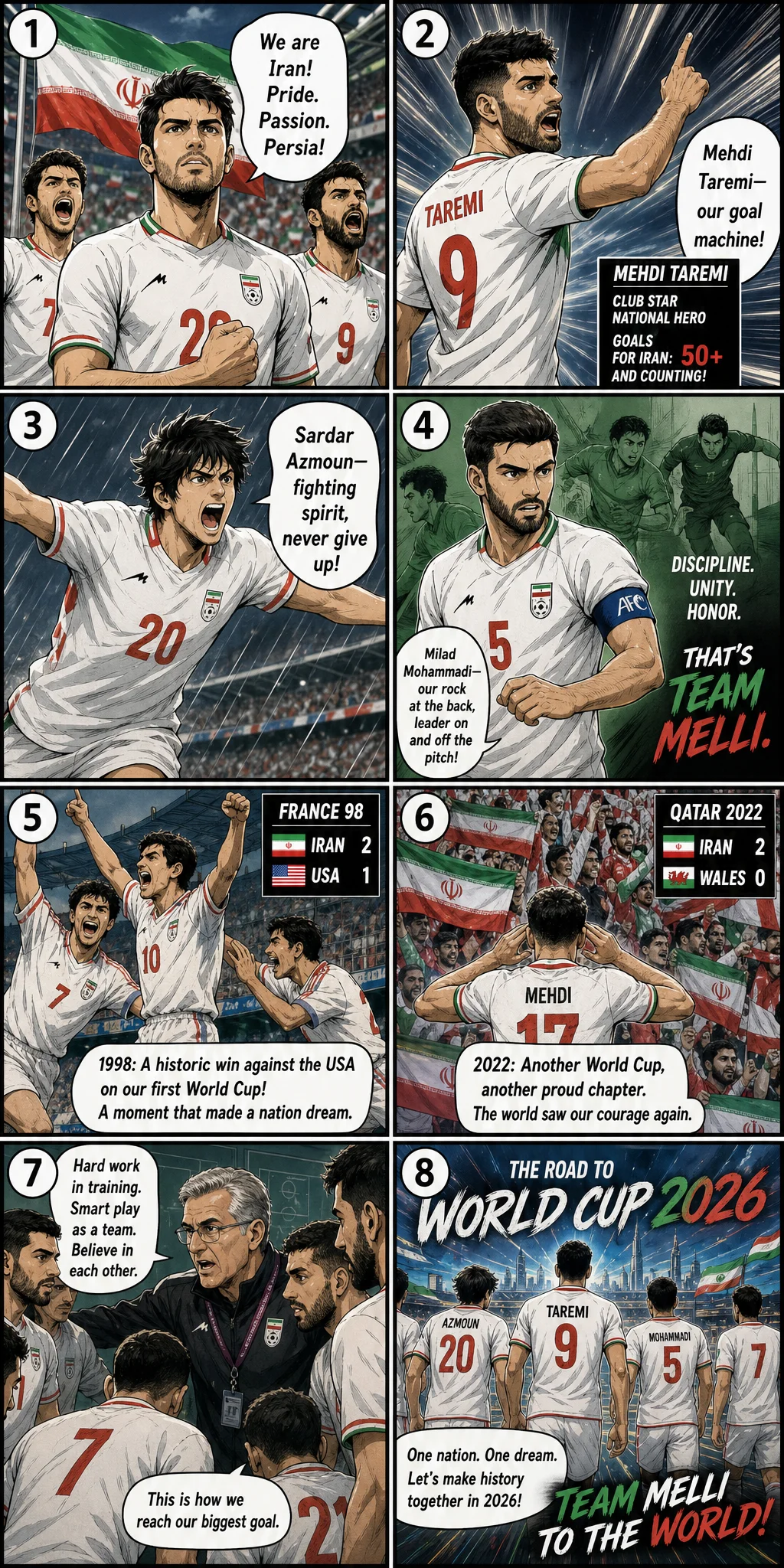
8-panel comic about Iran national football team and their journey to the 2026 FIFA World Cup.
Published: June 5, 2026
Iran National Football Team: Team Melli's Persian Pride
The Iran national football team, known as "Team Melli" — The National Team — represents one of Asian football's most storied and passionate traditions. As the continent's historically dominant power alongside Japan and South Korea, Iran has consistently qualified for the World Cup and occasionally stunned the football world with performances that transcend sport and become expressions of national identity. Their qualification for the 2026 FIFA World Cup continues a legacy of Asian football excellence that stretches back over half a century.
HISTORICAL FOUNDATIONS
Football arrived in Iran in the early twentieth century, introduced by British workers in the oil industry and quickly embraced by a population that discovered in the sport a new arena for competition and expression. The Iranian Football Federation was founded in 1920, and the national team played its first international match in 1941 against Afghanistan — a 1-0 victory that inaugurated a tradition of West Asian football dominance.
Iran's breakthrough on the global stage came with qualification for the 1978 World Cup in Argentina. That team, featuring legendary figures like Ali Parvin and Hassan Rowshan, competed in a group containing the Netherlands, Scotland, and Peru. While Iran failed to advance, the experience of competing at the World Cup — and the iconic images of Iranian players exchanging jerseys with Johan Cruyff and the Dutch stars — introduced Team Melli to the global football community.
The Iranian Revolution of 1979 transformed the nation and its football. The Iran-Iraq War (1980-1988) devastated the country's sporting infrastructure and consumed an entire generation of potential football talent. The domestic league was disrupted, international competition became irregular, and Iranian football entered a period of survival rather than development.
The 1998 World Cup in France represented Iran's return to football's highest level — and produced one of the tournament's most politically charged and emotionally significant matches. Iran's 2-1 victory over the United States in Lyon, secured by goals from Hamid Estili and Mehdi Mahdavikia, was celebrated across Iran as a moment of national pride and symbolic vindication. The pre-match handshakes, the gifts exchanged between players, and the goodwill gestures between two nations with no diplomatic relations demonstrated football's unique capacity for human connection across political divides.
LEGENDS OF TEAM MELLI
Ali Daei stands as one of international football's most prolific goalscorers. His 109 international goals held the world record for men's international football until Cristiano Ronaldo surpassed it in 2021. Daei's combination of physical power, aerial dominance, and clinical finishing — honed at clubs including Bayern Munich and Hertha Berlin in the Bundesliga — made him the most feared striker in Asian football for over a decade. His legacy extends beyond statistics: he demonstrated that Iranian and Asian footballers could compete at the highest levels of European club football.
Ali Karimi, the "Asian Maradona" or "Wizard of Tehran," was the most naturally gifted Iranian footballer of his generation. His dribbling, vision, and the effortless creativity of his play delighted fans and frustrated defenders across Asia. Karimi's spells at Bayern Munich and Schalke 04 in the Bundesliga, while not as sustained as his talent deserved, demonstrated his technical quality. For many Iranian fans, Karimi represents the purest expression of Persian footballing artistry.
Mehdi Mahdavikia, the right-sided defender and midfielder whose career at Hamburger SV in the Bundesliga spanned over a decade, was the model of Iranian professional excellence in Europe. His pace, crossing, and professional longevity — over 200 Bundesliga appearances — established him as the most successful Iranian export to European football history. His goal against the United States in 1998 remains one of the defining moments of Iranian football history.
Nasser Hejazi, the legendary goalkeeper of the 1970s, was voted Asia's best goalkeeper of the twentieth century. His commanding presence, reflex saves, and celebrity status made him the face of Iranian football during its pre-revolutionary golden era. Ali Parvin, the midfield general who captained the 1978 World Cup team and later became the spiritual leader of Persepolis — one of Tehran's two great clubs — embodied the competitive fire that defines Iranian football.
THE MODERN ERA
Iran enters the 2026 World Cup as Asia's top-ranked team, a position earned through consistent performances in World Cup qualifying and Asian Cup competitions. The team's professional infrastructure has improved significantly, with Iranian players competing in leagues across Europe and the Persian Gulf region, bringing back experience and tactical knowledge that elevates the national team.
Sardar Azmoun, the striker known as the "Iranian Messi" (a nickname he shares with several players, a testament to the national obsession with the Argentine), has been Team Melli's most prolific goalscorer of the modern era. His career at Zenit Saint Petersburg, Bayer Leverkusen, and Roma — combined with his intelligent movement and clinical finishing — has established him as one of Asia's premier forwards. Mehdi Taremi, the powerful striker and creator whose performances for Porto and Inter Milan have made him one of Europe's most respected forwards, provides the physical presence, link-up play, and goal-scoring threat that complement Azmoun's qualities.
Alireza Jahanbakhsh, the winger who won the Eredivisie Golden Boot with AZ Alkmaar before moving to the Premier League, provides creativity and goal threat from wide positions. The midfield features technically proficient players developed in Iran's improving domestic league and in European academies. The defensive unit, historically Iran's most organized area, continues to provide the stability that allows the attacking talents to flourish.
The Persepolis-Esteghlal rivalry — the Tehran derby, the most significant club fixture in Iranian football — continues to produce passionate atmospheres and talented players. Azadi Stadium, with its capacity of over 78,000, transforms into one of Asia's most intimidating venues when filled with passionate Iranian supporters.
FOOTBALL AND IRANIAN CULTURE
Football occupies a uniquely important position in Iranian society — one of the few public arenas where collective joy, collective disappointment, and collective identity find expression. The sport's popularity crosses class, regional, and political divisions, creating a rare space of shared national experience. When Team Melli plays in a World Cup, the streets of Tehran, Isfahan, Tabriz, and every Iranian city fill with celebrants — men and women, young and old — defying social restrictions in moments of national unity.
Women's access to football stadiums has been a site of political struggle in Iran. The decades-long ban on women attending men's football matches was partially lifted in recent years following international pressure and domestic activism, with women allowed to attend selected national team and club matches. The presence of women in Azadi Stadium for Team Melli matches has become a symbolic and emotionally powerful element of Iranian football culture.
The political dimensions of Iranian football are inescapable. The national team's matches are invested with symbolic meaning — representations of national capability and resilience in the face of international sanctions and diplomatic isolation. Players have occasionally become political symbols, their goal celebrations, social media posts, and even their haircuts scrutinized for political meaning. The team walks a delicate line between representing the Islamic Republic and expressing the aspirations of a young, increasingly globally connected population.
THE PATH FORWARD
Iran enters the 2026 World Cup with realistic ambitions of progression from the group stage — a historic achievement that no Iranian team has accomplished in six previous tournament appearances. The team's physical preparation, tactical organization under coach Amir Ghalenoei (or his successor), and the attacking quality of Azmoun and Taremi provide genuine grounds for optimism.
The tactical approach reflects Iranian football's traditional strengths: defensive organization, physical competitiveness, and the counter-attacking threat posed by technically proficient forwards. The team is comfortable without possession, content to absorb pressure from higher-ranked opponents, and dangerous on set pieces — a traditional source of Iranian goals in major tournaments.
For Iran, the 2026 World Cup is about more than results. It is about representation — the opportunity to present Iranian culture, Iranian excellence, and Iranian humanity to a global audience that often encounters Iran only through the lens of geopolitical conflict. Team Melli carries the pride of a civilization thousands of years old and the hopes of a young population that loves football with a passion that transcends politics. The Persian lion roars once more.