New Zealand: Journey to 2026
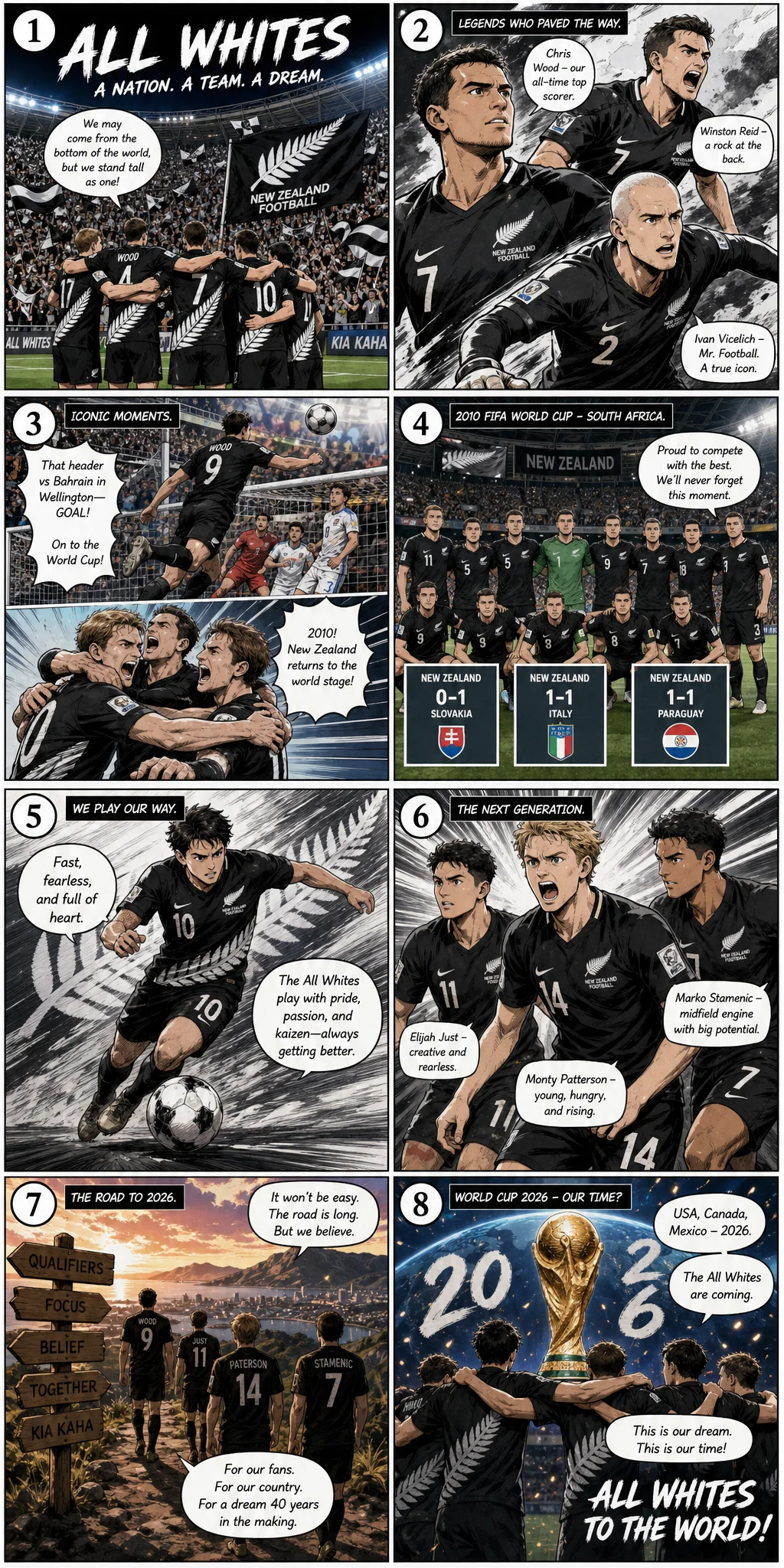
8-panel comic about New Zealand national football team and their journey to the 2026 FIFA World Cup.
Published: June 5, 2026
New Zealand National Football Team: The All Whites' Pacific Dream
The New Zealand men's national football team, known as the "All Whites" for the distinctive white kits they have worn since changing from black in 1982 (to avoid confusion with referees), represents one of football's most isolated outposts — a nation of just over five million people, separated by vast oceans from the sport's traditional centers of power. New Zealand's qualification for the 2026 FIFA World Cup marks only the third World Cup appearance in the nation's history, an achievement that reflects the unique challenges and distinctive character of Oceanian football.
HISTORICAL FOUNDATIONS
Football arrived in New Zealand with British settlers in the nineteenth century, and the sport established itself in the country's sporting landscape alongside rugby union, cricket, and netball. New Zealand Football was founded in 1891 as the New Zealand Football Association, making it one of the world's older national governing bodies. The sport developed primarily at the amateur level, with regional leagues and cup competitions providing the competitive framework.
New Zealand's international football has been defined by the challenge of geography. The country's isolation — a three-hour flight to Australia, far longer to Asia, the Americas, or Europe — made regular international competition logistically difficult and financially burdensome. The Oceania Football Confederation, of which New Zealand was the largest and most developed football nation (until Australia's 2006 departure to the Asian confederation), provided limited competitive opportunities against nations that would truly test the All Whites' quality.
The 1982 World Cup in Spain represented New Zealand's first appearance at football's highest level — an achievement secured through a grueling qualification campaign that required 15 matches and 90,000 kilometers of travel. The team, featuring players drawn almost entirely from the domestic semi-professional league and the Australian competition, lost all three group matches to Scotland, the Soviet Union, and Brazil. New Zealand conceded 12 goals without scoring, but the experience of competing against the world's best — against John Wark, Socrates, and the stars of global football — was the defining moment of the nation's football history to that point.
Twenty-eight years separated the 1982 and 2010 World Cup appearances. The 2010 qualification campaign ended with a dramatic playoff victory over Bahrain, secured by Rory Fallon's header in Wellington — a moment that produced nationwide celebrations and validated decades of football development. The 2010 World Cup in South Africa produced New Zealand's finest tournament performance: three draws against Slovakia, Italy (the defending champions), and Paraguay. The All Whites became the only unbeaten team in the 2010 tournament — eliminated in the group stage, yes, but undefeated. Shane Smeltz's goal against Italy, Winston Reid's dramatic equalizer against Slovakia, and the defiant performances of a team composed largely of lower-league professionals and domestic amateurs created one of World Cup history's most endearing underdog stories.
LEGENDS OF THE ALL WHITES
Wynton Rufer is New Zealand's greatest ever footballer. His career at Werder Bremen in the Bundesliga — where he won the Bundesliga title, the DFB-Pokal, and the European Cup Winners' Cup — made him the most successful Oceanian footballer in European history. Rufer's 12 goals in 23 international appearances only hint at his quality; his professional career in Germany and his role as Oceania's first truly world-class footballer inspired a generation. Named Oceania Footballer of the Century, Rufer's legacy is the standard against which all New Zealand footballers are measured.
Ryan Nelsen, the central defender who captained Blackburn Rovers, Tottenham Hotspur, and Queens Park Rangers in the English Premier League, was the most accomplished defender ever produced by New Zealand. His leadership, tactical intelligence, and physical presence made him the natural captain of the All Whites throughout his international career. Nelsen's professional success in England demonstrated that New Zealand footballers could compete at the highest levels of the world's most demanding league.
Steve Sumner, the midfielder who captained the 1982 World Cup team, scored New Zealand's first World Cup goal against Scotland in a 5-2 defeat — a moment of historical significance that, while occurring in a losing cause, represented the nation's arrival in global football's scoring records. Chris Wood, the powerful striker whose goal-scoring record in the English Championship and Premier League with clubs including Leicester City, Leeds United, Burnley, and Newcastle United has made him New Zealand's most prolific active goalscorer, is the current generation's standard-bearer.
THE MODERN ERA
New Zealand football has been transformed by structural changes in the Oceanian confederation and the development of professional pathways for Kiwi players. Australia's departure from the OFC to the AFC in 2006 left New Zealand as Oceania's dominant force — a position that guarantees World Cup playoff qualification but has reduced the quality of regular competitive matches for the All Whites.
The Wellington Phoenix, New Zealand's sole professional club competing in the Australian A-League, has provided a vital development pathway for Kiwi talent. The club's youth academy has produced players who have gone on to professional careers in Europe, Asia, and North America. The domestic New Zealand Football Championship, while semi-professional, provides competitive opportunities for players developing toward professional careers.
The current All Whites squad features an unprecedented number of European-based professionals, reflecting the improvement in New Zealand's player development pathways. Chris Wood's continued Premier League presence as an elite-level striker provides the attacking focal point. Sarpreet Singh, the technically gifted midfielder developed at the Wellington Phoenix who moved to Bayern Munich and has since played across Europe, represents the creative dimension that New Zealand football has historically lacked.
Emerging defenders and midfielders operating in European leagues — from the English Football League to competitions in Scandinavia and the Netherlands — provide a depth of professional experience that previous New Zealand teams could not match. The goalkeeper position, historically a strength, continues to produce reliable performers.
FOOTBALL AND NEW ZEALAND CULTURE
Football occupies a unique position in New Zealand's sporting culture — the most-played sport by participation (particularly among youth and women) but not the most commercially dominant or culturally prominent. Rugby union commands the nation's primary sporting attention and emotional investment, with the All Blacks representing the gold standard of New Zealand sporting identity. Cricket and netball also compete for public attention.
The Football Ferns, New Zealand's women's national team, have arguably achieved greater international success and recognition than the All Whites, particularly following their performances in Women's World Cups. The country's co-hosting of the 2023 FIFA Women's World Cup with Australia accelerated women's football development and increased the sport's overall visibility.
The All Whites' World Cup campaigns provide moments of national sporting unity — rare occasions when football briefly challenges rugby for the nation's attention. The 2010 unbeaten campaign captured the imagination of New Zealanders in a way that exceeded the sport's usual cultural footprint, demonstrating the universal appeal of World Cup competition.
THE PATH FORWARD
New Zealand enters the 2026 World Cup with realistic expectations shaped by the nation's previous tournament experiences. Winning a match — having drawn three and lost three across the 1982 and 2010 tournaments — would represent a historic first and a successful campaign. Progression from the group stage, given the expanded tournament format, is a stretch target that would elevate New Zealand football to unprecedented heights.
The tactical approach will emphasize the defensive organization and collective spirit that produced the 2010 unbeaten campaign. Chris Wood's physical presence and finishing ability provide the goal-scoring threat, while the professional experience of the European-based squad members should reduce the gap between New Zealand and mid-tier international opponents. Set pieces — with Wood's aerial dominance and the delivery quality of midfield technicians — will be a critical weapon.
For New Zealand football, each World Cup appearance builds the sport's credibility and visibility in a competitive sporting marketplace. The All Whites carry the flag of Oceania into the 2026 tournament, representing a region whose football ambitions far exceed its resources. The Pacific dream continues — and with a deeper, more experienced squad than ever before, this time it might produce a different ending.