Spain: Journey to 2026
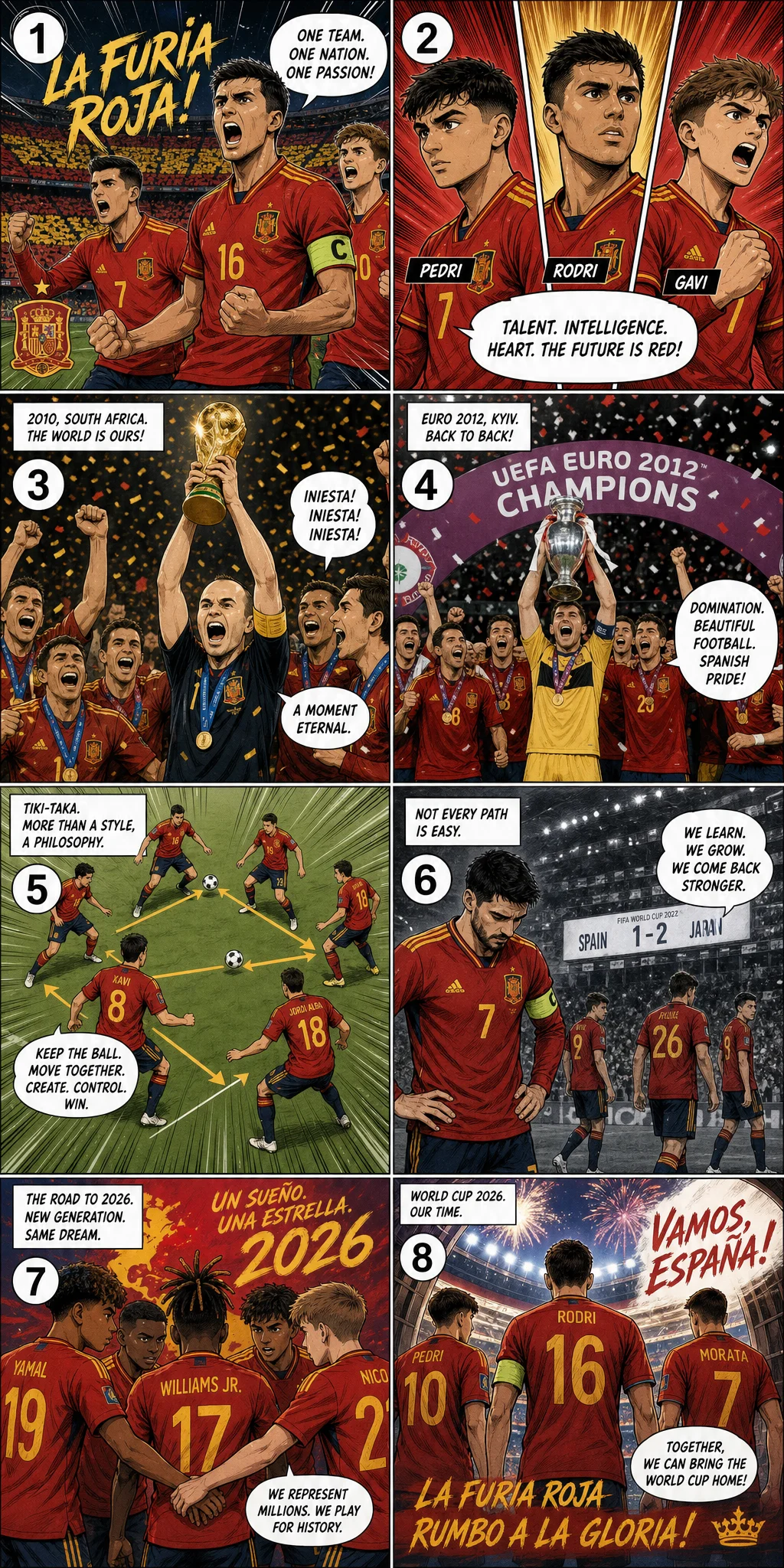
8-panel comic about Spain national football team and their journey to the 2026 FIFA World Cup.
Published: June 5, 2026
Spain National Football Team: La Roja's Tiki-Taka Renaissance
The Spain national football team, known as "La Roja" — The Red One — for the crimson jerseys that have become synonymous with one of football's most dominant periods of international success, carries the legacy of a golden era that transformed how the game is played and understood. Between 2008 and 2012, Spain won two European Championships and a World Cup with a style of football — possession-obsessed, pass-intoxicated, geometrically precise — that established a new paradigm of tactical orthodoxy. The 2026 FIFA World Cup represents an opportunity for a new generation to connect Spain's glorious past to a promising future.
HISTORICAL FOUNDATIONS
The Royal Spanish Football Federation was founded in 1909, and the national team competed in the 1920 Olympic Games — winning silver — before making its World Cup debut in 1934. For most of the twentieth century, Spain carried a reputation as international football's great underachiever: a nation whose clubs dominated European competition (Real Madrid's five consecutive European Cups in the 1950s) while the national team consistently fell short of expectations.
The 1964 European Championship, won on home soil with a 2-1 victory over the Soviet Union in the final at the Santiago Bernabéu, represented Spain's lone international triumph for over four decades. Luis Suárez, the elegant midfielder who won the 1960 Ballon d'Or — the only Spanish-born male player to receive the honor — embodied Spanish football's technical sophistication, even as the national team failed to match his individual excellence with collective achievement.
The decades between 1964 and 2008 were a chronicle of tournament disappointment. Talented generations — the 1982 World Cup on home soil, the 1986 team featuring Emilio Butragueño's "Quinta del Buitre," the 1990s sides featuring Pep Guardiola, Fernando Hierro, and Raúl — all fell short, often in dramatic and heartbreaking fashion. The quarter-final became Spain's notorious ceiling, a psychological barrier that seemed to define the limits of Spanish football identity.
LEGENDS OF LA ROJA
Luis Suárez, "The Architect," is Spain's only male Ballon d'Or winner. His career at Barcelona and Inter Milan — where he was the creative fulcrum of Helenio Herrera's legendary "Grande Inter" team that won consecutive European Cups — established him as one of the greatest midfielders in football history. Suárez's passing range, tactical intelligence, and goalscoring from midfield were decades ahead of his time.
Raúl González, the "Angel of Madrid," scored 44 goals in 102 international appearances and was the face of Spanish football throughout the late 1990s and early 2000s. His instinctive finishing, his iconic kiss of the wedding ring celebration, and his longevity at Real Madrid (where he scored over 300 goals) made him a national icon. Raúl's misfortune was timing: his prime years coincided with Spain's pre-golden era, and his departure from the national team preceded the 2008-2012 dynasty.
Iker Casillas, "San Iker" — Saint Iker — captained Spain to the 2010 World Cup and the 2008 and 2012 European Championships. His save from Arjen Robben in the 2010 World Cup final — a one-on-one moment that preserved Spain's 0-0 scoreline before Andrés Iniesta's extra-time winner — is the most consequential save in football history. Casillas's leadership, humility, and consistent excellence made him the ideal captain for the golden generation.
Xavi Hernández was the metronome of the tiki-taka dynasty — the midfielder whose metronomic passing, 360-degree spatial awareness, and relentless movement created the rhythm of the most dominant international team of the modern era. His ability to find space, to receive and release the ball in fractions of a second, was the operating system upon which Spanish football ran. Xavi completed over 600 passes in a single match at the 2010 World Cup — numbers that verge on the absurd.
Andrés Iniesta scored the most important goal in Spanish football history — the extra-time winner against the Netherlands in the 2010 World Cup final, a strike of absolute composure struck across Maarten Stekelenburg into the far corner. His shirt bore a message to Dani Jarque, the Espanyol captain who had died of a heart attack a year earlier: "Dani Jarque, siempre con nosotros." Iniesta's humility, his ballet-like close control, and his habit of producing brilliance in football's biggest moments made him beloved far beyond Spain.
THE GOLDEN ERA
The period from 2008 to 2012 redefined Spanish football. Under Luis Aragonés (Euro 2008) and Vicente del Bosque (World Cup 2010, Euro 2012), Spain developed a playing philosophy — tiki-taka, or possession-based, short-passing, positionally structured football — that proved virtually impossible to counter. The 2010 World Cup campaign in South Africa was a tactical statement: 1-0 victories over Portugal, Paraguay, Germany, and the Netherlands in the knockout stages, each match controlled through suffocating possession that starved opponents of the ball and systematically dismantled their defensive structures.
The 2008-2012 team won three consecutive major tournaments — a feat no other international team has achieved. The Euro 2012 final, a 4-0 demolition of Italy, was the apotheosis of the style: a performance of such complete technical and tactical dominance that it seemed to transcend competitive sport and enter the realm of art. Xavi, Iniesta, Xabi Alonso, Sergio Busquets, David Villa, and the defenders who joined the attack — they made football look like a game they had invented and only they truly understood.
THE MODERN TRANSITION
Spain enters the 2026 World Cup in a period of renewal and regeneration. The 2014-2022 tournaments — group-stage elimination in Brazil, Round of 16 exits in Russia and Qatar — marked the end of the golden generation's dominance and the beginning of a reconstruction project. The fundamental philosophy — possession-based, positionally structured football — has been preserved, but the execution has been updated for a new generation.
Pedri and Gavi, the Barcelona midfield duo who seem to have emerged from a laboratory designed to produce the perfect Spanish midfielders, are the creative core of the new Spain. Pedri's vision, passing, and composure at the highest level — he was named Young Player of the Tournament at Euro 2020 at age 18 — reflect the continuation of the Iniesta-Xavi lineage. Gavi's intensity, competitive fire, and technical quality provide the energy that the modern midfield requires.
Rodri, the Manchester City defensive midfielder who has evolved into one of the world's most complete players — capable of shielding a defense, controlling possession, and scoring crucial Champions League final goals — is the system's anchor. Lamine Yamal, the teenage winger whose emergence at Barcelona announced the latest chapter of the club's talent production, represents the individual brilliance that complements Spain's collective methodology. Nico Williams, the explosive Athletic Bilbao winger, provides the directness and pace that diversifies Spain's attacking options.
FOOTBALL AND SPANISH CULTURE
Spanish football reflects the country's complex regional identities. The national team, particularly during the golden era, provided a rare symbol of unified Spanishness in a country where Catalan, Basque, and Galician identities compete with a central Spanish identity. The success of the 2008-2012 team, featuring Catalan stars (Xavi, Puyol, Piqué, Busquets) alongside players from across Spain, was celebrated as a moment of national unity.
The domestic La Liga, featuring the global institutions of Real Madrid and Barcelona alongside historic clubs like Atlético Madrid, Athletic Bilbao, Valencia, and Sevilla, is one of the world's strongest football competitions. The league's technical quality — shaped by Spanish coaching's emphasis on passing, positioning, and tactical intelligence — provides the developmental environment for national team players.
Spanish football's coaching influence has been global. From Guardiola's Manchester City through the Spanish-trained coaches across Europe, Asia, and the Americas, the Spanish methodology — positionism, rondo-based training, possession as both means and end — has become football's dominant tactical language. The national team benefits from this intellectual infrastructure, the accumulated knowledge of Spanish football's great minds.
THE PATH FORWARD
Spain enters the 2026 World Cup as one of the tournament favorites — a team with the technical quality to dominate possession against any opponent, the tactical organization to control matches, and the emerging talent to sustain performance across a tournament's duration. The quarter-final ceiling of the post-golden generation must be broken; a semi-final appearance or better is the realistic ambition.
The tactical identity is clear: Spain will seek to possess the ball, to control the tempo, to tire opponents through passing and movement, and to strike through the individual quality of young stars like Yamal, Pedri, and the attacking talents. The defensive organization has been strengthened since the vulnerability that characterized the 2014-2018 period.
For Spain, the 2026 World Cup is about proving that La Roja's dominance was not a historical anomaly but the expression of a football culture that produces excellence across generations. The tiki-taka renaissance has arrived. Now it must be proven on the pitch.