South Korea: Journey to 2026
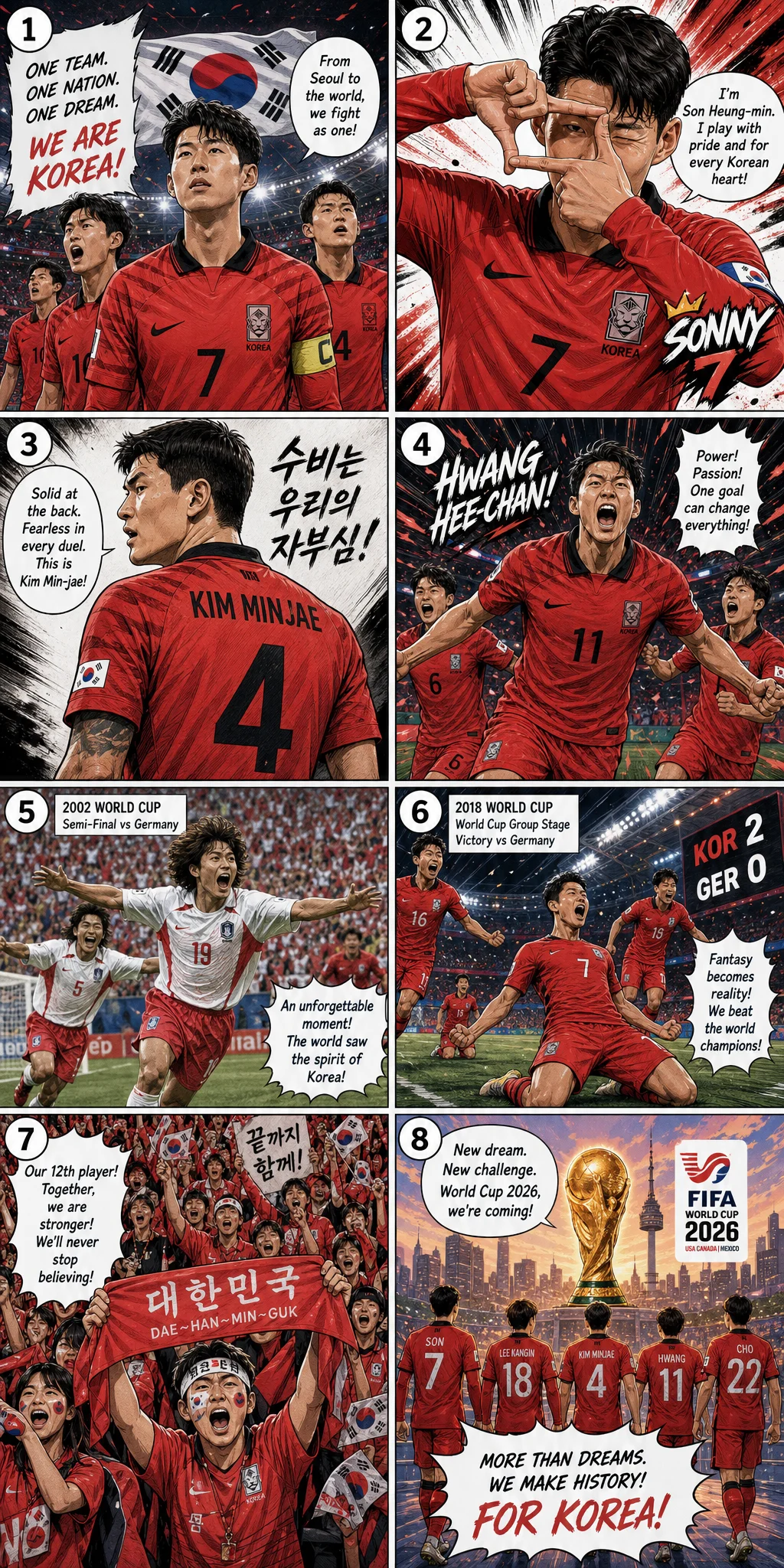
8-panel comic about South Korea national football team and their journey to the 2026 FIFA World Cup.
Published: June 5, 2026
South Korea National Football Team: The Taegeuk Warriors' Relentless March
The South Korea national football team, known as the "Taegeuk Warriors" for the red-and-blue yin-yang emblem they wear on their chests, represents one of the most consistent and respected football nations in Asia. With eleven World Cup appearances — more than any other Asian nation — South Korea has built a legacy of discipline, speed, and unyielding determination. Participating in the 2026 World Cup in Group A alongside hosts Mexico, South Africa, and Czechia, the Taegeuk Warriors carry the hopes of a football-mad nation that dreams of recreating the magic of 2002.
HISTORICAL FOUNDATIONS
Football arrived on the Korean Peninsula in the late nineteenth century, introduced by British sailors and quickly embraced by Korean communities. The Korea Football Association was founded in 1933, though the tumultuous decades of Japanese colonial rule and the subsequent Korean War severely disrupted the sport's development. The division of the peninsula into North and South created separate football traditions, with South Korea's team emerging as the standard-bearer of the nation's sporting identity.
South Korea made its World Cup debut at Switzerland 1954, entering as a representative of a nation still scarred by war. The team suffered heavy defeats against Hungary and Turkey, but the experience of competing on football's greatest stage planted seeds that would take decades to fully bloom. For thirty-two years, the World Cup remained out of reach, but qualification for Mexico 1986 began a remarkable streak of ten consecutive World Cup appearances — a record of consistency unmatched across Asia.
The 1990s saw South Korea's emergence as a genuine Asian football power, with regular qualification punctuated by occasional moments of brilliance against elite opposition. The domestic K League, founded in 1983, became the engine of national team development, producing technically proficient players who combined Asian discipline with increasing tactical sophistication.
THE 2002 DREAM
No discussion of South Korean football is complete without the 2002 World Cup, co-hosted with Japan. Under Dutch coach Guus Hiddink, South Korea embarked on an improbable journey that captured the imagination of an entire nation. Victories over Poland, Portugal, Italy, and Spain — the latter two in dramatic, controversial circumstances — propelled the team to the semi-finals, the best ever performance by an Asian team at a World Cup.
The image of Ahn Jung-hwan's golden goal against Italy, his soaring header silencing the Azzurri in extra time, remains etched in Korean football mythology. The Sea of Red — millions of supporters wearing red shirts, gathering in plazas, streets, and stadiums across the nation — became the iconic visual identity of that tournament. The synchronized chanting, the relentless drumming, the waves of red that seemed to physically propel the team forward — this was Korean football at its most passionate and powerful. The campaign ended with a fourth-place finish after defeats to Germany and Turkey, but the legacy of 2002 transformed Korean football permanently.
LEGENDS OF THE TAEGEUK
Cha Bum-kun, known as "Cha Boom" for his thunderous shot, is widely regarded as Asia's greatest-ever footballer. His career at Bayer Leverkusen and Eintracht Frankfurt in the Bundesliga during the 1980s produced 98 goals in 308 matches, making him one of the most prolific foreign players in German football history. His combination of explosive pace, physical power, and clinical finishing broke stereotypes about Asian footballers and paved the way for future generations.
Park Ji-sung stands as South Korea's most decorated footballer of the modern era. His tireless running, tactical intelligence, and selfless work ethic made him an indispensable member of Sir Alex Ferguson's Manchester United, where he won four Premier League titles and the UEFA Champions League in 2008. Park's ability to mark the world's best players out of matches — most famously Andrea Pirlo in a Champions League clash with AC Milan — earned him the nickname "Three-Lung Park" for his seemingly infinite stamina.
Son Heung-min has elevated South Korean football to unprecedented heights in the current era. His journey from a youth academy in Chuncheon to becoming the first Asian player to win the Premier League Golden Boot — scoring 23 goals for Tottenham Hotspur in the 2021-22 season — is a testament to technical excellence, relentless dedication, and world-class finishing ability with both feet. Son's global popularity, humility, and beaming smile have made him one of football's most marketable and beloved figures. For South Korea, he is more than a captain; he is a national treasure.
THE MODERN ERA
South Korea enters the 2026 World Cup as a technically accomplished, tactically flexible team that has moved beyond the stereotype of mere endurance and work-rate. Under the current coaching regime, the team blends Asian tactical discipline with a progressive attacking approach that emphasizes possession, quick combination play, and incisive wide attacks.
Beyond Son Heung-min, the squad features established European-based professionals who form a strong spine. Kim Min-jae, the commanding central defender nicknamed "The Monster," established himself at Napoli and Bayern Munich as one of the world's premier defenders — his physical dominance, reading of the game, and ability to carry the ball out of defense make him the defensive cornerstone. Lee Kang-in, the creative midfielder at Paris Saint-Germain, brings Spanish-influenced technical flair, close control, and vision that adds a new dimension to the Korean attack. Hwang Hee-chan, the explosive forward at Wolverhampton Wanderers, provides direct running and clinical finishing in transition.
Emerging talents from the K League and European academies continue to replenish the talent pool. The South Korean football system — from elementary school leagues through university competition to the professional ranks — remains one of Asia's most productive talent pipelines, ensuring a steady flow of technically proficient, tactically educated players.
FOOTBALL AND KOREAN CULTURE
Football occupies a central place in contemporary South Korean culture, rivaling baseball and esports for the attention of the nation's youth. The K League enjoys passionate local support, though the global popularity of the Premier League and other European competitions often draws Korean fans' primary viewing attention. The national team, however, unites the country like nothing else — when the Taegeuk Warriors play in a World Cup, the nation stops.
The "Red Devils," the official supporters' group, represent one of the most organized and passionate fan cultures in world football. Their synchronized chants, elaborate stadium-wide card displays, and relentless positive energy create an atmosphere that opponents find both inspiring and intimidating. The group's philosophy — to support without aggression, to celebrate without hostility — reflects Korean cultural values of collective harmony and respect.
Football also serves as a bridge across the political divide between North and South Korea. Joint teams, friendly matches, and shared participation in international tournaments have occasionally offered moments of sporting diplomacy, though the political situation remains complex and unpredictable. The sport's capacity to create human connections across seemingly insurmountable barriers remains one of its most powerful qualities.
THE PATH FORWARD
South Korea's Group A assignment — facing hosts Mexico at the Azteca, South Africa, and Czechia — presents a navigable challenge. The opening match against Mexico will be a test of composure amid a hostile atmosphere, while the subsequent matches offer genuine opportunities for points. Progression from the group stage is the minimum expectation; a run to the Round of 16, where a winnable matchup could await, is the realistic ambition.
The tactical approach will leverage Son Heung-min's elite finishing and leadership, Kim Min-jae's defensive mastery, and Lee Kang-in's creative spark. The team's traditional strengths — exceptional fitness, tactical discipline, and set-piece proficiency — remain potent weapons. The players' experience in Europe's top leagues means they will not be intimidated by any opponent.
For South Korea, the 2026 World Cup is an opportunity to reaffirm the nation's status as Asia's premier football power and to create new memories that will inspire the next generation. The Sea of Red will travel to North America in force, bringing their drums, their chants, and their unwavering faith. The Taegeuk Warriors march on.