Cabo Verde: Journey to 2026
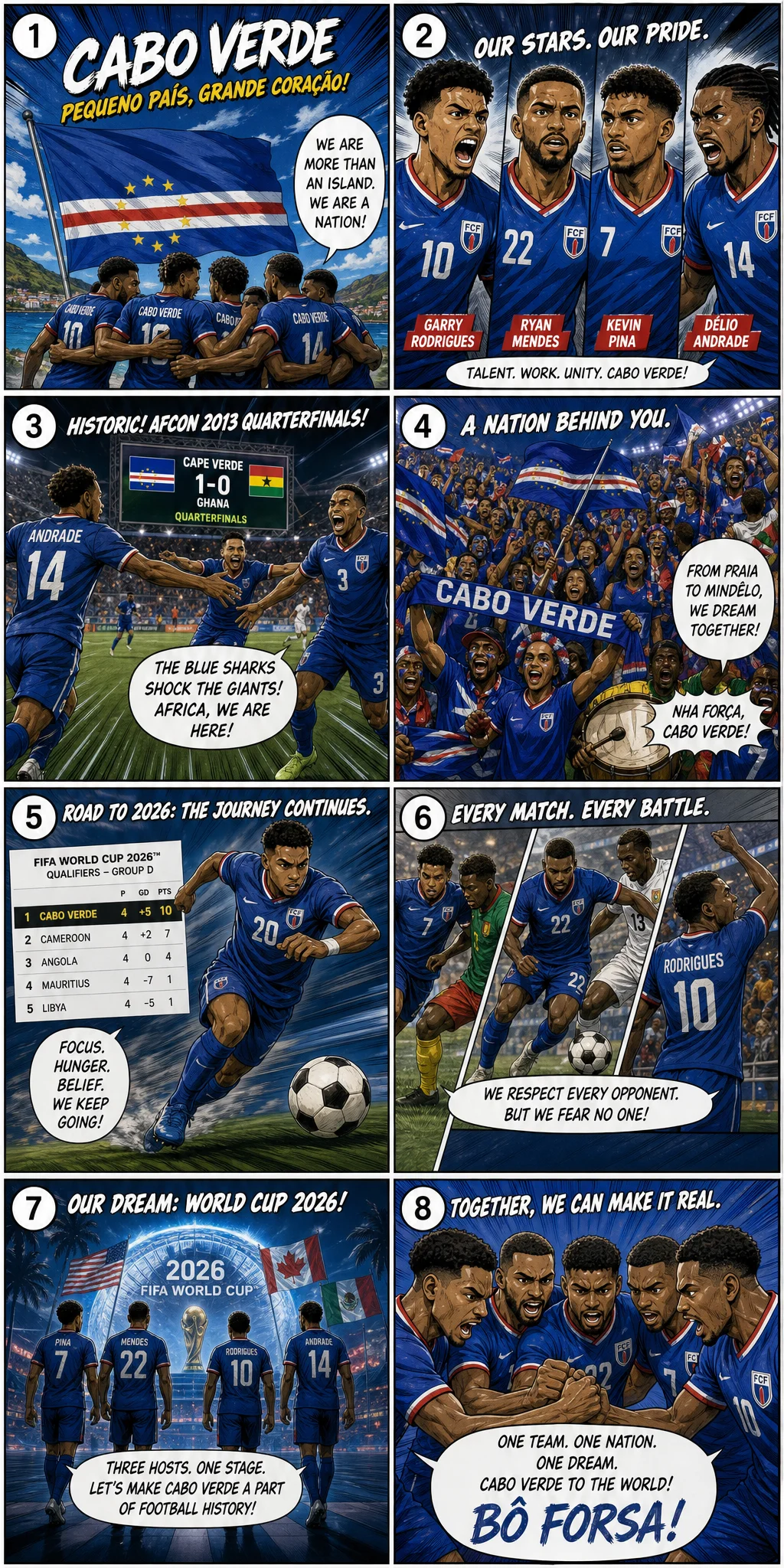
8-panel comic about Cabo Verde national football team and their journey to the 2026 FIFA World Cup.
Published: June 5, 2026
Cabo Verde National Football Team: The Blue Sharks' Island Miracle
The Cabo Verde national football team, known as the "Tubarões Azuis" — Blue Sharks — represents one of world football's most extraordinary development stories. An archipelago of ten volcanic islands in the central Atlantic Ocean, home to just over half a million people, Cabo Verde has produced a football team capable of competing with — and defeating — nations with many times its population and resources. The Blue Sharks' qualification for the 2026 FIFA World Cup is the culmination of a strategic approach to talent development that transforms geographical and demographic limitations into competitive advantages.
HISTORICAL FOUNDATIONS
Football arrived in Cabo Verde during the Portuguese colonial period, introduced by colonial administrators and the maritime traffic that connected the islands to Europe, Africa, and the Americas. The Federação Cabo-verdiana de Futebol was founded in 1982, seven years after independence from Portugal, and the national team played its first official international matches in the 1990s.
For decades, Cabo Verdean football operated on the margins of African competition. The domestic league, contested across islands separated by ocean channels that made travel expensive and logistically complex, struggled to develop the consistent competitive environment necessary for player development. The islands' small population and limited economic resources made sustained football investment difficult.
The transformation of Cabo Verdean football began with a strategic realization: the nation's diaspora was its greatest resource. More Cabo Verdeans live outside the islands than within them — communities in Portugal, the Netherlands, France, Luxembourg, and the United States (particularly in New England) maintain strong connections to the homeland. Among these diaspora communities were young footballers being developed in European professional academies, players of Cabo Verdean descent who could, under FIFA eligibility rules, represent the nation of their heritage.
THE DIASPORA STRATEGY
Cabo Verde's football federation developed a systematic approach to identifying and recruiting diaspora talent. Scouts and federation officials monitored European club academies for players with Cabo Verdean surnames, established relationships with the families of eligible players, and presented the national team as an opportunity for meaningful international football that might not be available through European national teams with deeper talent pools.
The results transformed Cabo Verde's competitive prospects. Players developed in the Portuguese, Dutch, French, and other European youth systems brought professional training, tactical education, and competitive experience that could not be replicated on the islands. The national team that emerged was essentially a European-developed squad representing an African island nation — a model that generated questions about authenticity but was entirely compliant with FIFA regulations.
Cabo Verde qualified for the Africa Cup of Nations for the first time in 2013, reaching the quarter-finals in a campaign that announced the Blue Sharks as a serious continental competitor. Subsequent AFCON appearances in 2015, 2021, and 2023 established the team as a regular presence in African football's premier competition. The 2023 tournament saw Cabo Verde reach the Round of 16, defeating Ghana and drawing with Egypt — traditional African powers — along the way.
THE CURRENT TEAM
Cabo Verde's squad features professionals based primarily in European leagues, with representation from Portugal, France, the Netherlands, Turkey, and additional European destinations. The team's playing style reflects its European developmental influences — tactical organization, technical proficiency, and positional discipline — combined with the athletic qualities characteristic of African football.
The midfield is typically the team's strongest area, with technically proficient players who can control possession and dictate tempo. The defensive unit, while not possessing the individual quality of Africa's elite teams, compensates through organization and collective discipline. The forward line features athletic players capable of threatening on counter-attacks and from set pieces.
The team's depth — a traditional weakness for small nations — remains the primary competitive limitation. While the starting eleven can compete with African opponents of any quality, the drop-off in quality between starters and reserves is pronounced. Squad health, injury management, and the avoidance of suspensions will be critical to the team's World Cup prospects.
FOOTBALL AND CABO VERDEAN CULTURE
Football occupies a central place in Cabo Verde's cultural and social life, both on the islands and throughout the diaspora. The domestic league features clubs with deep community roots, island-specific identities, and passionate local followings. Match days bring communities together, with the modest island stadiums — some with spectacular ocean views — creating a uniquely Cabo Verdean football atmosphere.
The connection between football and migration is fundamental to Cabo Verdean identity. The islands have historically been a place of departure — generations leaving for economic opportunities in Europe, Africa, and the Americas — and the national team reflects this reality. The Blue Sharks are a diaspora team wearing the colors of the homeland, and their success is celebrated with equal intensity in Mindelo and Rotterdam, Praia and Lisbon, on the islands and in the emigrant communities that maintain cultural connections across oceans.
The music of Cabo Verde — the melancholic morna of Cesária Évora, the rhythmic funaná, the festive coladeira — provides the soundtrack to match celebrations. Football and music are the two great Cabo Verdean cultural exports, and their intersection defines the emotional experience of following the Blue Sharks.
THE PATH FORWARD
Cabo Verde's qualification for the 2026 World Cup — benefiting from the expansion to 48 teams and Africa's increased allocation of spots — is a historic achievement. The Blue Sharks will be, by population, among the smallest nations ever to compete in a World Cup. Their presence at the tournament is, in itself, a victory of strategic thinking over demographic limitation.
Competitive expectations must be realistic. Cabo Verde will not advance from the group stage; it will face opponents with vastly greater resources, deeper talent pools, and generations of World Cup experience. Success will be measured by competing with dignity, by scoring goals that will be celebrated across the archipelago and its diaspora, by providing moments of joy for a nation of half a million people.
The tactical approach will emphasize the organized, technically proficient football that reflects the team's European developmental background. Defensive organization will be paramount — avoiding the scorelines that can damage morale and national pride. Counter-attacks and set pieces will provide the scoring opportunities that must be maximized.
For Cabo Verde, the 2026 World Cup is about visibility. The Blue Sharks carry the flag of a small island nation onto football's greatest stage, introducing the world to Cabo Verdean culture, music, and football passion. The archipelago of ten islands, the half-million people, the diaspora communities across oceans — all will see their identity represented on the global stage. The Blue Sharks swim among giants. That, above any result, is the miracle.