Saudi Arabia: Journey to 2026
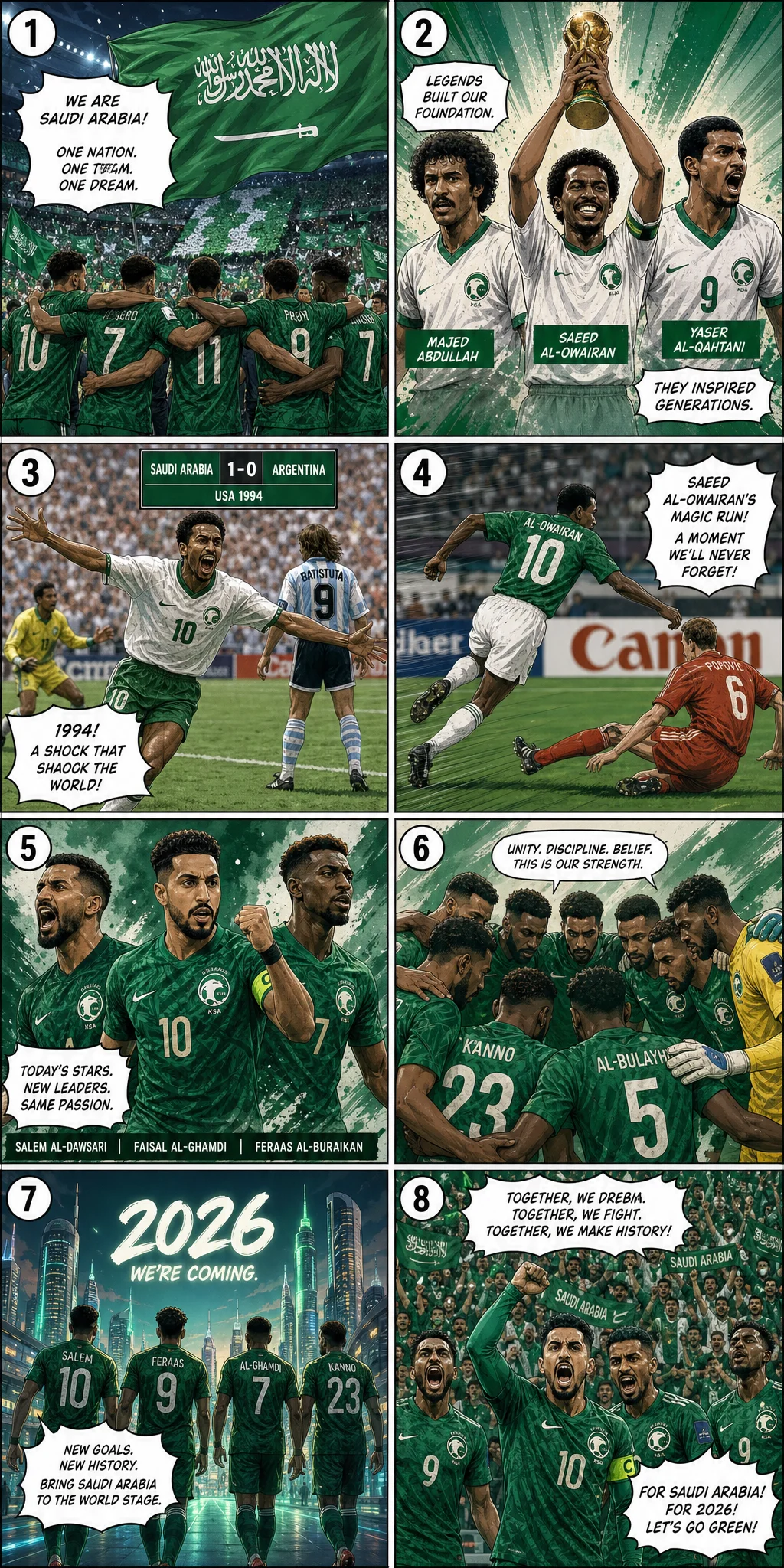
8-panel comic about Saudi Arabia national football team and their journey to the 2026 FIFA World Cup.
Published: June 5, 2026
Saudi Arabia National Football Team: The Green Falcons' Ambitious Flight
The Saudi Arabia national football team, known as "Al-Suqoor Al-Khodour" — The Green Falcons — for the distinctive green jerseys that represent the color of Islam and the Saudi national flag, carries the ambitions of a kingdom that has invested massively in sport as part of a broader national transformation strategy. Saudi Arabia's football history — six World Cup appearances, three Asian Cup titles, and a generation of domestic stars — provides the foundation upon which a new era of ambition is being constructed. The 2026 FIFA World Cup represents an opportunity for the Green Falcons to demonstrate that the kingdom's football investment is producing competitive results on the sport's greatest stage.
HISTORICAL FOUNDATIONS
Football arrived in Saudi Arabia in the early twentieth century, introduced through the kingdom's connections to the wider Islamic world and the British presence in the Arabian Peninsula. The Saudi Arabian Football Federation was founded in 1956, and the national team played its first official international matches in the 1960s. For the first decades of Saudi football, regional Gulf competition provided the primary international arena.
Saudi Arabia's emergence as an Asian football power began in the 1980s and accelerated dramatically in the 1990s. The national team won the AFC Asian Cup in 1984 and 1988 — back-to-back continental championships that established Saudi Arabia as the dominant force in Asian football. The 1984 triumph on home soil, featuring the legendary Majed Abdullah, was the moment when Saudi football announced itself to the continent.
World Cup qualification followed, with Saudi Arabia making its tournament debut at the 1994 World Cup in the United States. That campaign — under Brazilian coach Carlos Alberto Parreira — produced one of the great World Cup underdog stories. The Green Falcons defeated Belgium 1-0, with Saeed Al-Owairan scoring one of the most spectacular individual goals in World Cup history — a 70-meter slalom through the entire Belgian defense, a goal that made global headlines and established Saudi Arabia as a nation capable of producing football moments of breathtaking quality. Saudi Arabia advanced to the Round of 16, losing to Sweden, but the 1994 campaign remains the benchmark for Saudi World Cup performance.
Subsequent World Cup appearances — 1998, 2002, 2006, 2018, and 2022 — produced increasingly disappointing results. The 2002 tournament, a nadir, saw Saudi Arabia lose 8-0 to Germany in their opening match. The gap between Saudi domestic football and global elite standards had widened, and the national team's World Cup performances reflected this growing disparity.
LEGENDS OF THE GREEN FALCONS
Majed Abdullah is Saudi Arabia's greatest ever footballer and one of Asian football's most prolific goalscorers. His career, spent entirely at Al-Nassr in Riyadh, produced a staggering number of goals — widely cited as over 300, though records from the era are inconsistent — and established him as the face of Saudi football during its golden era. Abdullah's goal-scoring instinct, his loyalty to a single club, and his role in Saudi Arabia's 1984 and 1988 Asian Cup triumphs made him a national icon.
Saeed Al-Owairan's legendary goal against Belgium at the 1994 World Cup — collecting the ball in his own half, dribbling past four defenders, and firing into the net — was voted one of the greatest World Cup goals of all time. That single moment, broadcast to billions, transformed global perceptions of Saudi football and remains the most replayed piece of footage in the nation's football history.
Mohamed Al-Deayea earned a then-world-record 178 international caps as Saudi Arabia's goalkeeper between 1993 and 2006. His longevity, consistency, and penalty-saving heroics made him the defensive foundation of Saudi football through four World Cup cycles. Sami Al-Jaber, with 46 international goals in 163 appearances, was the modern era's most reliable Saudi goalscorer — a striker who competed in four World Cups and scored in three of them.
THE TRANSFORMATION ERA
Saudi Arabian football is experiencing the most dramatic transformation in its history, driven by the kingdom's Vision 2030 program and the massive investment in sport that is reshaping the Saudi domestic landscape. The Saudi Pro League's acquisition of global superstars — Cristiano Ronaldo, Neymar, Karim Benzema, Sadio Mané, and numerous others — has brought unprecedented international attention and playing quality to the domestic competition.
The impact on the national team is complex and still developing. On one hand, Saudi players now train and compete alongside world-class talent on a daily basis, potentially elevating their standards through exposure to elite professionalism. On the other hand, the influx of foreign stars has reduced playing time for some Saudi nationals, particularly in attacking positions, creating concerns about the development pipeline for national team forwards.
The 2022 World Cup in Qatar provided evidence of Saudi progress. The Green Falcons' 2-1 victory over eventual champions Argentina in their opening match — one of the greatest upsets in World Cup history — announced that Saudi football was capable of competing with any opponent. Salem Al-Dawsari's winning goal, a curling strike of remarkable technical quality, and goalkeeper Mohammed Al-Owais's heroic performance announced that the Saudi generation had arrived. Defeats to Poland and Mexico followed, and Saudi Arabia exited in the group stage, but the Argentina result changed perceptions.
The current squad continues to develop, with the core of the 2022 team — Al-Dawsari, Al-Owais, and the emerging midfield and defensive talents — supplemented by younger players developed in the increasingly professional Saudi Pro League environment. The team's tactical approach under coach Roberto Mancini (or his successor) emphasizes organization and technical quality, reflecting the Italian coach's influence.
FOOTBALL AND SAUDI CULTURE
Football is the most popular sport in Saudi Arabia, a national passion that transcends the kingdom's regional and social divisions. The Saudi Pro League's historic clubs — Al-Hilal, Al-Nassr, Al-Ittihad, Al-Ahli — command passionate followings and represent civic and regional identities. The Riyadh derby between Al-Hilal and Al-Nassr and the Jeddah rivalry between Al-Ittihad and Al-Ahli are among Asian football's most intense club fixtures.
The relationship between football and social change in Saudi Arabia has been transformed by Vision 2030. Women's attendance at football matches, banned until 2018, is now permitted and increasingly common. The Saudi women's national team has been established and is competing internationally. The broader liberalization of entertainment and public life has changed the match-day experience, though significant restrictions on personal freedom and political expression remain.
The national team's connection to Saudi national identity is profound. The green jerseys, the national flag displayed on every surface, the connection to the monarchy and the religious leadership — Saudi football is inextricably linked to the kingdom's broader identity project. The investment in sport, including the national team, is understood as an expression of national ambition and a vehicle for improving the kingdom's global image.
THE PATH FORWARD
Saudi Arabia enters the 2026 World Cup with ambitions that extend beyond participation. The Argentina victory in 2022 demonstrated that the Green Falcons can compete with the world's best on any given day. The challenge is consistency — producing performances across a tournament's duration that justify the investment and ambition of the Saudi football project.
Progression from the group stage — matching the achievement of 1994 — is the realistic target. The tactical approach will emphasize defensive organization, technical quality in midfield, and the counter-attacking threat posed by Al-Dawsari and the emerging attacking talents. The team's physical preparation, often a vulnerability in previous World Cup campaigns, has been addressed through improved sports science and conditioning programs.
For Saudi Arabia, the 2026 World Cup is a milestone in a longer journey. The kingdom's football ambition extends beyond this tournament — to the 2034 World Cup, which Saudi Arabia aims to host, and to a future in which Saudi football is a consistent global force. The Green Falcons' flight to North America is a step toward that destination. The ambitious journey continues.