Uruguay: Journey to 2026
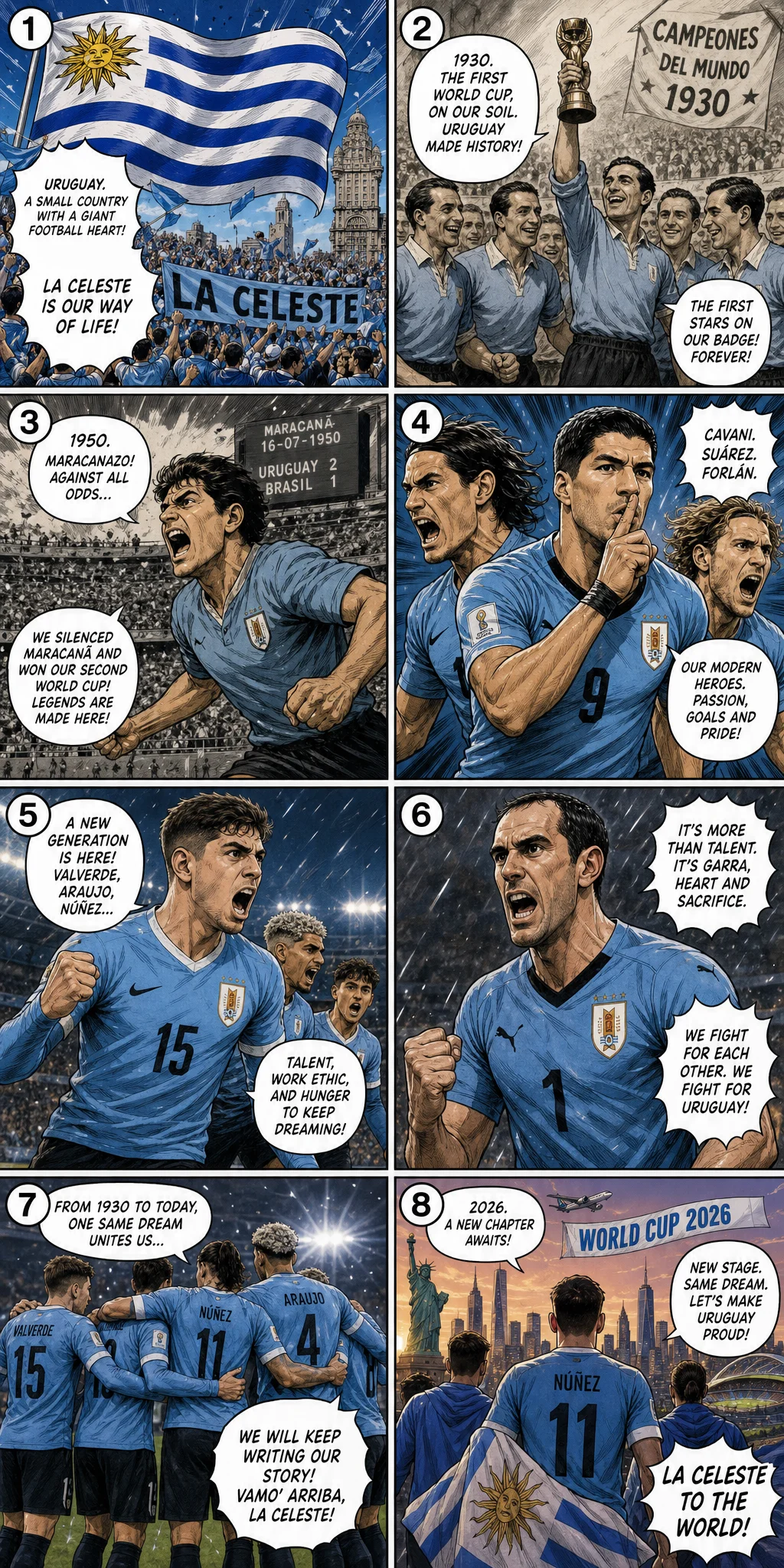
8-panel comic about Uruguay national football team and their journey to the 2026 FIFA World Cup.
Published: June 5, 2026
Uruguay National Football Team: The Celeste's Indomitable Spirit
The Uruguay national football team, known as "La Celeste" — The Sky Blue — for the distinctive light blue jerseys that have become one of football's most recognizable and historic kits, represents a nation whose football achievements vastly exceed what its population of just over three million would suggest possible. Two World Cup titles, a record fifteen Copa América championships, and a ferocious competitive culture rooted in the concept of "garra charrúa" — an indomitable fighting spirit — make Uruguay one of football's most respected and feared opponents. The 2026 FIFA World Cup offers La Celeste another opportunity to demonstrate that the smallest nation ever to win the World Cup remains one of the sport's most formidable competitors.
HISTORICAL FOUNDATIONS
Football arrived in Uruguay in the late nineteenth century through British influence, spreading rapidly through the port of Montevideo and the surrounding communities. The Uruguayan Football Association was founded in 1900, and the nation quickly established itself as a South American football pioneer alongside Argentina. The first international match between the two neighbors was played in 1901, inaugurating the oldest international rivalry outside the British Isles.
Uruguay's Olympic gold medals in 1924 (Paris) and 1928 (Amsterdam) — the latter being the first football tournament recognizable as a genuine world championship — established the small nation as the dominant football power of the pre-World Cup era. These Olympic triumphs, achieved by teams featuring the legendary José Leandro Andrade and Héctor Scarone, gave Uruguay the confidence to host and win the inaugural FIFA World Cup in 1930.
The 1930 World Cup Final in Montevideo — Uruguay defeating Argentina 4-2 before 93,000 spectators at the Estadio Centenario, a stadium built specifically for the tournament — is the foundational moment of modern international football. Uruguay had hosted the world and won, cementing a national identity deeply intertwined with footballing excellence. The Centenario, named to mark the centenary of Uruguayan independence, remains one of football's most historically significant venues.
Uruguay's second World Cup title came in 1950 in Brazil, in the match forever known as the "Maracanazo" — the Maracanã blow. Brazil, the host nation, needed only a draw from the final match of the round-robin tournament to claim the championship. Uruguay, needing a victory, fell behind to a Friaça goal before Juan Alberto Schiaffino equalized and, with 11 minutes remaining, Alcides Ghiggia scored the winning goal. The stadium, holding an estimated 199,854 spectators, fell silent. Ghiggia later reflected: "Only three people have ever silenced the Maracanã: Frank Sinatra, the Pope, and me."
LEGENDS OF THE CELESTE
José Leandro Andrade, the "Black Marvel," was the star of Uruguay's 1924 and 1928 Olympic teams and the first globally recognized Black football superstar. An elegant half-back whose style combined physical power with balletic grace, Andrade's performances in Paris — where the French press christened him "La Merveille Noire" — introduced the world to Uruguayan football's distinctive aesthetic.
Juan Alberto Schiaffino, "Pepe," was the creative genius of the 1950 World Cup team — a player of such technical refinement that AC Milan made him one of the highest-paid footballers in the world during the 1950s. His goal in the Maracanazo final was the product of his characteristic intelligence: finding space where none appeared to exist, finishing with the composure of a player who understood the magnitude of the moment.
Enzo Francescoli, "El Príncipe" — The Prince — was the elegant playmaker who defined Uruguayan football in the 1980s and 1990s. His career at River Plate in Argentina, Racing Club in France, Cagliari and Torino in Italy, and briefly at Marseille established him as one of South America's most admired footballers. Zinedine Zidane named his first son Enzo after Francescoli — perhaps the ultimate tribute from one football artist to another.
Diego Forlán was the modern embodiment of Uruguayan excellence — a striker whose spectacular long-range shooting, intelligent movement, and golden boot-winning performances (shared with four others) at the 2010 World Cup made him the tournament's best player. His goal against Germany in the third-place match, a bouncing volley struck with perfect technique, was one of the great World Cup goals. Luis Suárez, the most talented and most controversial Uruguayan footballer of the modern era, has scored more international goals than any player in the nation's history. His brilliance — the improvisational genius, the clinical finishing, the relentless competitiveness — has coexisted with moments of madness (the handball against Ghana in 2010, the biting incidents) that have made him one of football's most complex figures.
THE MODERN ERA
Uruguay enters the 2026 World Cup under new leadership, with Marcelo Bielsa having taken charge and imposed his distinctive high-intensity, high-pressing tactical philosophy. The transformation has been dramatic — from the pragmatic, defensively solid approach that characterized previous Uruguayan teams to a more ambitious, front-foot style that seeks to dominate opponents through physical and tactical aggression.
Federico Valverde, the Real Madrid midfielder, has developed into one of the world's most complete footballers — a player whose athletic capacity, shooting power, passing range, and tactical intelligence make him the natural leader of the new Uruguay. Darwin Núñez, the Liverpool striker whose pace, power, and increasingly clinical finishing provide the attacking focal point, represents the physical and technical evolution of Uruguayan forward play. Ronald Araújo, the Barcelona center-back, anchors a defensive unit that combines traditional Uruguayan resilience with modern ball-playing quality.
The midfield features emerging talents from South American and European leagues who provide the energy and technical quality that Bielsa's system demands. The squad's average age has decreased significantly from previous tournaments, with several players at the beginning of their international careers rather than nearing the end.
FOOTBALL AND URUGUAYAN CULTURE
Football's place in Uruguayan culture is unique — a source of national identity for a small country sandwiched between the giants of Argentina and Brazil, a reminder of a glorious past and a vehicle for asserting continued relevance. The phrase "garra charrúa" — invoking the spirit of the indigenous Charrúa people, who resisted Spanish colonization with legendary ferocity — has become shorthand for the Uruguayan playing style: tenacious, uncompromising, indefatigable.
The domestic Primera División, anchored by the historic rivalry between Nacional and Peñarol, remains one of South America's most competitive leagues and a crucial talent pipeline. The Montevideo derby between the two giants is among world football's oldest and most passionate rivalries, dividing the capital along lines of class, neighborhood, and tradition. Nacional and Peñarol have won multiple Copa Libertadores titles, maintaining Uruguay's continental competitiveness in club football.
Uruguay has historically been a net exporter of football talent, with the domestic league producing more professional footballers per capita than any other nation. The migration path — from Montevideo's youth academies to Argentine, Brazilian, and European clubs — has been traveled by generations of Uruguayan footballers. The remittances and economic activity generated by football exports represent a small but meaningful component of Uruguay's economy.
THE PATH FORWARD
Uruguay enters the 2026 World Cup as a dangerous outsider — not among the tournament favorites, but a team that no opponent wants to face, particularly in the knockout stages where the Celeste's competitive spirit and tournament experience become decisive. The Bielsa era has injected tactical ambition and physical intensity into a squad that has always possessed the fundamental Uruguayan attributes of competitiveness and resilience.
The tactical approach emphasizes high pressing, rapid transitions, and wide attacking play — a departure from the more pragmatic Uruguayan tradition but one that leverages the athletic qualities of Valverde, Núñez, and the emerging generation. The question is whether this more ambitious style can succeed against elite opponents or whether Uruguay will need to revert to its more traditional, defensively solid approach in the tournament's decisive moments.
For Uruguay, the 2026 World Cup is about proving that La Celeste remains relevant at the highest level, that the nation of three million can still compete with and defeat nations of three hundred million. The sky blue shirt carries the weight of history — the Olympic golds of the 1920s, the World Cups of 1930 and 1950, the Maracanazo, the garra charrúa that has defined Uruguayan football for a century. The indomitable spirit travels to North America.