France: Journey to 2026
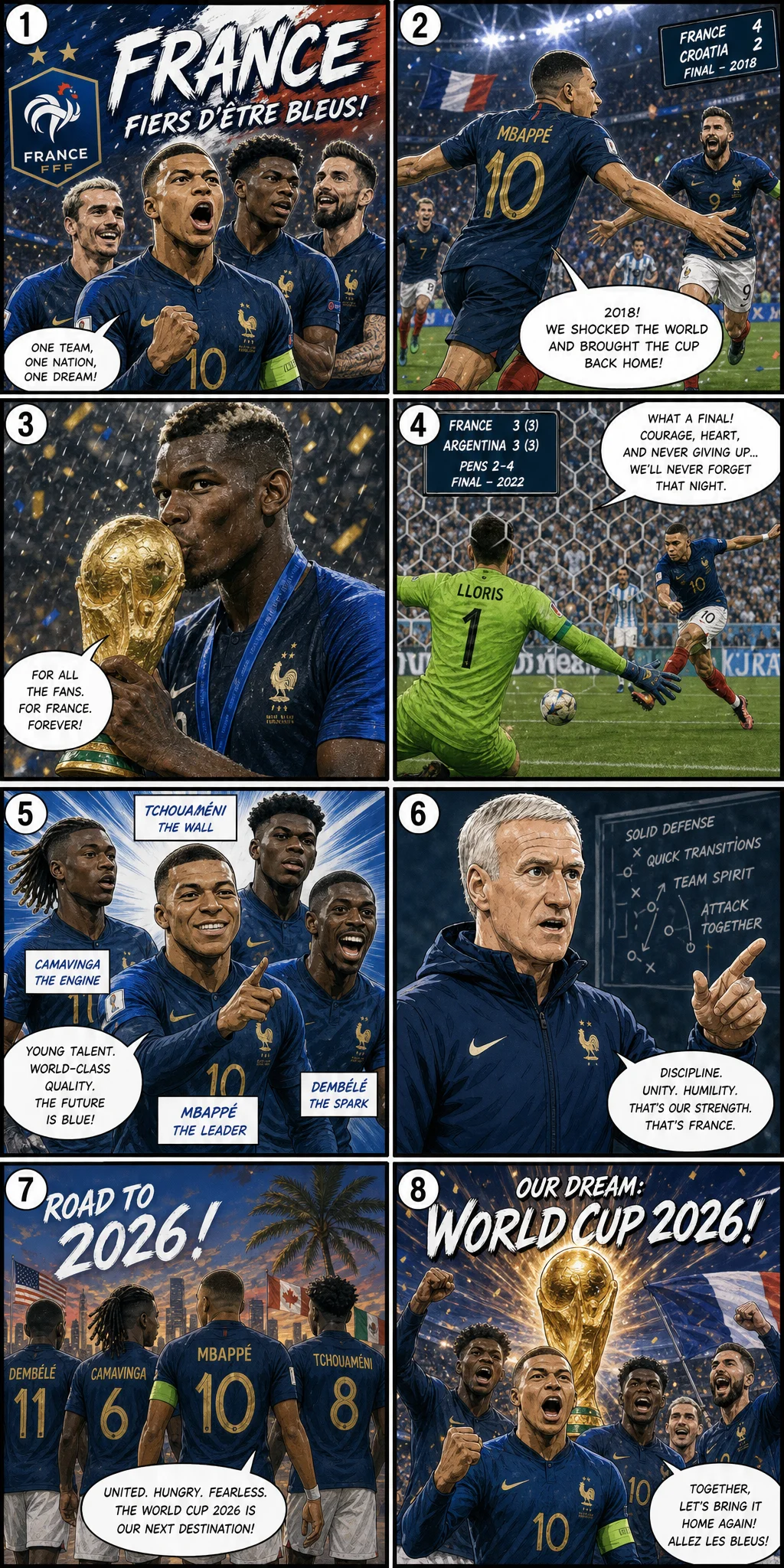
8-panel comic about France national football team and their journey to the 2026 FIFA World Cup.
Published: June 5, 2026
France National Football Team: Les Bleus' Quest for Dynasty
The France national football team, known as "Les Bleus" — The Blues — for the tricolor jerseys that have become synonymous with a new era of French football dominance, enters the 2026 FIFA World Cup as one of the tournament's prohibitive favorites. France has reached four of the last seven World Cup finals (1998, 2006, 2018, 2022), winning two, a record of sustained excellence matched only by Brazil in the modern era. The nation that produced Zinedine Zidane and Kylian Mbappé, that transformed a colonial football culture into a multicultural symbol of national unity and competitive excellence, seeks to become the first nation since Brazil in 1962 to defend the World Cup title.
HISTORICAL FOUNDATIONS
Football arrived in France in the late nineteenth century, with the first clubs founded by English expatriates in Paris and Le Havre. The French Football Federation was established in 1919, and the national team competed in the early World Cups without distinction. For most of the twentieth century, French football operated in the shadow of its European neighbors — talented individuals, particularly the legendary Just Fontaine (whose 13 goals in the 1958 World Cup remain a single-tournament record), but no collective achievement to match.
The transformation began with the establishment of the French Football Federation's national technical center at Clairefontaine in 1988 — an elite academy that would become the model for systematic talent development worldwide. Combined with the professionalization of French club academies and the nation's multicultural talent pool, Clairefontaine created the pipeline that would produce French football's golden generations.
The 1980s, under coach Michel Hidalgo, saw France develop a style of elegant, attacking football — "champagne football" — epitomized by the midfield genius of Michel Platini. The 1984 European Championship, won on home soil with Platini scoring nine goals in five matches, was France's first major international trophy. The 1982 and 1986 World Cup semi-final appearances established France as a football power, though the ultimate prize remained elusive.
The 1998 World Cup, hosted by France, changed everything. Under coach Aimé Jacquet, a team featuring Zinedine Zidane, Didier Deschamps, a young Thierry Henry, and the defensive solidity of Laurent Blanc, Marcel Desailly, Lilian Thuram, and Bixente Lizarazu won the World Cup on home soil. Zidane's two headed goals against Brazil in the final — from corners delivered by Emmanuel Petit and Youri Djorkaeff — are images seared into French national memory. The "Black-Blanc-Beur" (Black-White-Arab) team celebrated by a diverse nation, with Zidane's face projected onto the Arc de Triomphe, represented a vision of French identity that transcended football.
LEGENDS OF LES BLEUS
Zinedine Zidane is, by the judgment of most informed observers, the greatest French footballer of all time and one of the small group of players who can be discussed as the greatest in football history. His elegance, his first touch (the ball falling dead at his feet regardless of the speed or angle of delivery), his capacity to produce transcendent moments in matches of ultimate consequence — the two headed goals in the 1998 World Cup final, the left-footed volley in the 2002 Champions League final, the Panenka penalty in the 2006 World Cup final — make him football's preeminent big-game player. The 2006 World Cup Final headbutt on Marco Materazzi, resulting in a red card in extra time of his final match, added a Shakespearean tragedy to the Zidane narrative: genius and human frailty, inseparable.
Michel Platini, before Zidane, was France's greatest player — a midfielder whose goalscoring (41 goals in 72 international appearances) set a standard for attacking midfield production that few have matched. His vision, his free-kick mastery, and his leadership of the "carré magique" (magic square) midfield that defined French football in the 1980s made him a three-time Ballon d'Or winner.
Kylian Mbappé has already entered the pantheon. His performance in the 2022 World Cup final — a hat-trick, including two goals in two minutes to rescue France from certain defeat, and a converted penalty in the shootout that still ended in loss — established him as the heir to Lionel Messi and Cristiano Ronaldo's throne. His speed, his clinical finishing, his confidence bordering on arrogance, and his capacity to dominate the biggest matches make him arguably the world's best player entering 2026.
Thierry Henry is the finest striker ever to wear the French shirt — his 51 international goals, his partnership with Zidane, his transformation of the forward position during his Arsenal years. Lilian Thuram, the elegant defender whose only two international goals came in the 1998 World Cup semi-final against Croatia, was the defensive rock of the golden generation. Didier Deschamps, the captain of the 1998 team and now the coach, has been the constant presence across thirty years of French football dominance.
THE MODERN DYNASTY
France enters the 2026 World Cup with an embarrassment of talent that other nations can only envy. Mbappé, at the peak of his powers, is supported by a cast of world-class performers who operate at the highest levels of European club football. The French player production system — Clairefontaine, the professional club academies, the competitive environment of Ligue 1 — continues to produce elite talent at a rate unmatched by any European nation.
Antoine Griezmann, despite advancing in age, remains the creative link between midfield and attack — a player whose intelligence, work-rate, and technical quality make him indispensable to Deschamps's system. Aurélien Tchouaméni and Eduardo Camavinga, the young Real Madrid midfielders, represent the next generation of French midfield dominance — athletic, technically proficient, tactically intelligent. The defensive unit features an extraordinary depth of talent: Dayot Upamecano, Ibrahima Konaté, William Saliba, and the emerging generation of French center-backs provide options that most nations would consider luxurious.
The forward line beyond Mbappé features Ousmane Dembélé's unpredictability, Randal Kolo Muani's physical presence, and a pipeline of young attacking talents who represent the latest products of French football's remarkable production system. France could field two entirely different squads and both would be legitimate contenders for the World Cup — a depth of talent that no other nation can approach.
FOOTBALL AND FRENCH CULTURE
French football occupies a unique position in the national culture — a site where debates about identity, immigration, and national unity are contested with particular intensity. The 1998 World Cup victory, celebrated under the banner of "La France Black-Blanc-Beur," was embraced as a vision of multicultural France. Subsequent successes and failures have been interpreted through the lens of national identity debates, with the national team serving as a Rorschach test for French anxieties and aspirations about race, religion, and belonging.
The French football infrastructure — from Clairefontaine to the network of professional academy centers — is arguably the world's most effective talent development system. The banlieues (suburbs) of Paris, Lyon, Marseille, and other major cities have produced a disproportionate share of French football talent, with football serving as a vehicle for social mobility in communities characterized by economic marginalization and social exclusion.
The relationship between club and national team support reflects broader French social dynamics. Olympique de Marseille's passionate, working-class, Mediterranean supporter culture differs dramatically from Paris Saint-Germain's increasingly global, Qatar-backed commercial identity. The national team, particularly when successful, provides a unifying force that transcends these divisions.
THE PATH FORWARD
France enters the 2026 World Cup as the defending champion and the consensus favorite. The depth of talent, the experience of winning in 2018 and reaching the final in 2022, the presence of Mbappé as the world's best player, and the tactical acumen of Deschamps — the only person to win the World Cup as both captain and coach — make France the team to beat.
The tactical approach blends defensive solidity (Deschamps's foundational principle) with the devastating counter-attacking threat posed by Mbappé's pace and the technical quality of the supporting attackers. France is comfortable without the ball — the 2018 World Cup final against Croatia, a 4-2 victory achieved with only 39% possession, demonstrated that Les Bleus can win by absorbing pressure and striking with clinical efficiency.
The challenge is psychological rather than technical or tactical. The only team that has successfully defended a World Cup title in modern football is Brazil (1958, 1962). France's early exit from Euro 2020 (losing to Switzerland on penalties after leading 3-1) demonstrated that the gap between talent and performance is not always bridged. The squad's internal dynamics — the personalities, the egos, the leadership structure — will be as important as the tactical preparation.
For France, the 2026 World Cup is about dynasty. Two World Cup wins in four tournaments would establish this generation alongside the great international teams of history. Les Bleus carry the weight of expectation and the confidence of proven winners. The quest for more than a team, for a legacy, travels to North America.