Senegal: Journey to 2026
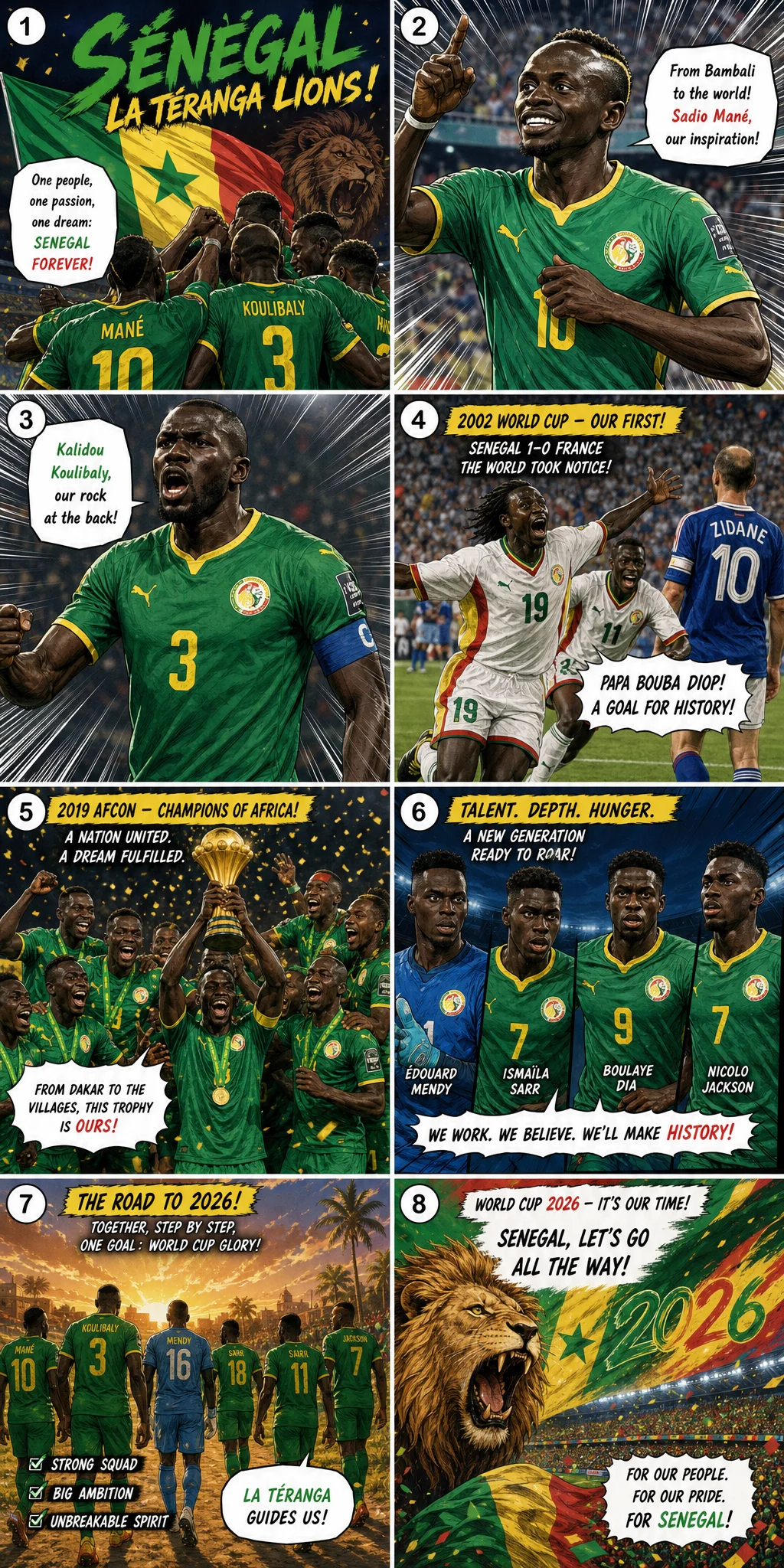
8-panel comic about Senegal national football team and their journey to the 2026 FIFA World Cup.
Published: June 5, 2026
Senegal National Football Team: The Lions of Teranga's Roaring Ambition
The Senegal national football team, known as the "Lions of Teranga" — Teranga being the Wolof concept of hospitality, generosity, and shared community that defines Senegalese culture — represents one of African football's most dynamic and successful programs. From their stunning World Cup debut in 2002 to their continental triumph at the 2021 Africa Cup of Nations, Senegal has established itself as a consistent force capable of competing with any opponent. The 2026 FIFA World Cup offers the Lions an opportunity to build on their growing international reputation and advance deeper than any Senegalese team before them.
HISTORICAL FOUNDATIONS
Football arrived in Senegal during the French colonial period, spreading through the coastal cities of Dakar, Saint-Louis, and Thiès. The Fédération Sénégalaise de Football was founded in 1960, the year of independence, and the national team quickly established itself in West African football competition. For the first decades of independence, Senegal operated as a competitive but not dominant African football nation — capable of producing talented players but not yet achieving breakthrough international results.
Senegal's first golden memory came at the 2002 World Cup, co-hosted by South Korea and Japan. Making their tournament debut under French coach Bruno Metsu, the Lions produced one of the great World Cup opening shocks: a 1-0 victory over defending champions France in Seoul. Papa Bouba Diop's goal — a scrambled finish after France's defense failed to clear — announced Senegal to the global football audience. Subsequent draws with Denmark and Uruguay, followed by a golden-goal victory over Sweden in the Round of 16, sent Senegal to the quarter-finals — matching Cameroon's 1990 achievement as the best African World Cup performance. The quarter-final against Turkey, a 1-0 defeat on a golden goal from İlhan Mansız, ended the dream but established Senegal as a force capable of competing at football's highest level.
The decades between 2002 and the current era were characterized by inconsistent performance — talented players, occasional strong results, but no sustained collective achievement. The 2018 World Cup appearance, ending in the group stage on fair play tiebreakers (Senegal eliminated with an identical record to Japan, but with more yellow cards), provided the painful motivation for the program's recent transformation.
LEGENDS OF THE LIONS
Sadio Mané is Senegal's greatest ever footballer and one of the most important athletes in African history. His career at Southampton, Liverpool (where he won the Premier League, Champions League, and was named African Footballer of the Year), Bayern Munich, and Al-Nassr has established him as one of his generation's elite attackers. Mané's unique combination of explosive pace, clinical finishing, and selfless team play — he has funded hospitals, schools, and community infrastructure in his hometown of Bambali — has made him a symbol of Senegalese excellence and generosity.
El Hadji Diouf, the controversial but undeniably talented forward who was the star of the 2002 World Cup team, became the first Senegalese player to be named African Footballer of the Year (twice, in 2001 and 2002). His dribbling, creativity, and confidence — occasionally crossing into arrogance — made him the face of Senegalese football during its breakthrough era. Papa Bouba Diop, the towering midfielder known as "The Wardrobe" for his physical presence, scored the goal against France in 2002 that remains Senegal's most famous World Cup moment. His untimely death in 2020 was mourned as a national tragedy.
Kalidou Koulibaly, the elegant center-back and national team captain whose career at Napoli, Chelsea, and in the Saudi Pro League established him as one of the world's premier defenders, has been the defensive foundation of the modern Senegal team. His leadership, physical dominance, and surprisingly graceful ball-playing ability have made him the team's spiritual leader. Henri Camara and Khalilou Fadiga were key contributors to the 2002 team whose professional careers across European leagues established the credibility of Senegalese players at the highest level.
THE MODERN ERA
Senegal enters the 2026 World Cup as African champion (owing to the rescheduled-then-delayed 2021 AFCON, won in 2022) and as one of the continent's most feared competitors. The current squad features an extraordinary concentration of players operating at the highest levels of European club football, particularly in the English Premier League — reflecting the physical and athletic qualities that characterize Senegalese football.
The midfield is anchored by a core of Premier League-based players who provide the defensive solidity and athletic dominance that define the modern Senegal team. Idrissa Gueye's ball-winning and experience, combined with younger midfield talents emerging from European academies, create a foundation of physical and technical quality. The forward line, beyond Mané, features attackers operating in top European leagues who offer pace, directness, and improving finishing quality.
Édouard Mendy, the Chelsea and Al-Ahli goalkeeper whose performances in the 2021 Champions League-winning campaign established him as one of the world's best, provides elite-level goalkeeping — a position that has historically been a strength for Senegalese football. The defensive unit, organized around Koulibaly's leadership and featuring emerging center-backs and full-backs from European leagues, provides the organizational foundation.
The domestic Senegal Premier League, anchored by historic clubs like ASC Diaraf and ASC Jeanne d'Arc in Dakar, continues to develop young talent that feeds the national team and the European export market. The Génération Foot academy, a partnership between the Senegalese club and FC Metz of France, has become one of Africa's most successful talent development projects — Mané, Papiss Cissé, and numerous other Senegalese internationals are graduates.
FOOTBALL AND SENEGALESE CULTURE
Football in Senegal is a unifying national passion that bridges ethnic, religious, and regional divisions. The nation is overwhelmingly Muslim (over 95%), with a strong tradition of Sufi brotherhoods, and football exists alongside and intertwined with religious practice. Players' public expressions of faith, the influence of marabouts (religious leaders) on football decisions, and the integration of football into the rhythms of religious and community life characterize the distinctive Senegalese football culture.
The concept of "teranga" — the Senegalese value of hospitality, generosity, and shared community — is invoked to describe the national team's spirit and the broader culture of Senegalese football. The Lions of Teranga are expected to play with pride, passion, and a commitment to collective success that reflects national values. The team's celebrations after the 2021 AFCON victory — president Macky Sall declaring a national holiday, the streets of Dakar and every Senegalese city filling with celebrants — demonstrated the national unity that football success can generate.
University and neighborhood football (navétanes) in Dakar and other cities provides a grassroots football culture that is among Africa's most vibrant. The beaches of Dakar, particularly the legendary Ngor and Yoff, are dotted with football matches from sunrise to sunset — informal, enthusiastic, producing the close control and improvisational skills characteristic of Senegalese footballers.
THE PATH FORWARD
Senegal enters the 2026 World Cup with ambitions that extend beyond the group stage. The quarter-final appearance of 2002 remains the benchmark, and the current squad — more talented and deeper than the 2002 team — has the quality to match or exceed that achievement. The expanded tournament format, with its more forgiving group stage, provides a favorable structure for ambitious African teams.
The tactical approach under coach Aliou Cissé (or his successor, should the long-serving manager move on) emphasizes defensive solidity, athletic dominance in midfield, and the counter-attacking threat posed by Mané and the supporting attackers. Set pieces — with Koulibaly's aerial threat and the delivery quality of midfield technicians — represent a critical goal-scoring avenue, as demonstrated throughout the AFCON-winning campaign.
For Senegal, the 2026 World Cup is about legacy — proving that the 2021 African championship was not a single triumph but the foundation of sustained excellence. The Lions of Teranga carry the hopes of a football-mad nation and the respect of opponents who understand that facing Senegal means a confrontation with African football's most complete modern team. The roar continues.