Iraq: Journey to 2026
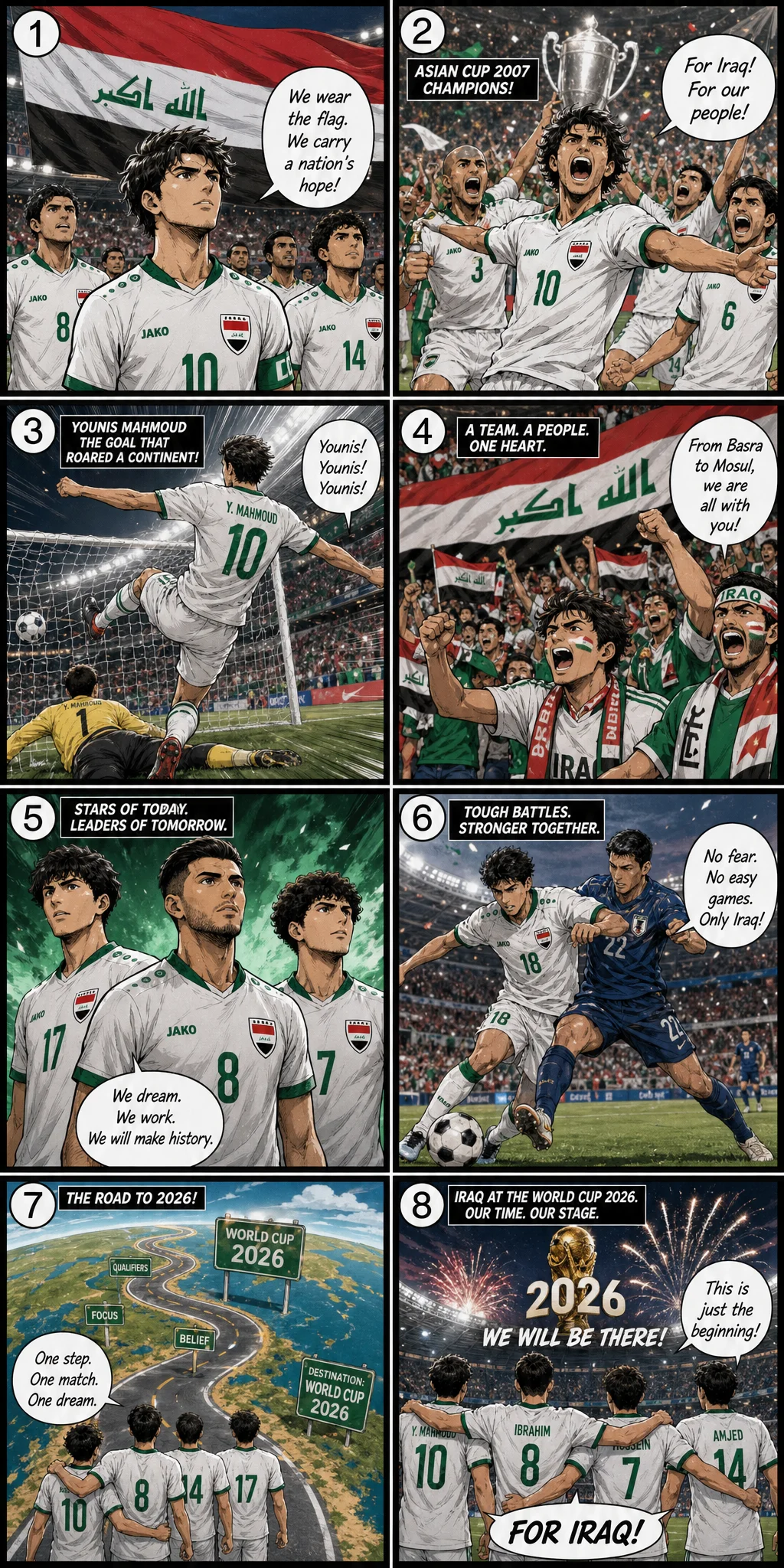
8-panel comic about Iraq national football team and their journey to the 2026 FIFA World Cup.
Published: June 5, 2026
Iraq National Football Team: The Lions of Mesopotamia's Triumph Over Adversity
The Iraq national football team, known as "Usood Al-Rafidayn" — The Lions of Mesopotamia — carries a football story that is inseparable from one of the most turbulent national histories in the modern world. Wars, sanctions, occupation, and internal conflict have devastated Iraqi society for decades, yet the national football team has repeatedly produced moments of transcendent achievement that unite the country across its deep ethnic and sectarian divisions. Iraq's qualification for the 2026 FIFA World Cup represents another chapter in a story of resilience that is among the most inspiring in international sport.
HISTORICAL FOUNDATIONS
Football arrived in Iraq during the British mandate period following World War I, introduced by British military personnel and quickly adopted by the Iraqi population. The Iraq Football Association was founded in 1948, and the national team competed in regional Arab and Asian competitions through the mid-twentieth century. For decades, Iraq was a competitive but not dominant Asian football nation — capable of producing talented players but not achieving breakthrough international results.
Iraq's lone World Cup appearance came in 1986 in Mexico, a qualification achieved against the backdrop of the Iran-Iraq War (1980-1988) that was consuming the nation's human and economic resources. The team, featuring the legendary striker Ahmed Radhi and midfielder Hussein Saeed, lost all three group matches to Paraguay, Belgium, and Mexico. Radhi scored Iraq's only World Cup goal against Belgium — a moment of national pride amid a tournament of heavy defeats.
The 1990s were a lost decade for Iraqi football. International sanctions following the Gulf War isolated the country from the global community, and the national team's competitive schedule was severely limited. The domestic league continued, but the infrastructure for talent development was decimated. The 2003 US-led invasion and subsequent occupation created new layers of violence and instability that made organized sport a secondary priority amid the daily struggle for survival.
THE 2007 ASIAN CUP MIRACLE
The 2007 AFC Asian Cup victory stands as Iraqi football's greatest achievement — and one of the most remarkable stories in international sporting history. Against the backdrop of a sectarian civil war that was killing thousands of Iraqis each month, a team composed of Sunni Arabs, Shia Arabs, and Kurds — representing the country's major communities, often at war with each other — united to win the Asian continental championship.
Under Brazilian coach Jorvan Vieira, Iraq defeated Australia (the tournament favorite), South Korea (the tournament co-favorite), and Saudi Arabia in the knockout stages. The final in Jakarta, a 1-0 victory over three-time champions Saudi Arabia secured by Younis Mahmoud's headed goal, produced celebrations across Iraq that momentarily transcended the violence. Tragically, those celebrations were interrupted by car bomb attacks that killed celebrating fans — a cruel reminder of the reality that Iraqi football existed within.
Captain Younis Mahmoud, a Sunni Arab from Kirkuk, and Nashat Akram, the elegant Shia midfielder, became national heroes. The image of Mahmoud, tears streaming down his face, lifting the Asian Cup trophy became an enduring symbol of Iraqi resilience and the possibility of national unity. The achievement demonstrated that football could, in the right circumstances, provide a vision of Iraq beyond sectarian division.
LEGENDS OF THE LIONS
Ahmed Radhi is Iraq's greatest ever footballer and a figure of tragic importance in the nation's sporting history. His goal against Belgium at the 1986 World Cup — Iraq's first and, until a recent tournament, only World Cup goal — made him a national icon. Radhi was, by all accounts, a striker of genuine international quality. His post-retirement career in Iraqi football administration was ended by tragedy: he contracted COVID-19 and died in June 2020, a loss mourned across Iraq.
Hussein Saeed earned 137 caps for Iraq between 1976 and 1990, scoring 78 international goals — one of the most prolific records in international football history. His longevity and goal-scoring consistency during the Iraq-Iran War years, when the national team's preparation and logistics were profoundly disrupted, represents remarkable sporting achievement.
Younis Mahmoud, the captain and hero of the 2007 Asian Cup, scored 57 goals in 148 international appearances — a record of sustained excellence. His goal in the 2007 Asian Cup final cemented his place in Iraqi sporting history. Nashat Akram, the technically gifted midfielder who played for clubs in Saudi Arabia, the Netherlands, and England (briefly at Manchester City, though work permit issues prevented him from playing), was the creative heart of the 2007 Asian Cup team.
THE MODERN ERA
Iraqi football continues to operate under extraordinarily difficult circumstances. The nation's football infrastructure — stadiums, training facilities, youth development programs — has been degraded by decades of conflict and underinvestment. The domestic Iraqi Premier League, while maintaining passionate followings, lacks the resources and professional standards of wealthier Asian and Gulf nations.
Despite these challenges, Iraq has maintained competitive Asian football standing. The national team has qualified for multiple Asian Cups since 2007 and achieved encouraging results in World Cup qualification campaigns. The team's traditional strengths — technical quality, physical competitiveness, and collective fighting spirit — remain evident, even as the infrastructure supporting player development lags behind Asian competitors.
The current squad features a mix of domestic-based players and a growing number of professionals competing in leagues across the Middle East, Asia, and occasionally Europe. The diaspora — Iraqi communities in Europe, North America, and Australia — has provided an additional talent source, with players of Iraqi heritage eligible for national team selection.
The 2026 World Cup qualification, benefiting from Asia's expanded allocation and Iraq's resilient campaign, represents a generational achievement. The return to the World Cup after four decades is a source of national pride and a moment of joy for a population that has experienced too little of either.
FOOTBALL AND IRAQI CULTURE
Football in Iraq occupies a uniquely important cultural position — perhaps the only institution capable of uniting the country across its profound ethnic (Arab, Kurd, Turkmen), religious (Shia, Sunni, Christian, Yazidi), and political divisions. The 2007 Asian Cup victory, celebrated across communities that were simultaneously at war with each other, demonstrated football's unique power in Iraqi society.
The sport's grassroots culture is resilient despite material constraints. Street football, played on any available surface with improvised equipment, is ubiquitous across Iraqi cities and towns. The passion for the game transcends class, region, and sect — a shared Iraqi identity expressed through football.
The relationship between football and politics has been unavoidable throughout Iraqi history. Uday Hussein, Saddam Hussein's son, presided over the Iraqi Football Association and the national Olympic committee during the Ba'athist era, using sport as an instrument of regime propaganda and, according to credible accounts, maintaining a torture chamber beneath the Olympic committee headquarters for athletes who failed to meet expectations. The post-2003 era brought new forms of political interference, with government officials and political factions seeking to influence federation decisions and team selections.
THE PATH FORWARD
Iraq enters the 2026 World Cup as one of the tournament's most compelling human stories. The team's presence at the tournament — a nation that has endured more suffering than most countries can imagine, competing in football's greatest celebration — is, in itself, a victory of human resilience.
Competitive expectations must be realistic. Iraq does not possess the squad depth, the professional infrastructure, or the preparation resources to match the tournament's elite. Progression from the group stage would be a historic achievement; avoiding heavy defeats and competing with dignity are the more modest but equally valid measures of success.
The tactical approach will emphasize the defensive organization and collective spirit that have been Iraqi football's historic strengths. Counter-attacks and set pieces — with the physical qualities of Iraqi defenders and forwards — will provide the scoring opportunities that must be maximized.
For Iraq, the 2026 World Cup is about more than football. It is about representation — the opportunity to present Iraqi culture, Iraqi resilience, and Iraqi humanity to a global audience that encounters Iraq primarily through coverage of conflict. The Lions of Mesopotamia carry a story of survival, of triumph over adversity, of the beautiful game's capacity to unite a divided nation. That story, told on the World Cup stage, is a victory regardless of results.