Norway: Journey to 2026
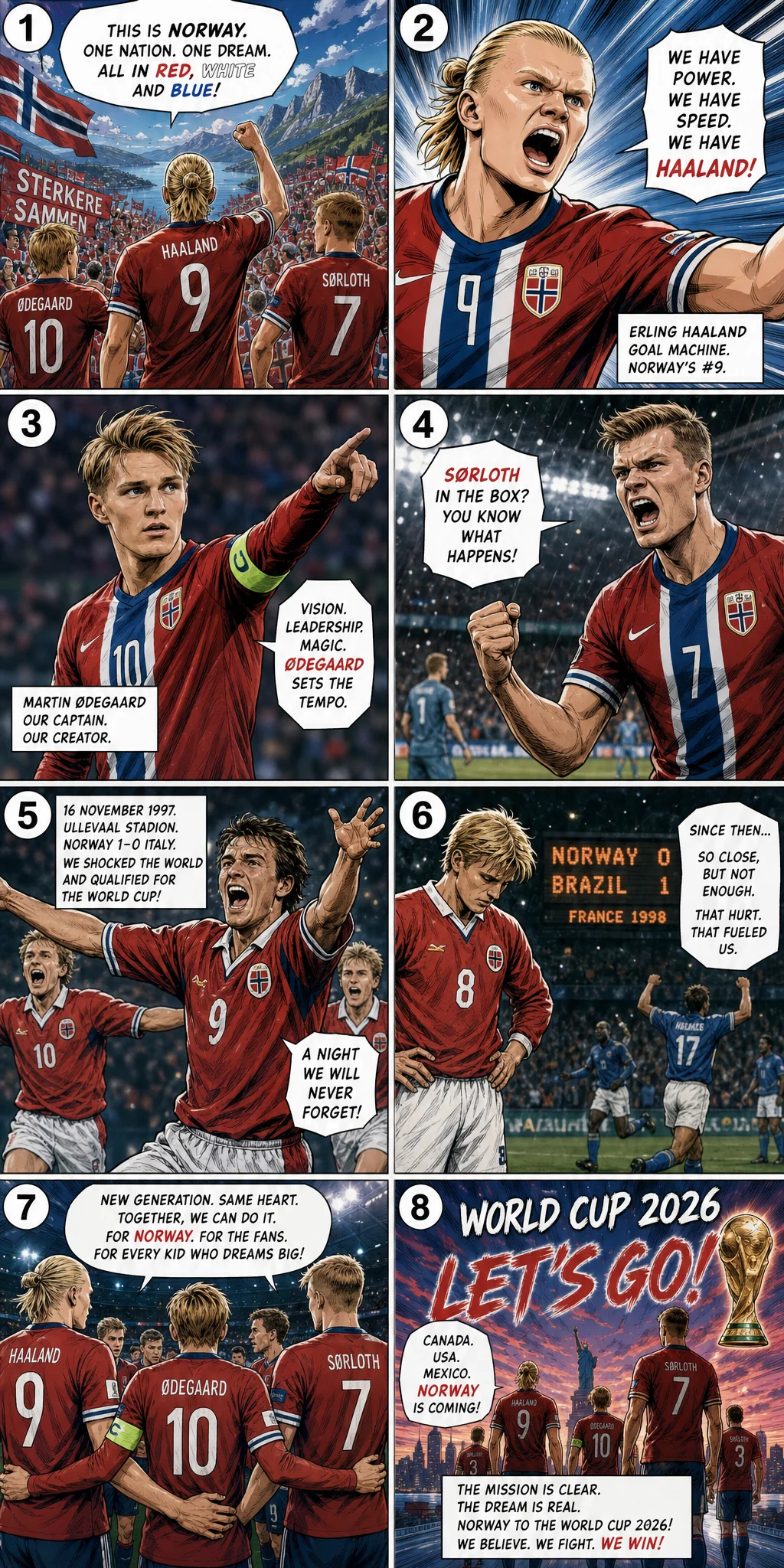
8-panel comic about Norway national football team and their journey to the 2026 FIFA World Cup.
Published: June 5, 2026
Norway National Football Team: The Nordic Renaissance
The Norway national football team, known as "Løvene" — The Lions — represents a football nation that has experienced dramatic fluctuations in its competitive fortunes, from the heights of the 1990s (when Norway reached number two in the FIFA World Rankings) to the depths of a 20-year tournament drought. Norway's qualification for the 2026 FIFA World Cup marks the return of Nordic football's sleeping giant, driven by a generation of talent that may be the most gifted in the nation's history. The combination of Erling Haaland — arguably the world's most lethal goalscorer — and Martin Ødegaard has transformed Norwegian football from afterthought to legitimate contender.
HISTORICAL FOUNDATIONS
Football arrived in Norway in the late nineteenth century, introduced by British sailors and merchants who brought the game to the coastal cities of Bergen, Oslo (then Kristiania), and Trondheim. The Football Association of Norway was founded in 1902, and the national team played its first international match in 1908 — a 11-3 defeat to Sweden, an inauspicious beginning that would be exceeded in embarrassment only by the 12-0 defeat to Denmark in 1917.
For most of the twentieth century, Norway was European football's northern afterthought — a nation where winter made outdoor sport impossible for months each year, where skiing and winter sports dominated the athletic culture, and where football infrastructure lagged behind the continent's developed football nations. Olympic football provided Norway's primary international achievement: a bronze medal at the 1936 Berlin Games, secured with a 3-2 victory over hosts Germany in front of Adolf Hitler — a result that carries historical significance beyond sport.
Norway's unexpected 2-1 victory over England in a 1981 World Cup qualifier — a result that prompted the legendary Norwegian radio commentator Bjørge Lillelien to deliver his famous "Your boys took a hell of a beating!" tirade, listing British historical and cultural figures who had been defeated ("Maggie Thatcher, can you hear me?") — remains the nation's most famous single match. The 1990s, under coach Egil "Drillo" Olsen, brought sustained success: qualification for the 1994 World Cup in the United States (the first since 1938), for the 1998 World Cup in France (where Norway famously defeated Brazil 2-1 in the group stage), and for Euro 2000.
The Drillo era defined Norwegian football's modern identity: a direct, physically imposing style based on long balls, aerial dominance, defensive organization, and set-piece mastery. It was not beautiful, but it was effective. Norway reached number two in the FIFA World Rankings in 1993 and 1995 — an achievement that, in retrospect, seems almost impossible for a nation of just over five million people with a limited football infrastructure.
THE LONG DROUGHT
The twenty-year period between Norway's Euro 2000 appearance and the current era was characterized by frustration and false dawns. The generation that had achieved ranking peaks retired, and the replacement generation did not match their quality. Promising qualification campaigns repeatedly collapsed at critical moments. The domestic Eliteserien, while respected in Nordic football terms, did not produce players at the level required for international competitiveness.
The absence from major tournaments subjected Norwegian football to a cycle of media criticism, public disengagement, and structural questions about the nation's football development model. Youth participation remained high, and the domestic league maintained stable support, but the national team was a source of national embarrassment rather than pride.
THE HAALAND-ØDEGAARD ERA
The transformation of Norwegian football has been driven by two generational talents whose emergence has fundamentally altered the nation's competitive prospects. Erling Haaland is a physical phenomenon — a 6'4" striker with elite-level acceleration, extraordinary physical power, and a goalscoring instinct that has produced numbers unmatched in modern football. His record at Manchester City — 52 goals in 53 appearances across all competitions in his debut season, breaking the Premier League single-season scoring record — represents the most prolific goalscoring rate in the history of the English top division. For Norway, Haaland has scored at a rate that places him on a trajectory to become the nation's all-time leading goalscorer before his 25th birthday.
Martin Ødegaard is Haaland's creative counterpart — the Arsenal captain and midfield orchestrator whose vision, passing, and leadership have made him one of the Premier League's most admired players. Ødegaard's journey from teenage prodigy (becoming the youngest player in Real Madrid history at age 16) to mature captain of one of England's biggest clubs represents the modern Norwegian footballer archetype: technically sophisticated, tactically intelligent, and psychologically resilient.
Beyond the two superstars, Norway possesses a supporting cast of professionals competing in Europe's top leagues that provides a depth of quality unprecedented in the nation's history. Alexander Sørloth, the tall forward who shared the La Liga Golden Boot, provides the alternative attacking option. Emerging midfield talents developed in European academies and the Eliteserien provide tactical flexibility and technical quality. The defensive unit, historically Norway's strength (the Drillo era was built on a back three/five), has been modernized with ball-playing defenders capable of supporting the team's more progressive attacking approach.
FOOTBALL AND NORWEGIAN CULTURE
Norwegian football culture reflects the nation's broader social values: egalitarianism, connection to nature, and a healthy skepticism of hierarchy and authority. The domestic Eliteserien operates on a fraction of the resources available to Europe's major leagues, yet maintains passionate local followings and a developmental focus that has begun producing internationally competitive players.
Women's football in Norway has achieved greater historical success than the men's game — the women's national team won the 1995 World Cup, reached multiple European Championship finals, and produced the Ballon d'Or-winning Ada Hegerberg. The integration of women's football into the broader Norwegian football culture — facilitated by social attitudes toward gender equality that are among the most progressive in the world — has created a more comprehensive football ecosystem.
The "Drillo style" of the 1990s — pragmatic, direct, physically oriented — created a tension with Norwegian football's self-image. The current team, with its technically sophisticated stars, represents a different vision of Norwegian football — one that acknowledges the nation's physical and mental attributes (outdoor toughness, collective discipline) while aspiring to a more aesthetically pleasing expression.
THE PATH FORWARD
Norway enters the 2026 World Cup as one of the tournament's most intriguing wildcards — a team with two genuine world-class players (Haaland and Ødegaard) and a supporting cast of professionals operating at high levels, but without the institutional tournament experience that defines more established football powers.
The tactical approach has evolved from the Drillo pragmatism to a more progressive, possession-oriented style that leverages Ødegaard's creativity and Haaland's unique physical and finishing attributes. The challenge is providing adequate service to Haaland — Manchester City's system, designed by Pep Guardiola with world-class creators in every position, maximizes Haaland's strengths in ways the national team cannot replicate. Ødegaard's ability to find spaces, to deliver passes of the quality that Haaland requires, will determine Norway's attacking effectiveness.
For Norway, the 2026 World Cup is about arrival — the nation's return to football's highest stage, the validation of a generation's talent, and the opportunity to demonstrate that Norwegian football has moved beyond the Drillo stereotypes into a new era of competitive ambition. The Nordic renaissance has been building for years. The world is about to see what Norway has become.