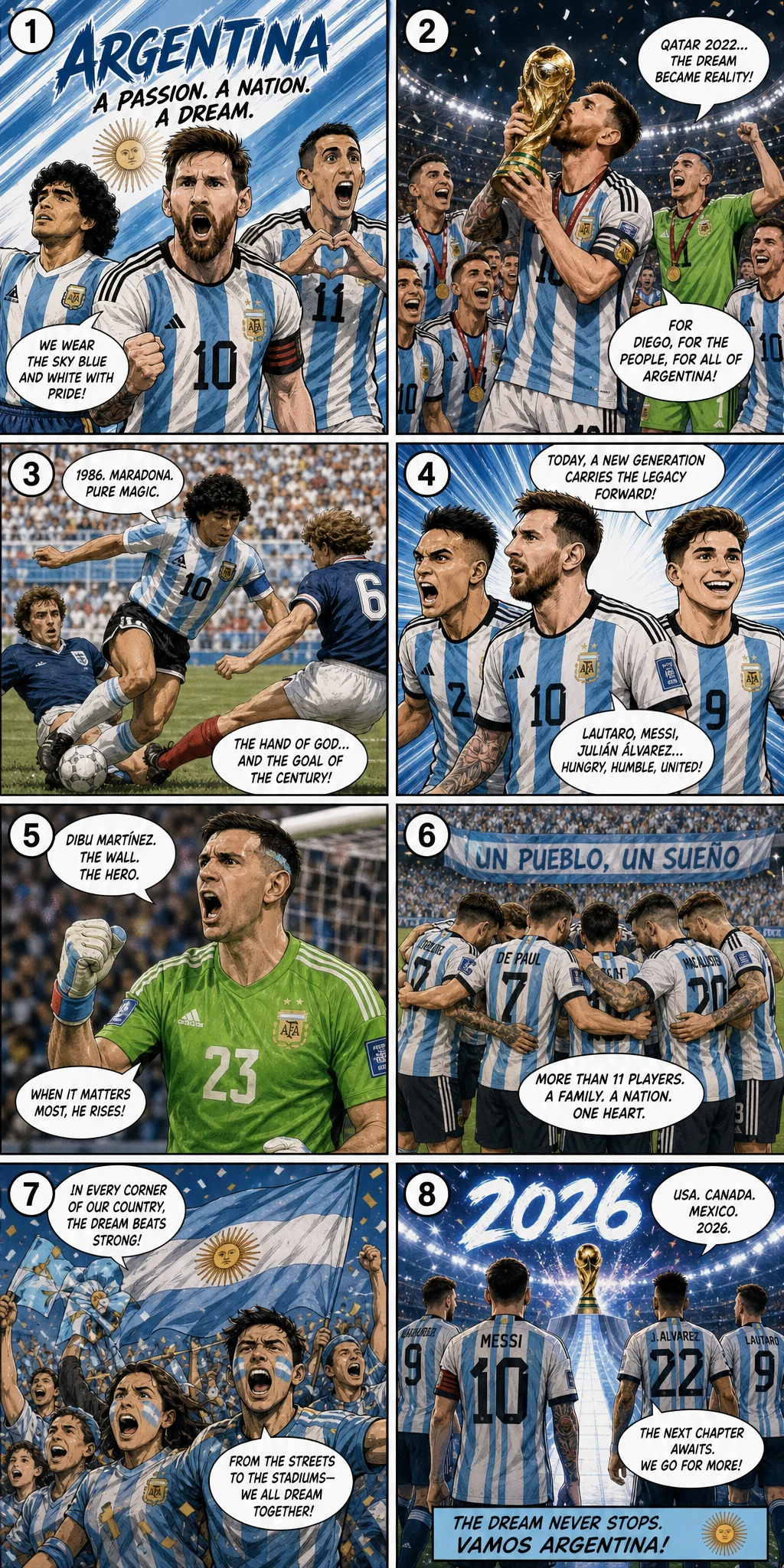
Argentina: Journey to 2026
8-panel comic about Argentina national football team and their journey to the 2026 FIFA World Cup.
Published: June 5, 2026
Argentina National Football Team: La Albiceleste's Eternal Flame
The Argentina national football team, known as "La Albiceleste" — The White and Sky Blue — for the striped jerseys that have been worn by some of the most transcendent talents in football history, enters the 2026 FIFA World Cup as the defending champion. Argentina's victory in Qatar 2022, secured through one of the greatest World Cup finals ever played, ended a 36-year title drought and delivered the crowning achievement to Lionel Messi's incomparable career. Now La Albiceleste arrives in North America seeking something even more difficult than winning once: proving that the triumph was not a final gift but the beginning of a new era.
HISTORICAL FOUNDATIONS
Football arrived in Argentina in the late nineteenth century through British immigrants, with the first recorded match played in 1867 in Buenos Aires. The Argentine Football Association was founded in 1893 (the oldest in South America), and the sport quickly became woven into the fabric of Argentine national identity. Argentina's early international football was defined by South American competition — the first official match against Uruguay in 1901 inaugurated the continent's oldest rivalry — and by the Copa América, which Argentina has won fifteen times.
Argentina's World Cup history is a chronicle of genius and tragedy. The 1930 team reached the final of the inaugural tournament in Uruguay, losing 4-2 to the hosts. The 1966 team, featuring a generation of domestic stars, fell victim to controversial officiating against England. The 1978 World Cup, hosted by Argentina under the military dictatorship, delivered the nation's first title — a 3-1 victory over the Netherlands in extra time, Mario Kempes scoring twice and captaining a team whose triumph was forever entangled with the political context of a brutal regime.
The 1986 World Cup in Mexico belonged to Diego Maradona. His individual performance across the tournament — five goals and five assists, including the two most analyzed goals in World Cup history (the "Hand of God" and the "Goal of the Century," scored within four minutes of each other against England in the quarter-final) — represents the most dominant individual World Cup campaign ever witnessed. The final against West Germany, a 3-2 victory secured after surrendering a two-goal lead, was the apotheosis: Maradona lifting the World Cup trophy in the Azteca Stadium, the fulfillment of a destiny written from the slums of Villa Fiorito.
The post-Maradona decades were defined by near-misses and the weight of the number 10 shirt. The 2014 World Cup final, lost 1-0 to Germany in extra time at the Maracanã, was the most painful — Messi, the heir to Maradona, unable to lift the trophy, the image of him staring at the golden trophy as he collected his Golden Ball award becoming a symbol of unfulfilled destiny. Three consecutive major final defeats — the 2014 World Cup and back-to-back Copa América finals in 2015 and 2016 — prompted Messi to briefly retire from international football.
LEGENDS OF LA ALBICELESTE
Diego Maradona is, alongside Pelé, one of the two players around whom the debate about football's greatest ever revolves. His genius — the impossible control, the vision, the competitive fury — transcended sport and became a cultural phenomenon. Maradona was Argentina's id: passionate, flawed, brilliant, self-destructive, beloved beyond reason. His death in 2020 provoked a global outpouring of grief that reflected his unique place in the human imagination.
Lionel Messi has resolved the impossible tension between Maradona's legacy and his own career with the 2022 World Cup triumph. His seven Ballon d'Or awards, his record goalscoring for Barcelona and Argentina, and now his World Cup championship have made him, by the judgment of the broadest consensus, the greatest footballer of all time. The 2022 World Cup final against France — two goals in normal time, a converted penalty in the shootout, a performance of leadership and competitive fury that seemed to channel Maradona himself — was the masterpiece that completed the collection.
Alfredo Di Stéfano, the "Blond Arrow" who led Real Madrid to five consecutive European Cups, was born in Argentina and represented both Argentina and Spain internationally — a testament to the shifting national allegiances of his era. Mario Kempes, the hero of 1978, was Argentina's first World Cup-winning talisman. Gabriel Batistuta, "Batigol," scored 56 goals in 78 international appearances and was the most feared striker of his generation. Daniel Passarella captained the 1978 champions. Javier Zanetti's elegance and longevity earned him 145 caps.
THE MODERN CHAMPIONS
Argentina enters the 2026 World Cup as defending champion under the continued leadership of Lionel Scaloni, the understated coach who transformed a team in crisis after the 2018 World Cup into continental and world champions. The Scaloni era has been defined by tactical intelligence, collective unity, and the harnessing of Messi's genius within a functional team structure rather than depending entirely upon it.
The core of the 2022 championship team returns with the confidence of proven winners. Emiliano Martínez, the goalkeeper whose penalty-shootout heroics against the Netherlands and France made him a national folk hero, provides the shot-stopping and psychological warfare that have become his trademark. Cristian Romero, the aggressive, ball-playing center-back, anchors a defensive unit that has been strengthened by the addition of emerging talents. Enzo Fernández and Alexis Mac Allister, the midfield partners who were revelations in Qatar, provide the progressive passing and tactical intelligence that define Argentina's possession-based approach.
The forward line beyond Messi features the emerging generation of Argentine attackers: Julián Álvarez, the Manchester City striker whose intelligent movement, clinical finishing, and willingness to press from the front made him an essential complement to Messi in Qatar; and young talents emerging from Argentine clubs and European academies who represent the continuation of the nation's historic production of attacking genius. The question of whether Messi, in his late 30s by 2026, can sustain World Cup-level performance across a tournament's duration is the central variable of Argentina's title defense.
FOOTBALL AND ARGENTINE CULTURE
Football in Argentina is not a pastime or an entertainment product — it is a fundamental component of national identity, discussed with the intensity and analytical depth of religious scripture. The sport arrived with British immigrants but was transformed by Argentine culture into something entirely distinct: a fusion of European tactical organization and South American individual expression, played with a passion that borders on violence and celebrated with a joy that borders on ecstasy.
The domestic Primera División, anchored by the superclásico between Boca Juniors and River Plate, is among world football's most passionate and chaotic environments. The Boca-River rivalry divides Buenos Aires and the nation along class lines (Boca associated with the working-class, immigrant communities of La Boca; River with the more affluent northern neighborhoods), and match days at La Bombonera and El Monumental produce atmospheres of religious intensity.
The political dimensions of Argentine football are inescapable. The 1978 World Cup's association with the military dictatorship remains a contested memory. Maradona's leftist political activism, his friendship with Fidel Castro and Hugo Chávez, and his vocal criticism of FIFA and the football establishment made him a political figure as well as a sporting one. Messi's relationship with Argentina has been more complex — his departure to Barcelona at age 13, his European accent, his perceived emotional distance from the national team — but the 2022 triumph erased all doubts. Messi is now, unreservedly, Argentina's.
THE PATH FORWARD
Argentina enters the 2026 World Cup as defending champion and one of the tournament favorites. The team's collective understanding — the product of the Scaloni era's tactical coherence — and the confidence that comes from having won the ultimate prize provide a foundation that talent alone cannot replicate. The expanded tournament format introduces new variables, but Argentina's balance of experience and youth should be an advantage over the tournament's duration.
The tactical approach continues to blend possession-based control with the devastating transitions that Messi, Álvarez, and the emerging attackers can execute. The midfield trio provides technical security and tactical intelligence. The defensive unit, historically Argentina's vulnerability, has been transformed under Scaloni into one of the world's best-organized international back lines. Emiliano Martínez's presence provides the psychological edge that every championship team requires.
For Argentina, the 2026 World Cup is about legacy — the opportunity to prove that the Qatar triumph was not a beautiful ending but a glorious beginning. La Albiceleste carries the weight of defending champions and the eternal flame of Argentine football passion. The quest for the fourth star has become the quest for more than four. The defending champions march to North America with Messi's final World Cup chapter to be written — and a nation's heart in their hands.