Algeria: Journey to 2026
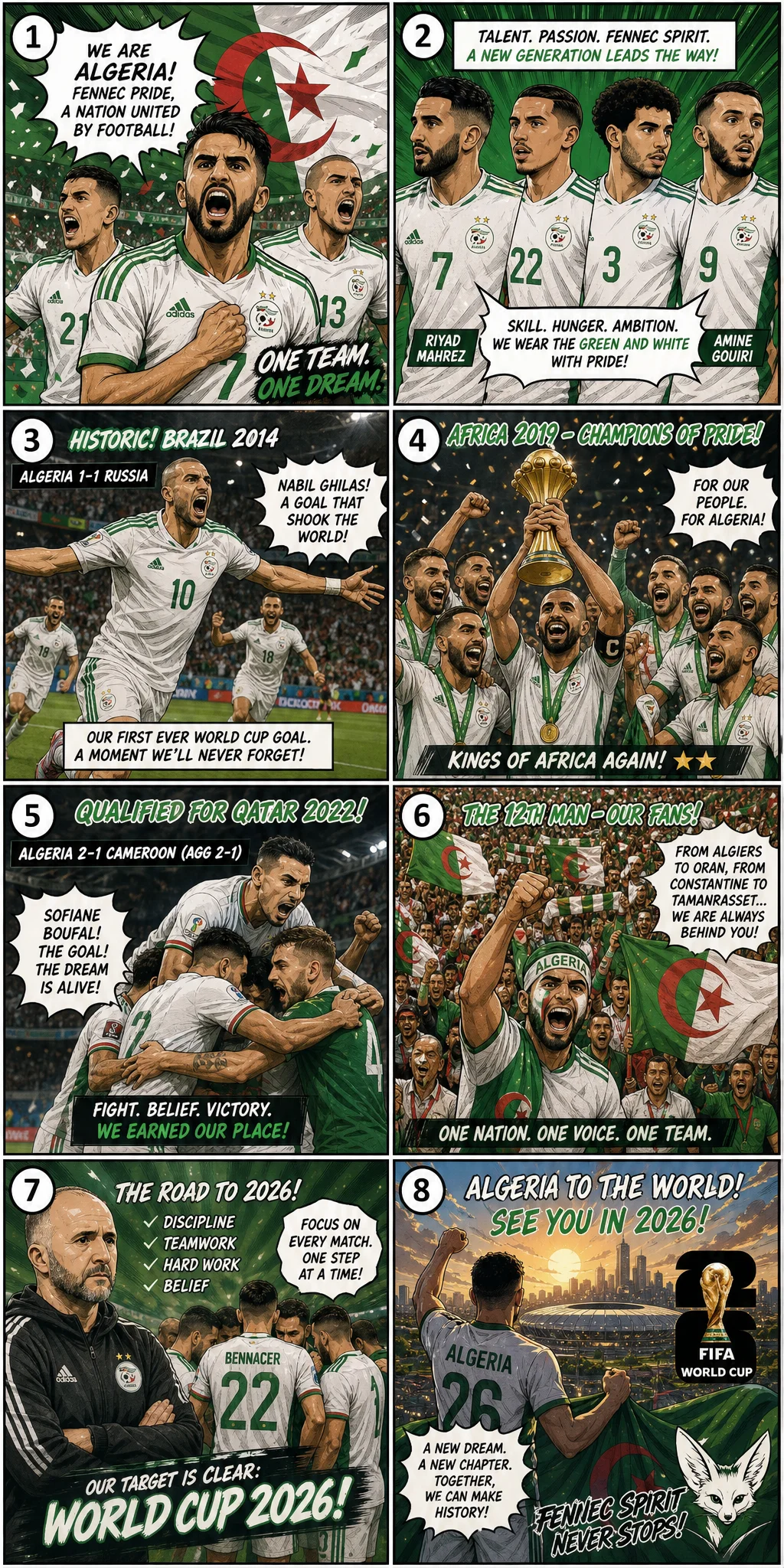
8-panel comic about Algeria national football team and their journey to the 2026 FIFA World Cup.
Published: June 5, 2026
Algeria National Football Team: The Desert Foxes' Fierce Return
The Algeria national football team, known as "Les Fennecs" — The Desert Foxes — for the small, large-eared fox native to the Sahara that symbolizes cunning, adaptability, and resilience, represents one of North African football's proudest and most passionate traditions. Algeria's football story encompasses the struggle for independence, the emergence of a golden generation in the 1980s, decades of frustration, and the triumphant renaissance of the 2010s. The 2026 FIFA World Cup offers the Desert Foxes an opportunity to reclaim their place among African and global football's elite after the disappointment of missing the 2022 tournament.
HISTORICAL FOUNDATIONS
Football arrived in Algeria during the French colonial period, with the first clubs founded by European settlers in the coastal cities of Algiers, Oran, and Constantine in the late nineteenth and early twentieth centuries. Algerian Muslims were initially excluded from these clubs, leading to the formation of separate Muslim sporting associations that became focal points of anti-colonial identity. The Front de Libération Nationale (FLN) famously assembled a "national team" of Algerian footballers playing professionally in France — including stars like Rachid Mekhloufi and Mustapha Zitouni — who abandoned their French clubs in 1958 to form a team that toured the world promoting the Algerian independence struggle. This FLN team never played an official FIFA match, but its existence demonstrated football's political significance in the Algerian national movement.
The Algerian Football Federation was founded in 1962, the year of independence following a brutal eight-year war of liberation. The national team's first official international matches established Algeria as a competitive North African football nation, and the team's rapid development led to its first major achievement: the 1975 Mediterranean Games gold medal.
Algeria's World Cup debut came at the 1982 tournament in Spain — and produced one of the most controversial moments in the competition's history. Under coach Mahieddine Khalef and featuring stars like Lakhdar Belloumi, Rabah Madjer, and Salah Assad, Algeria shocked the football world with a 2-1 victory over West Germany in their opening match. Belloumi's winning goal — a sweeping team move finished with a clinical strike — announced Algeria as a legitimate football force. A subsequent 3-2 victory over Chile positioned Algeria for knockout qualification, but the infamous "Disgrace of Gijón" — West Germany and Austria playing out a mutually beneficial 1-0 result that eliminated Algeria — denied the Desert Foxes progression. The German-Austrian collusion prompted FIFA to change tournament rules, mandating that final group matches be played simultaneously — a reform known as the "Algeria Rule."
LEGENDS OF THE DESERT FOXES
Rabah Madjer is Algeria's greatest ever footballer and the scorer of African football's most iconic goal. His back-heeled equalizer for Porto against Bayern Munich in the 1987 European Cup Final — an act of audacious improvisation that gave Porto the momentum to secure a 2-1 victory and their first European championship — is one of the most memorable goals in football history. Madjer's elegance, creativity, and big-game temperament made him a legend at Porto and the face of Algerian football's golden era.
Lakhdar Belloumi scored Algeria's winning goal against West Germany in 1982 — a moment of technical quality and historical significance. His vision, passing, and goalscoring from midfield made him one of African football's greatest playmakers. Belloumi's entire career was spent in Algeria (primarily with GC Mascara and MC Oran) rather than in Europe, but his quality was recognized across the continent. He was named African Footballer of the Year in 1981.
Riyad Mahrez is the modern standard-bearer of Algerian football — a winger whose technical brilliance, left-footed magic, and big-game performances at Leicester City (where he was PFA Players' Player of the Year in the miraculous 2015-16 Premier League title season) and Manchester City (where he won four Premier League titles and a Champions League) have made him one of Africa's most decorated footballers. Mahrez's 30 goals in over 90 international appearances, his captaincy of the national team, and his role in Algeria's 2019 Africa Cup of Nations triumph have cemented his legacy.
THE MODERN RENAISSANCE
Algeria's 2019 Africa Cup of Nations victory in Egypt — secured with a 1-0 victory over Senegal in the final, Baghdad Bounedjah's deflected early goal proving decisive — ended a 29-year continental title drought. Under coach Djamel Belmadi, the Desert Foxes played intelligent, technically sophisticated football that honored the nation's footballing tradition while demonstrating modern tactical organization. The celebrations across Algeria — and across the Algerian diaspora in France, where millions with Algerian heritage celebrated — demonstrated the national unity that football success can generate.
The 2022 World Cup qualification campaign ended in heartbreaking fashion, with Algeria eliminated by Cameroon on away goals in a playoff — a result that prompted Belmadi's temporary resignation and deep national disappointment. The qualification for the 2026 tournament represents redemption, a return to the global stage that this talented generation deserves.
The current squad blends experienced campaigners with emerging talents. Islam Slimani, Algeria's all-time leading goalscorer with over 40 international goals despite being in the latter stages of his career, provides the physical presence and goal-scoring instinct that have defined his career at Sporting Lisbon, Leicester City, Lyon, and various clubs. Younger forwards and midfielders developed in European academies — particularly in France, where a significant portion of the Algerian squad plays or was developed — provide the technical and athletic qualities that characterize modern Algerian football.
FOOTBALL AND ALGERIAN CULTURE
Football in Algeria occupies a uniquely important position in national identity — intertwined with the independence struggle, the post-colonial nation-building project, and the complex relationship with France that continues to shape Algerian society. Matches between Algeria and France carry political and emotional weight that transcends sport, representing the unresolved tensions of colonial history.
The domestic Ligue Professionnelle 1, anchored by historic clubs like JS Kabylie, USM Alger, MC Alger, and CR Belouizdad, maintains passionate followings. The Kabylie region's distinctive football culture — JS Kabylie's historic success, the region's Berber identity expressed through football support — adds an ethnic dimension to the national football landscape. The Algiers derby between USM Alger and MC Alger divides the capital with traditional intensity.
The Algerian diaspora in France — numbering in the millions, the product of colonial history and post-colonial migration — represents both a football talent pipeline and a cultural bridge between nations. Many current national team players were born or developed in France, choosing to represent Algeria through family heritage. This diaspora dimension — Algerians in France celebrating the national team's successes with car horns and flag-waving on the Champs-Élysées — has become an integral part of the Desert Foxes' story.
THE PATH FORWARD
Algeria enters the 2026 World Cup determined to advance beyond the group stage — a historic achievement that would improve on the 1982, 1986, 2010, and 2014 campaigns, all of which ended in early elimination. The expanded tournament format provides a more favorable structure, and Algeria's combination of technical quality, tactical organization, and tournament experience makes progression a realistic ambition.
The tactical approach under the coaching staff emphasizes possession-based attacking football when circumstances permit, defensive organization against superior opponents, and the technical quality that has always characterized Algerian football. Set pieces and individual moments of brilliance — the Mahrez free-kick, the Slimani header, the emerging talents' contribution — will be critical in tight matches.
For Algeria, the 2026 World Cup is about representation and respect. The Desert Foxes carry the pride of North African football, the memory of the FLN team that sacrificed professional careers for national liberation, and the hopes of a nation that loves football with a passion that borders on the spiritual. The foxes are hunting once more.