Austria: Journey to 2026
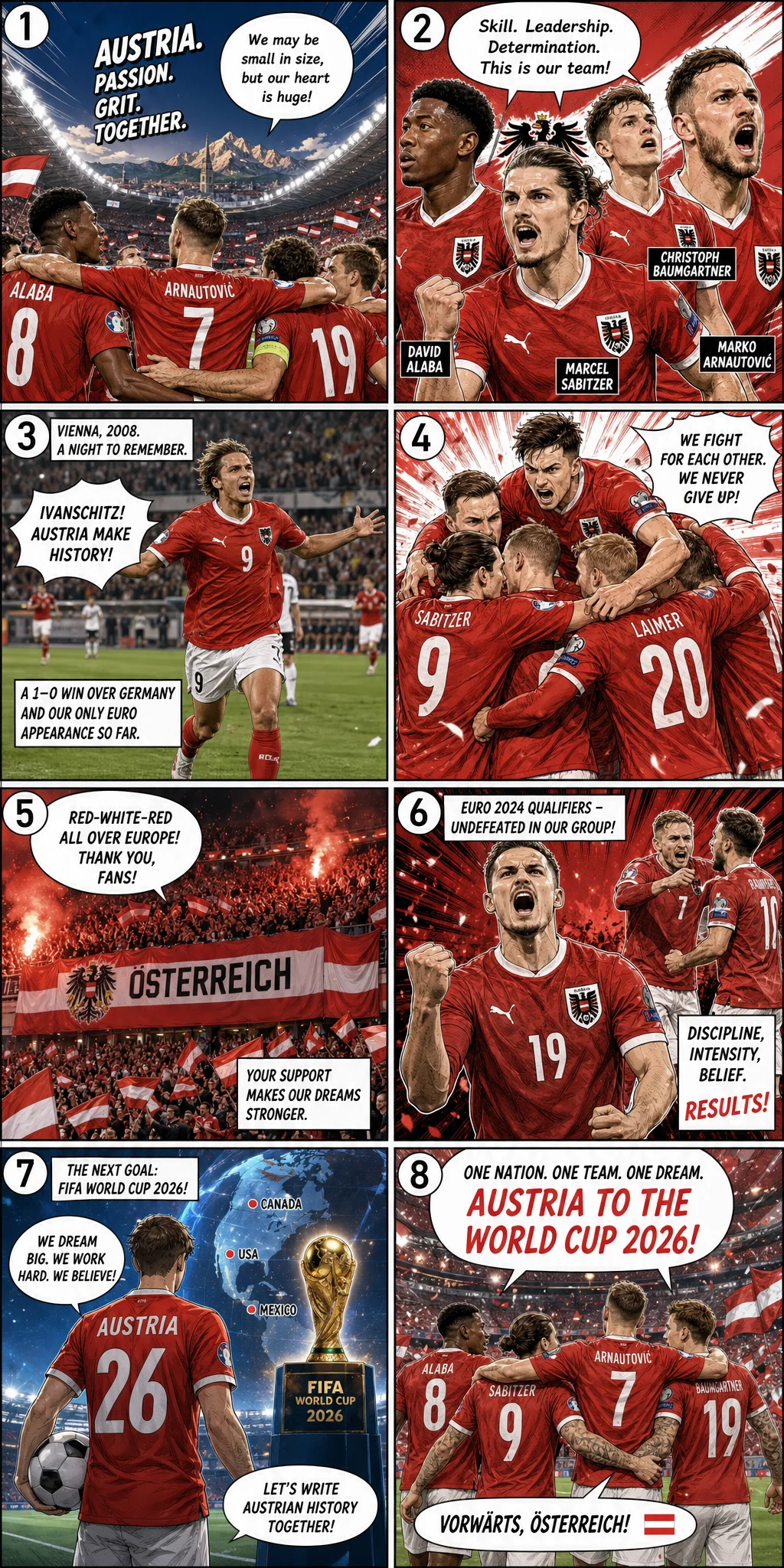
8-panel comic about Austria national football team and their journey to the 2026 FIFA World Cup.
Published: June 5, 2026
Austria National Football Team: The Alpine Symphony's New Movement
The Austria national football team, known as "Das Team," carries a football heritage that is richer and more romanticized than the nation's recent tournament performances might suggest. Once the epicenter of Central European football's most sophisticated tactical tradition — the "Wunderteam" of the 1930s — Austria has experienced decades of underachievement relative to its footballing history. The 2026 FIFA World Cup represents an opportunity for a new generation, shaped by one of European football's most innovative coaching cultures, to reconnect Das Team with its glorious past and establish a new standard of Austrian football excellence.
HISTORICAL FOUNDATIONS
Football arrived in Austria in the 1890s through the cultural connections of the Austro-Hungarian Empire, with British expatriates establishing the first clubs in Vienna. The Austrian Football Association was founded in 1904, and the sport spread rapidly through the imperial capital's café society — football discussed with the same intellectual intensity as literature, music, and politics in the establishments that gave Vienna its distinctive cultural atmosphere.
The "Wunderteam" (Wonder Team) of the early 1930s represents the foundational myth of Austrian football. Under coach Hugo Meisl and built around the creative genius of Matthias Sindelar — the "Mozart of Football," a player of such balletic elegance that his movement inspired musical metaphors — Austria developed a style of sophisticated passing, positional fluidity, and attacking flair that influenced the development of football across Central Europe. The Wunderteam went undefeated in 14 consecutive international matches between 1931 and 1932, defeating Germany 5-0 and 6-0, Switzerland 8-1, and Scotland's celebrated team 5-0 in Vienna. They were widely considered the best team in the world and favorites for the 1934 World Cup.
The 1934 World Cup in Italy, won by the hosts under Mussolini's regime in controversial circumstances, ended Austria's dream — a 1-0 semi-final defeat to Italy (with allegations of biased refereeing) and a third-place finish. The Anschluss (Germany's annexation of Austria in 1938) forcibly dissolved Austrian football into the German system. Sindelar, who had refused to play for the unified German-Austrian team, died in mysterious circumstances in 1939 — officially a gas leak, though conspiracy theories of Nazi retribution persist. The Wunderteam was destroyed by history, and Austrian football entered a long period of diminished relevance.
Post-war Austrian football achieved respectable results — third place at the 1954 World Cup, reaching the quarter-finals in 1978 (the "Miracle of Córdoba," a 3-2 victory over West Germany that remains Austria's most famous modern result) — but never recaptured the Wunderteam's magic. The 1990s and 2000s were a period of consistent qualification without tournament breakthroughs.
LEGENDS OF DAS TEAM
Matthias Sindelar, "Der Papierene" (The Paper One) for his slender build, is Austrian football's immortal. His elegance, his creativity, his status as a symbol of Viennese cultural sophistication — and his tragic, politically-charged death — make him the most romanticized figure in Austrian sporting history. The "Sindelar goal" against Scotland in 1931 — an angled chip struck with the outside of his foot, celebrated by leaping onto the crossbar — is Austrian football's most iconic image.
Hans Krankl was the modern hero of the "Miracle of Córdoba" — his two goals against West Germany at the 1978 World Cup, including the 88th-minute winner that eliminated the defending champions, made him a national legend. Krankl's goal-scoring record at Rapid Vienna and Barcelona, his 1978 European Golden Boot, and his distinctive personality (he later became a popular singer) made him Austria's most beloved modern footballer.
Toni Polster scored 44 goals in 95 international appearances, making him Austria's all-time leading goalscorer. His career at clubs including Sevilla and Torino, combined with his international goal-scoring consistency throughout the 1980s and 1990s, made him the face of Austrian football during its most consistent modern era. Andreas Herzog, with 103 caps, provided midfield creativity and set-piece mastery. Herbert Prohaska, the elegant midfielder of the 1970s and 1980s, bridged the Krankl and Polster generations.
THE MODERN ERA
Austria enters the 2026 World Cup with a squad that reflects the nation's evolving football identity. Under the coaching of Ralf Rangnick — the German tactical innovator credited as the "godfather of gegenpressing" who influenced an entire generation of German coaches including Jürgen Klopp — Austria has adopted an aggressive, high-intensity pressing style that maximizes the team's athletic qualities and collective organization.
David Alaba, the Real Madrid defender and national team captain, has been Austria's most accomplished modern footballer — a player whose versatility (center-back, left-back, central midfield), technical quality, and leadership have made him one of European football's most respected figures. His career at Bayern Munich (where he won 10 Bundesliga titles and two Champions Leagues) and Real Madrid has established the standard for Austrian football excellence. His absence from playing due to injury has been a challenge the team has had to adapt to, with other players stepping into leadership roles.
Marcel Sabitzer, the Borussia Dortmund midfielder whose powerful shooting, creative passing, and goal-scoring threat from midfield make him Austria's most dangerous attacking midfielder, has emerged alongside Alaba as the team's creative fulcrum. Marko Arnautović, the physically imposing forward whose club career at Inter Milan, Bologna, West Ham United, and Stoke City has demonstrated quality when fully engaged, provides the attacking focal point — a player whose talent has occasionally been complicated by temperament but whose best performances have been transformative.
The Red Bull football network — RB Leipzig, Red Bull Salzburg, and the associated clubs — has been crucial to Austrian football's development. Salzburg's Champions League appearances, their academy's production of talent (including Erling Haaland, Sadio Mané, and numerous Austrian internationals), and the tactical philosophy shared across the network have elevated Austrian football's professional standards.
FOOTBALL AND AUSTRIAN CULTURE
Austrian football culture reflects the nation's broader identity — sophisticated, historically conscious, and existing in a complex relationship with its German neighbor. The rapid Wien-Austria Wien rivalry divides the capital along class, neighborhood, and cultural lines, with Rapid associated with the working-class districts and Austria Wien with the intellectual and artistic community.
The country's football tradition is often discussed in terms of what was lost — the Wunderteam, Sindelar's tragedy, the cultural sophistication of Viennese café football — rather than what has been achieved. This nostalgia coexists with the modern reality: Austria is a wealthy European nation with excellent sporting infrastructure, a technically proficient domestic league, and a generation of players competing at the highest levels of European club football.
The Austrian Bundesliga, while not among Europe's financial elite, provides competitive football and a development pathway. Red Bull Salzburg's dominance of the domestic league — winning 10 consecutive titles before Sturm Graz's recent triumph — has created debates about competitive balance, but the club's contribution to Austrian talent development is undeniable.
THE PATH FORWARD
Austria enters the 2026 World Cup with ambitions shaped by Rangnick's tactical philosophy: aggressive, front-foot, pressing-based football that seeks to dominate opponents through collective intensity and rapid transitions. The style is demanding — physically and mentally — but it gives Austria an identity that can trouble technically superior opponents who are uncomfortable facing organized pressing.
Progression from the group stage, which Austria last achieved in 1982, is the realistic target. The team's collective organization, work rate, and tactical discipline compensate for the absence of the individual brilliance that defines tournament favorites. Set pieces — with the aerial threats of center-backs and the delivery quality of Sabitzer and the midfield technicians — provide a reliable goal-scoring avenue.
For Austria, the 2026 World Cup is about reconciliation — between the romantic past and the pragmatic present, between the Wunderteam's legend and the modern team's ambition. Das Team carries a football history that belongs to the sport's most sophisticated traditions. The Alpine symphony begins a new movement.