Czechia: Journey to 2026
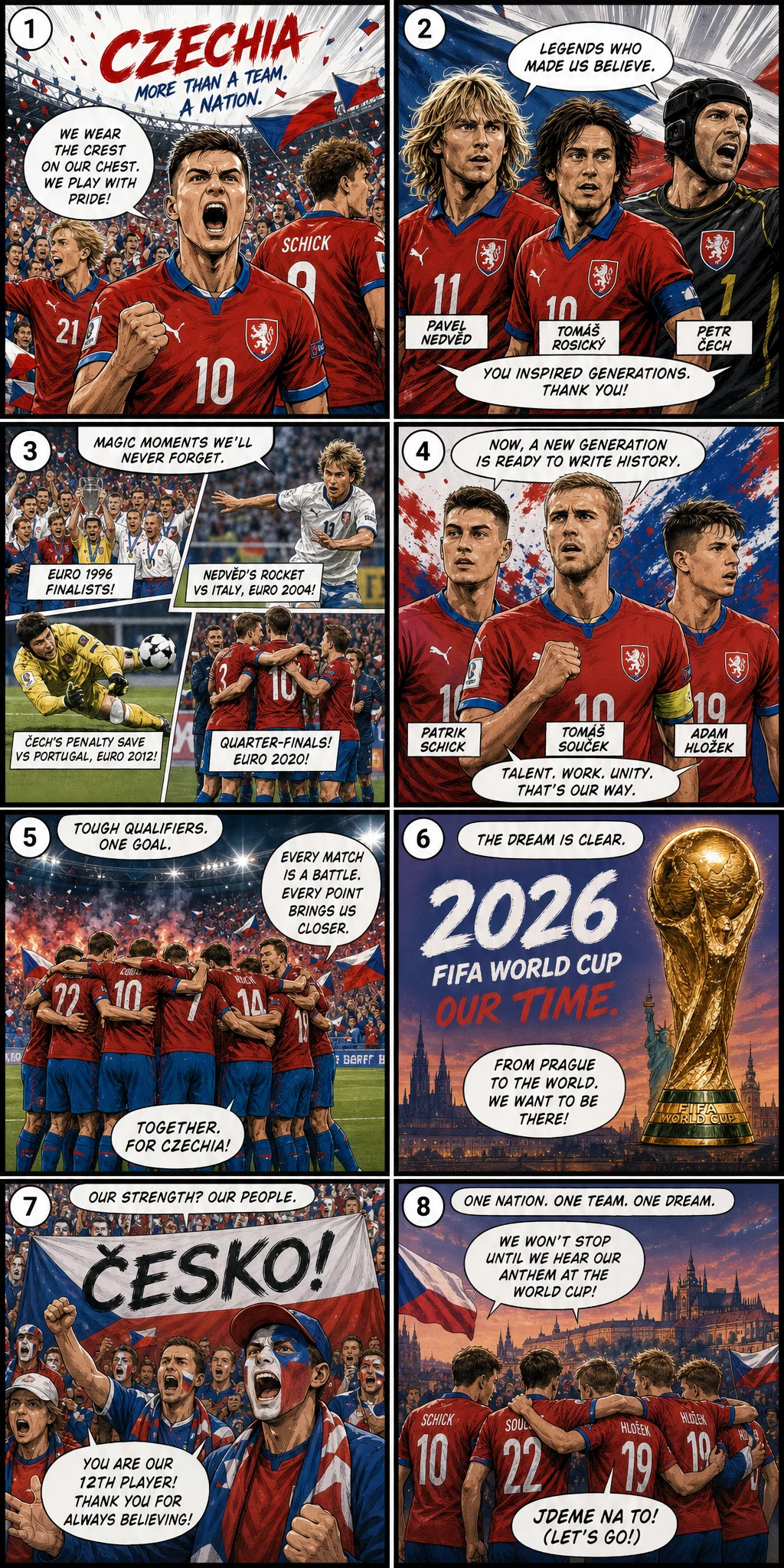
8-panel comic about Czechia national football team and their journey to the 2026 FIFA World Cup.
Published: June 5, 2026
Czechia National Football Team: The Lions of Central Europe
The Czechia national football team, known as "Národní tým" and carrying the proud symbol of the Bohemian lion, represents a football tradition rich in technical excellence, tactical sophistication, and a history of producing players who elevate the beautiful game to an art form. As participants in the 2026 FIFA World Cup, placed in Group A alongside hosts Mexico, South Africa, and South Korea, the Czechs bring generations of football heritage to North America's grandest sporting stage.
HISTORICAL FOUNDATIONS
The roots of Czech football stretch deep into the soil of Central Europe, where the sport flourished in the late nineteenth century amid the cultural and intellectual ferment of Bohemia and Moravia. The first football clubs appeared in Prague during the 1890s, founded by students and intellectuals who had encountered the game in England and brought it home with missionary zeal. Sparta Prague and Slavia Prague, both founded in the 1890s, became the twin pillars of Czech football — institutions whose fierce rivalry and commitment to attacking football established a national footballing identity.
Czechoslovakia, the unified state that existed from 1918 to 1992, provided the international framework through which Czech football announced itself to the world. The 1934 World Cup saw Czechoslovakia reach the final in Rome, losing 2-1 to host Italy after extra time in a match remembered for its technical quality and dramatic tension. Oldřich Nejedlý's five goals earned him the tournament's Golden Boot, and the team's elegant passing style won admirers across the football world. In 1962, Czechoslovakia reached another World Cup final in Chile, losing 3-1 to a transcendent Brazil side led by Garrincha, but not before Josef Masopust — the midfield genius who would win that year's Ballon d'Or — had given his team the lead with a goal of exquisite quality.
The 1976 European Championship in Yugoslavia produced one of football's most iconic moments: Antonín Panenka's audacious chipped penalty that won the final against West Germany. The "Panenka" — a delicate, almost dismissive dink down the center of the goal as the goalkeeper dived helplessly away — has become a permanent part of football's vocabulary, endlessly imitated by generations of players seeking to replicate its cool brilliance.
LEGENDS OF THE LION
Josef Masopust stands as the greatest Czech footballer of all time. A complete midfielder who combined defensive tenacity with creative vision and goalscoring instinct, he captained Czechoslovakia to the 1962 World Cup final and became the first — and for decades, only — Czech winner of the Ballon d'Or. His legacy transcends statistics: he embodied a philosophy of football as intelligent, beautiful, and dignified.
Pavel Nedvěd, the "Czech Fury," brought relentless energy, ferocious shooting, and indomitable will to Lazio and Juventus, winning the Ballon d'Or in 2003. His flowing blond hair streaming behind him as he covered every blade of grass became one of the defining images of Italian football in the early 2000s. Nedvěd's loyalty to Juventus — remaining with the club after its relegation to Serie B in 2006 — endeared him to fans as a man of principle in an era of mercenaries.
Petr Čech, the goalkeeper with the iconic protective headguard, set Premier League records for clean sheets and established himself as one of the game's greatest shot-stoppers. His 11-year spell at Chelsea yielded four Premier League titles, the Champions League in 2012, and a reputation for meticulous preparation and fearless bravery. Tomáš Rosický, "The Little Mozart," conducted Arsenal's midfield with delicate touches and visionary passing whenever fitness allowed, his injury-plagued career a tantalizing glimpse of what might have been. Karel Poborský's famous lob against Portugal at Euro 96 — a scooped finish from the edge of the box that floated over the stranded goalkeeper — announced the rebirth of Czech football in the post-Czechoslovakia era.
THE MODERN ERA
Since the dissolution of Czechoslovakia in 1993, the Czech Republic — now officially competing as Czechia — has maintained a consistent presence in international football. The Euro 1996 campaign, which ended with a golden-goal defeat to Germany in the final at Wembley, demonstrated that Czech football's technical foundations remained strong. The team has qualified for every European Championship since independence and made its first World Cup appearance as an independent nation in 2006.
The current Czechia squad blends experience with emerging talent. Patrik Schick, the striker whose stunning halfway-line goal against Scotland at Euro 2020 was named goal of the tournament, provides the focal point in attack. His combination of height, technical ability, and clinical finishing makes him a threat in open play and from set pieces. Tomáš Souček, the towering West Ham United midfielder and national team captain, embodies Czech football's virtues: intelligent positioning, aerial dominance, tireless work-rate, and a knack for arriving late in the box to score crucial goals.
Vladimír Coufal, Souček's club teammate at West Ham, provides attacking thrust and defensive reliability from right-back. The emergence of young talents like midfielder Alex Král and forward Adam Hložek, who developed at Sparta Prague before moving to Germany, suggests that the production line of Czech technical excellence continues to operate. The domestic Fortuna Liga, anchored by the historic clubs Sparta Prague, Slavia Prague, and Viktoria Plzeň, remains competitive and continues to develop players for the national team pipeline.
FOOTBALL AND CZECH CULTURE
In Czechia, football is woven into the fabric of daily life. The country possesses one of Europe's highest per-capita rates of football participation, and the sport serves as a social glue across generations. Local clubs dot every town and village, their modest facilities hosting matches every weekend from spring through autumn. The tradition of playing football in the streets, in schoolyards, and on frozen ponds during winter has historically produced players with exceptional technical skills and creative instincts.
The Sparta-Slavia derby, known as the "Prague Derby," is one of Central Europe's most intense sporting rivalries, dividing families and friendships while providing a cultural institution that has endured for over a century. The match combines footballing quality with social, political, and class dimensions — Sparta historically associated with the establishment, Slavia with the intellectual and artistic community — that add layers of meaning beyond the ninety minutes.
Czech football culture values intelligence over athleticism, technique over power. The nation's footballing philosophy — shaped by decades of coaches who emphasized positional play, combination passing, and tactical flexibility — produces players who understand the game at a conceptual level. This "football brain" tradition, combined with typically robust Central European physical attributes, creates a distinctive national style that has proven competitive across eras.
THE PATH FORWARD
Group A presents Czechia with a challenging but navigable path. The opening match against South Africa offers an opportunity to establish momentum, while subsequent fixtures against South Korea and hosts Mexico will test the team's tactical discipline and mental fortitude. The Estadio Azteca clash with Mexico, in particular, will be an examination of character amid one of world football's most intimidating atmospheres.
The tactical approach under the current coaching staff emphasizes defensive organization, midfield control through Souček's physical presence, and attacking variation through wide combinations and Schick's penalty-box instincts. Set pieces — a traditional Czech strength, leveraging the team's height advantage — will be a critical weapon. The team's ability to manage matches, to absorb pressure without breaking, and to strike efficiently in transition will define its tournament.
For Czechia, the 2026 World Cup represents an opportunity to reintroduce the nation's football identity to a global audience. The lions of Central Europe carry the legacy of Masopust, Nedvěd, Panenka, and generations of technically gifted footballers who proved that a small nation can produce giants of the game. In the thin air of Mexico City and the passionate stadiums of North America, Czechia will fight with the intelligence, technique, and quiet pride that have always defined its football.