Portugal: Journey to 2026
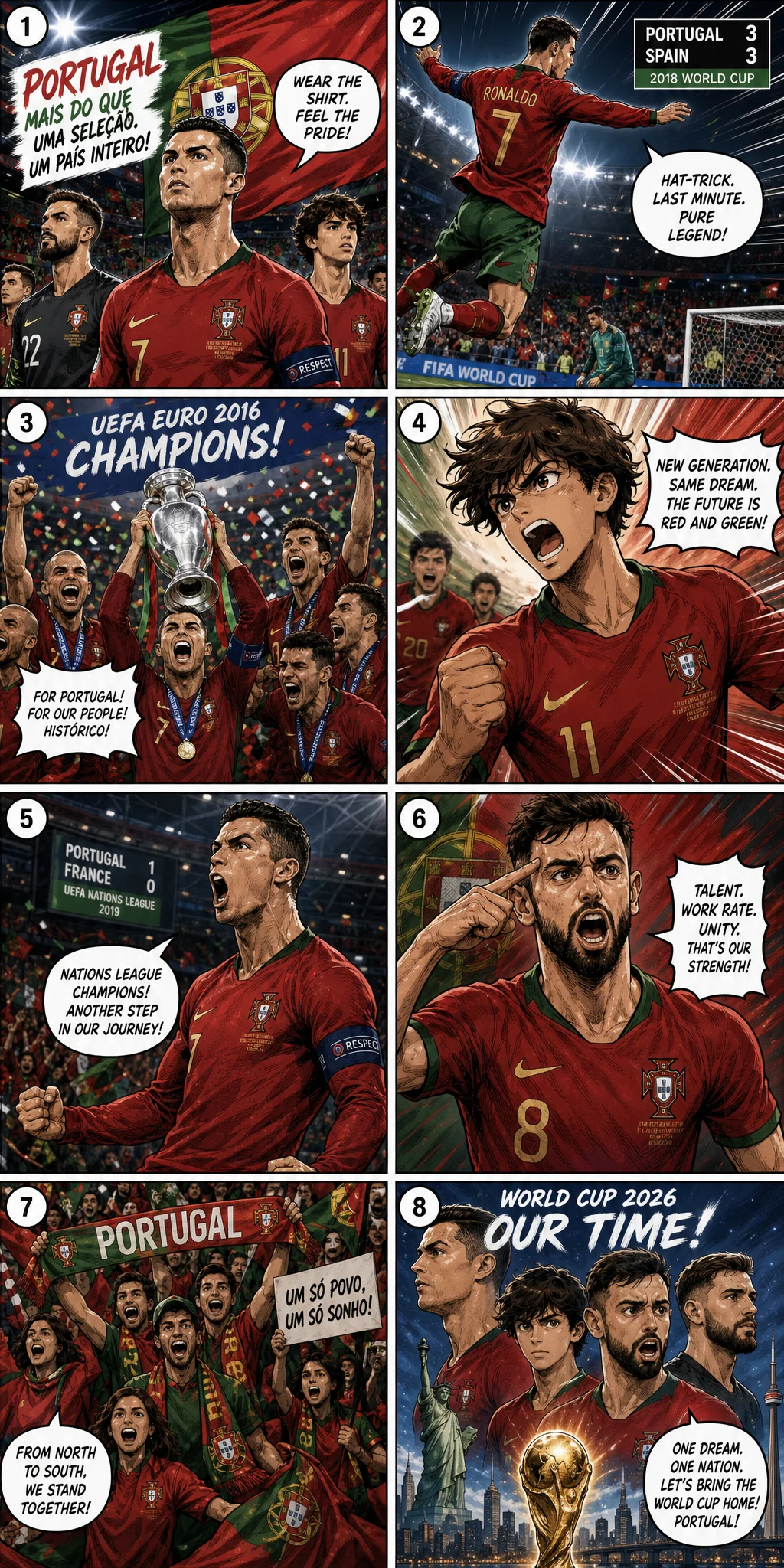
8-panel comic about Portugal national football team and their journey to the 2026 FIFA World Cup.
Published: June 5, 2026
Portugal National Football Team: Navigators of the Beautiful Game
The Portugal national football team, known as "A Seleção das Quinas" (The Team of the Five Shields), carries the weight of a small nation's outsized ambition onto the global stage. From a country of just over ten million people perched on the western edge of Europe, Portugal has produced some of football's most luminous talents and, in recent years, finally translated generational brilliance into international silverware. As they prepare for the 2026 FIFA World Cup, Portugal finds itself at a fascinating inflection point — transitioning from the era defined by its greatest-ever player toward a new generation equally rich in promise.
HISTORICAL FOUNDATIONS
Portuguese football's roots stretch back to the late nineteenth century, when British merchants, students, and engineers brought the game to Lisbon and Porto. The country's oldest clubs — Académica de Coimbra, founded by students in 1887, and FC Porto, established in 1893 — reflect this Anglo-Portuguese connection. The Portuguese Football Federation was founded in 1914, and the national team played its first official match against Spain in 1921, losing 3-1 in Madrid.
For decades, Portugal remained on the periphery of world football. The nation's first World Cup appearance came only in 1966, but what a debut it was. Led by the sublime Eusébio — the "Black Panther" born in Portuguese Mozambique — Portugal stormed to a third-place finish in England. Eusébio finished as the tournament's top scorer with nine goals, including four in a legendary quarter-final comeback against North Korea, where Portugal overturned a 3-0 deficit to win 5-3. That team, featuring the elegant Coluna, the crafty José Augusto, and the indomitable goalkeeper José Pereira, established Portugal's footballing identity: technically exquisite, emotionally impassioned, and capable of the extraordinary.
The decades that followed were lean. Portugal failed to qualify for the next five World Cups, a drought that stretched until 1986. The "Golden Generation" of Luís Figo, Rui Costa, Fernando Couto, and João Pinto — world champions at youth level in 1989 and 1991 — promised much. They reached the semi-finals of Euro 2000, losing heartbreakingly to France on a Zinedine Zidane penalty in extra time, and hosted Euro 2004, where they were stunned by Greece in the final on home soil. That Lisbon night, with a teenage Cristiano Ronaldo weeping inconsolably on the pitch, would become the emotional foundation for everything that followed.
THE RONALDO ERA
No discussion of Portuguese football can begin anywhere other than Cristiano Ronaldo dos Santos Aveiro. Born on the island of Madeira in 1985, raised in a working-class neighborhood, he rose from Sporting Lisbon's academy to become the most prolific goal-scorer in the history of men's international football. His story is Portugal's story for nearly two decades — the shared journey of a nation and its talisman, each believing against the odds.
Ronaldo's transformation from a dazzling but inconsistent winger at Manchester United into a relentlessly efficient goal machine at Real Madrid defined an era. For Portugal, he provided moments that will echo through generations: the hat-trick against Spain in the 2018 World Cup, capped by a last-minute free-kick of breathtaking technique and nerve; the soaring header against Wales in the Euro 2016 semi-final; the goal against Ghana in 2022 that made him the first man to score in five World Cups. His 130-plus international goals represent a record unlikely to be broken, a monument to longevity, physical discipline, and an unquenchable competitive fire.
Yet the Ronaldo era's crowning achievement came on a night when he could barely participate. In the Euro 2016 final against hosts France, Ronaldo was stretchered off in the first half with a knee injury, his tears evoking memories of 2004. But this time, the ending was different. Éder, a substitute striker born in Guinea-Bissau, struck a thunderous long-range goal in extra time to secure Portugal's first major trophy. Ronaldo, limping along the touchline, exhorting his teammates like a manager, had willed his team to victory from the sideline. The image of him lifting the Henri Delaunay trophy remains the defining photograph of Portuguese football history.
LEGENDS BEYOND THE HEADLINES
Beyond Ronaldo, Portugal's pantheon runs deep. Eusébio, with 41 goals in 64 international matches, remains the spiritual father of the national team. A statue of him stands outside the Estádio da Luz, and when he died in 2014, the nation mourned with state honors. Luís Figo, the 2000 Ballon d'Or winner and the symbol of the Golden Generation, carried Portuguese football through its modern renaissance. His controversial transfer from Barcelona to Real Madrid made global headlines, but for the national team, he was the graceful, creative force that elevated those around him.
Rui Costa, the elegant playmaker whose through-balls seemed to bend time and space, formed with Figo a partnership of rare telepathic quality. Fernando Couto anchored the defense with old-school physicality and leadership. Paulo Futre, the electric winger who dazzled at Atlético Madrid, was Portugal's first genuine European star before Figo. Vítor Baía, with his ponytail and cat-like reflexes, redefined goalkeeping for a generation. More recently, Pepe — the Brazilian-born warrior who became Portugal's defensive colossus — brought an intensity and physicality that perfectly complemented the team's technical flair. His partnership with Ronaldo, spanning nearly two decades and multiple tournaments, formed the backbone of Portugal's most successful era.
THE MODERN GENERATION
Portugal enters 2026 with a squad depth unprecedented in its history. The generation that succeeded the Golden Generation has matured into world-class operators. Bruno Fernandes, the creative engine at Manchester United, provides the vision, passing range, and goal threat that once came exclusively from Ronaldo. His ability to find space between the lines, deliver defense-splitting passes, and strike from distance makes him the tactical fulcrum of the modern Seleção.
Bernardo Silva, the Manchester City artisan, brings an artistry that is distinctly Portuguese — a dribbler who glides rather than sprints, a passer who thinks three moves ahead, a player whose football intelligence borders on the preternatural. Rúben Dias has established himself as one of the world's premier center-backs, a leader who organizes, anticipates, and defends with the authority of a veteran despite his relative youth. Rafael Leão, the AC Milan winger with explosive pace and balletic finishing, represents the raw, unpredictable talent that Portuguese football has always prized.
Behind them, the depth is staggering. João Félix possesses touch and vision that evoke comparisons to Kaká and even early Ronaldo Nazário. Diogo Jota, when fit, offers a goal-scoring instinct that few can match. Nuno Mendes bombs forward from left-back with devastating effect. Vitinha controls tempo from midfield with the quiet authority of a veteran. João Palhinha destroys opposition attacks with the relish of a man who treats tackling as an art form. The goalkeeper trio of Diogo Costa, Rui Patrício, and José Sá offers security that Portuguese teams of the past could only dream of.
TACTICAL IDENTITY
Portuguese football has evolved from the counter-attacking pragmatism that characterized the Euro 2016 campaign. Under Roberto Martínez, who took charge after the 2022 World Cup, Portugal has embraced a more proactive, possession-oriented approach. The 4-3-3 system maximizes the creative talents of Fernandes and Bernardo Silva while providing the defensive structure that Rúben Dias demands. Full-backs push high, the midfield rotates intelligently, and the front three interchange positions with the fluidity that defines modern elite football.
The tactical flexibility is Portugal's greatest modern strength. Against stronger opponents, they can absorb pressure and strike on the counter — Ronaldo, even in his late thirties, and Leão provide devastating pace in transition. Against weaker sides, they can dominate possession and break down low blocks with the creative precision of Fernandes and Bernardo. The set-piece threat, with Dias and the ageless Pepe attacking deliveries, adds another dimension that wins tight matches.
THE 2026 CAMPAIGN
Portugal arrives at the 2026 World Cup with legitimate ambitions. Placed in Group F alongside Germany, Iran, and New Zealand, the path to the knockout stage is demanding but navigable. Germany, the group's other heavyweight, promises a titanic clash of European football cultures — the systematic efficiency of Die Mannschaft against the creative artistry of A Seleção. Iran, disciplined and physically imposing under Carlos Queiroz — a Portuguese coach who once led the national team — adds a layer of tactical and emotional complexity. New Zealand, the group's underdog, cannot be underestimated in a tournament that has repeatedly punished complacency.
If Ronaldo participates — and given his extraordinary physical condition and insatiable ambition, few would bet against him — it would be his sixth World Cup, a men's record. Whether as a starter or an impact substitute, his presence transforms the team's psychology. Opponents fear him. Teammates are elevated by him. The world watches him.
FOOTBALL AND PORTUGUESE IDENTITY
Football in Portugal is inseparable from national identity. The "big three" clubs — Benfica, Porto, and Sporting — dominate domestic life to a degree unmatched in most European countries. Their rivalries are Shakespearean in their intensity, their dramas covered by daily sports newspapers that outsell general news publications. The national team, however, transcends club loyalties. When A Seleção plays, Benfiquistas and Portistas stand shoulder to shoulder, united by the five shields on the crest.
The country's footballing identity reflects its history as a seafaring nation. Portuguese football has always been about exploration — discovering talent, exporting it to the world's best leagues, and adapting foreign influences into something uniquely Portuguese. The nation's academy system is among Europe's finest, consistently producing technically gifted players who combine the South American flair inherited from Brazil with the tactical discipline learned from Northern Europe. Portugal's football is a creole, a beautiful hybrid that reflects the nation's global history.
ECONOMIC REALITY AND NATIONAL PRIDE
Portugal's football success carries economic significance beyond the pitch. Player exports generate hundreds of millions of euros annually for Portuguese clubs, funding academy development and infrastructure in a virtuous cycle. The national team's success fuels tourism, national confidence, and soft power projection. When Portugal won Euro 2016, the economic impact was estimated in the hundreds of millions — from merchandise sales to increased tourism interest to the intangible but real boost in national morale.
For a country that experienced a devastating financial crisis and austerity measures in the early 2010s, football has provided moments of pure, uncomplicated joy. Cristiano Ronaldo, the Madeiran boy who became the most famous athlete on Earth, embodies a national narrative of overcoming limitations through talent and relentless work. His story is Portugal's story, told to the world.
THE ROAD AHEAD
As Portugal prepares for 2026, the central question is not one of talent — the squad is among the deepest in world football — but of identity. How does a team built around one of history's greatest players transition to life after him? The answer may lie in the collective. This Portuguese generation is not a one-man show; it is an ensemble cast of world-class talents entering their prime together. Bruno Fernandes, Bernardo Silva, Rúben Dias, and Rafael Leão form a core that could contend for multiple tournaments.
The 2026 World Cup may represent the final chapter of the Ronaldo era, but it also marks the beginning of something new. Portugal has evolved from a nation that produced occasional genius into a footballing powerhouse that produces them in every generation. The navigators have charted their course. Now they sail toward history, carrying the hopes of ten million people who believe that the best is yet to come.