DR Congo: Journey to 2026
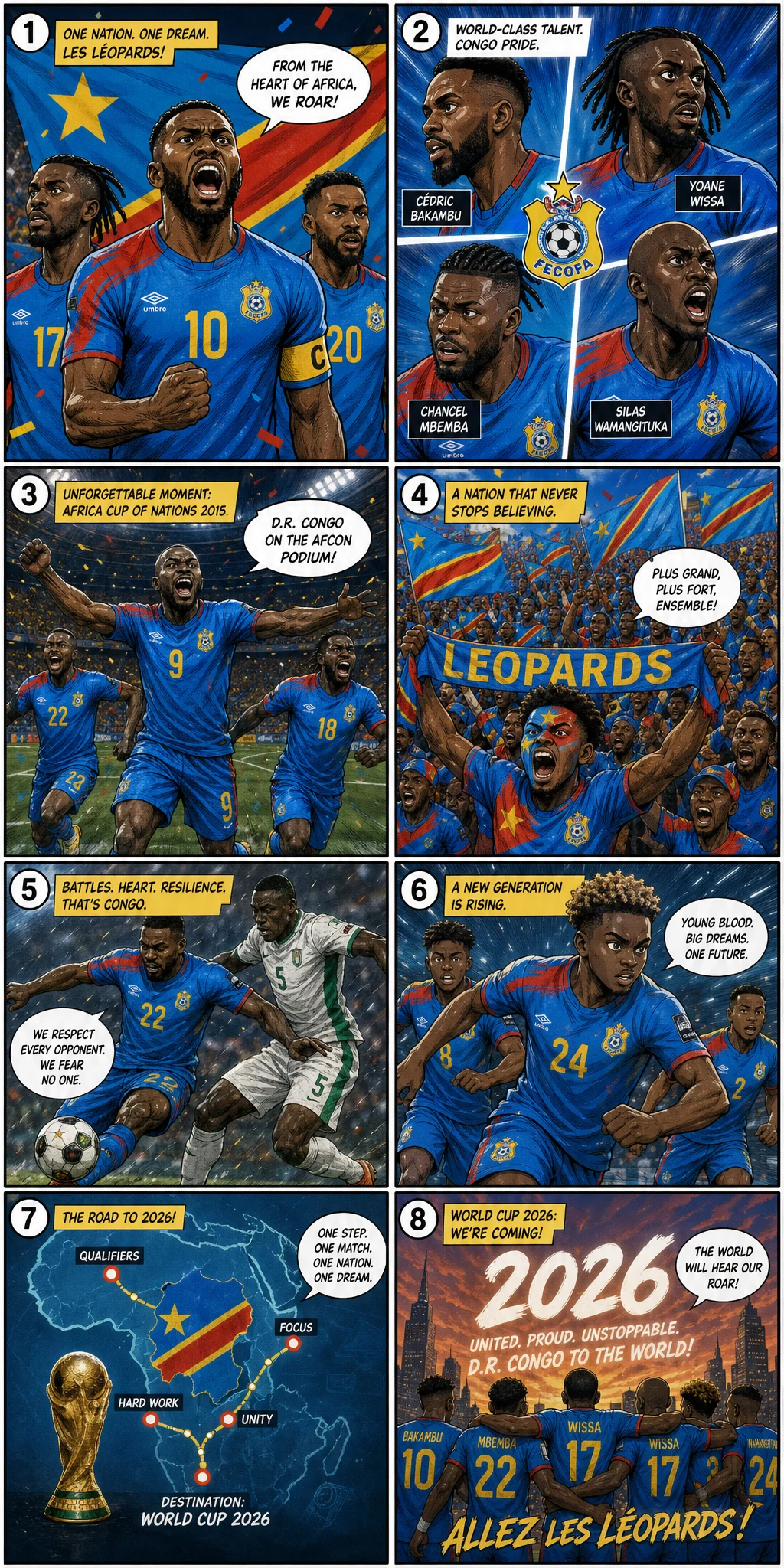
8-panel comic about DR Congo national football team and their journey to the 2026 FIFA World Cup.
Published: June 5, 2026
DR Congo National Football Team: The Leopards Roaring for Recognition
The Democratic Republic of the Congo national football team, known as "The Leopards," represents a nation of immense footballing potential that has long fought for its place among Africa's elite. A country of over 100 million people, endowed with staggering natural resources and a football passion that runs as deep as the Congo River itself, DR Congo carries the weight of unfulfilled promise into every tournament. As the Leopards prepare for the 2026 FIFA World Cup, they seek not merely participation but the kind of breakthrough performance that would transform Congolese football forever.
HISTORICAL FOUNDATIONS
Football arrived in the Congo basin during the Belgian colonial period in the early twentieth century, brought by missionaries, colonial administrators, and returning students. The game spread rapidly through the sprawling cities of Kinshasa (then Léopoldville) and Lubumbashi (then Élisabethville), where it became an expression of urban identity and, increasingly, anticolonial sentiment. Congolese clubs like AS Vita Club and TP Mazembe, founded in the 1930s, grew into institutions that would dominate African club football decades later.
The country's golden age came in the 1970s, when Zaire — as the nation was then known under Mobutu Sese Seko — became the first sub-Saharan African nation to qualify for a World Cup. The 1974 tournament in West Germany marked a historic milestone, though it is remembered for a moment that Congolese football has spent decades trying to transcend. In a group match against Brazil, defender Mwepu Ilunga famously raced from the wall to blast away a free-kick before it was taken, a gesture widely misunderstood as comic ignorance of the rules but later revealed as a deliberate protest against the Mobutu regime's treatment of the players. The Leopards lost all three matches, but the experience seared itself into African football consciousness — a reminder of both how far the continent had come and how far it still had to travel.
The intervening decades brought political instability, civil war, and the near-collapse of national infrastructure — all of which inevitably affected football. Yet the Leopards endured. They won the Africa Cup of Nations in 1968 and 1974, confirming their status as continental powers in an era when African football was still finding its global footing. The country's club football remained vibrant: TP Mazembe became the first African club to reach the FIFA Club World Cup final in 2010, a stunning achievement that reminded the world of Congolese football's enduring quality.
LEGENDS OF THE LEOPARDS
The pantheon of Congolese football is populated by players whose talents illuminated European leagues while their hearts remained in Kinshasa. Shabani Nonda, the clinical striker who starred for Monaco and Roma, demonstrated the goal-scoring instinct that Congolese forwards are famous for. Lomana LuaLua, with his acrobatic back-flip celebrations and explosive pace, brought Congolese flair to the Premier League with Newcastle United and Portsmouth. His brother, Kazenga LuaLua, continued the family tradition of dazzling wing play. Dieumerci Mbokani, powerful and technically gifted, conquered the Belgian Pro League and carried the national team's attacking hopes for a decade.
Perhaps the most emblematic figure is Trésor Mputu, the TP Mazembe legend who spent his entire career in African football, repeatedly rejecting European moves to remain the talisman of Congolese club football. His loyalty, his creativity, and his almost mystical connection with Lubumbashi's supporters made him a folk hero — a player who proved that African football could be a destination, not merely a stepping stone. Youssouf Mulumbu anchored the midfield with the combative elegance that defined his years at West Bromwich Albion and Norwich City. Cédric Bakambu, born in France to Congolese parents, chose to represent the Leopards and became the most expensive African player in Chinese Super League history, his pace and finishing making him the spearhead of a new generation.
THE MODERN ERA
Contemporary Congolese football presents a fascinating paradox. The nation's diaspora — Congolese communities in France, Belgium, England, and beyond — has produced an extraordinary generation of talent. Many of these players, raised in European academies, must navigate the complex identity question: to represent the country of their birth or the country of their heritage? The Congolese Football Federation has worked diligently to convince dual-nationals that wearing the Leopards' blue and yellow is not merely an alternative but an honor.
This recruitment has borne fruit. Gaël Kakuta, the former Chelsea prodigy whose silky left foot and close control evoke comparisons to Eden Hazard, brings creative spark and international experience. Chancel Mbemba, the imposing Porto and Marseille defender, provides leadership, physical dominance, and a goal threat from set pieces. Yoane Wissa, the Brentford forward whose intelligent movement and clinical finishing have made him one of the Premier League's most underrated attackers, represents the cutting edge of the modern Leopard. Samuel Moutoussamy, the Nantes midfielder, controls tempo with the composure of a player who understands that Congolese football's raw passion needs structure to succeed at the highest level.
The domestic league, despite chronic underfunding and infrastructure challenges, continues to produce talent. TP Mazembe's academy in Lubumbashi remains one of Africa's finest talent factories, its graduates populating leagues across the continent and beyond. AS Vita Club's fierce rivalry with Mazembe — the Kinshasa-Lubumbashi derby that divides a nation — creates an intensity that forges players capable of handling pressure at any level. The Congolese league may lack the resources of its North African counterparts, but its rawness, its passion, and its capacity to surprise remain undimmed.
TACTICAL IDENTITY
The Leopards play with an emotional intensity that reflects the national character. Congolese football is physical, direct, and unafraid — a style built on powerful midfielders, pacey wingers, and defenders who treat every duel as a matter of personal honor. The 4-3-3 or 4-2-3-1 formations favored by recent coaches emphasize quick transitions, with the ball moved rapidly from defense to attack through the midfield pivot before being released to wingers tasked with isolating full-backs.
Defensive organization has historically been the team's vulnerability. The Leopards can be undone by lapses in concentration, moments when the emotional intensity that fuels their best performances tips into indiscipline. Recent coaching appointments have prioritized compact defensive shape and positional discipline without sacrificing the attacking verve that makes the team dangerous. The balance remains elusive — a team capable of beating anyone on its day but equally capable of inexplicable collapses.
Set pieces represent a significant weapon. Mbemba's aerial dominance, combined with the physical presence of multiple six-foot-plus outfield players, makes every corner and free-kick a genuine scoring opportunity. Counter-attacking situations, with Wissa and Kakuta running at retreating defenders, represent the Leopards' most potent threat — moments when individual brilliance can overcome systemic limitations.
THE 2026 CAMPAIGN
DR Congo enters the 2026 World Cup qualifiers with cautious optimism. The expanded 48-team format, with its increased African allocation, provides a more accessible path to qualification than ever before. The Leopards are no longer fighting for one or two spots against a continent of fifty-plus nations — they are competing for nine direct qualification slots, a structural change that fundamentally alters the mathematics of African World Cup qualification.
The qualifying campaign tests more than football. It tests the Federation's ability to organize, to manage logistics across a country the size of Western Europe with infrastructure that remains among the world's most challenging. It tests the diaspora recruitment strategy — whether players who grew up in Paris, Brussels, or London can forge genuine cohesion with those who developed in Lubumbashi or Kinshasa. It tests the nation's patience, its willingness to invest in football infrastructure amid competing demands for basic services and economic development.
FOOTBALL AND CONGOLESE SOCIETY
In a nation marked by decades of conflict, poverty, and political instability, football serves as one of the few unifying forces. When the Leopards play, ethnic divisions — the fault lines of Congolese politics — temporarily dissolve. A Lingala-speaking supporter from Kinshasa and a Swahili-speaking supporter from Goma share the same hope, the same agony, the same transcendent joy when the ball hits the net. The national stadium in Kinshasa, the Stade des Martyrs, becomes a crucible of national identity, 80,000 voices singing as one.
The economic dimension is inescapable. For countless Congolese youth, football represents the only visible pathway out of poverty. Informal academies and street football produce raw talent in staggering quantities, but the absence of structured development pathways means that most of this talent is never realized. Every Congolese child who dribbles a ball made of plastic bags and string on a dusty Kinshasa street holds the same dream: to become the next Mbemba, the next Bakambu, the next Leopard to roar on the world stage.
Music, fashion, and football intertwine in Congolese popular culture. Congolese rumba, the soulful guitar-driven music that has conquered Africa, provides the soundtrack for football gatherings. The sapeurs — the elegantly dressed dandies of Kinshasa and Brazzaville — bring their sartorial flair to the stands, transforming football matches into fashion shows. The Leopards are not merely a football team; they are a cultural phenomenon, an expression of Congolese creativity and resilience in a world that has too often overlooked the nation's contributions.
THE ROAD AHEAD
DR Congo's footballing potential is, by any objective measure, among the greatest in Africa. A population of over 100 million, a diaspora scattered across the world's best leagues, a domestic football culture of extraordinary depth and passion — the raw materials for sustained success are present. What has been lacking is the organizational infrastructure, the political stability, and the long-term investment to convert potential into achievement.
The 2026 World Cup represents both an opportunity and a test. Qualification would transform Congolese football — attracting investment, inspiring a generation, and proving that the Leopards belong among the world's football nations. Failure would extend a drought that has lasted since 1974, a half-century in the international wilderness. The players carry the responsibility. But more importantly, they carry the hope of a nation that believes, with every fiber of its being, that its time has finally come.