Colombia: Journey to 2026
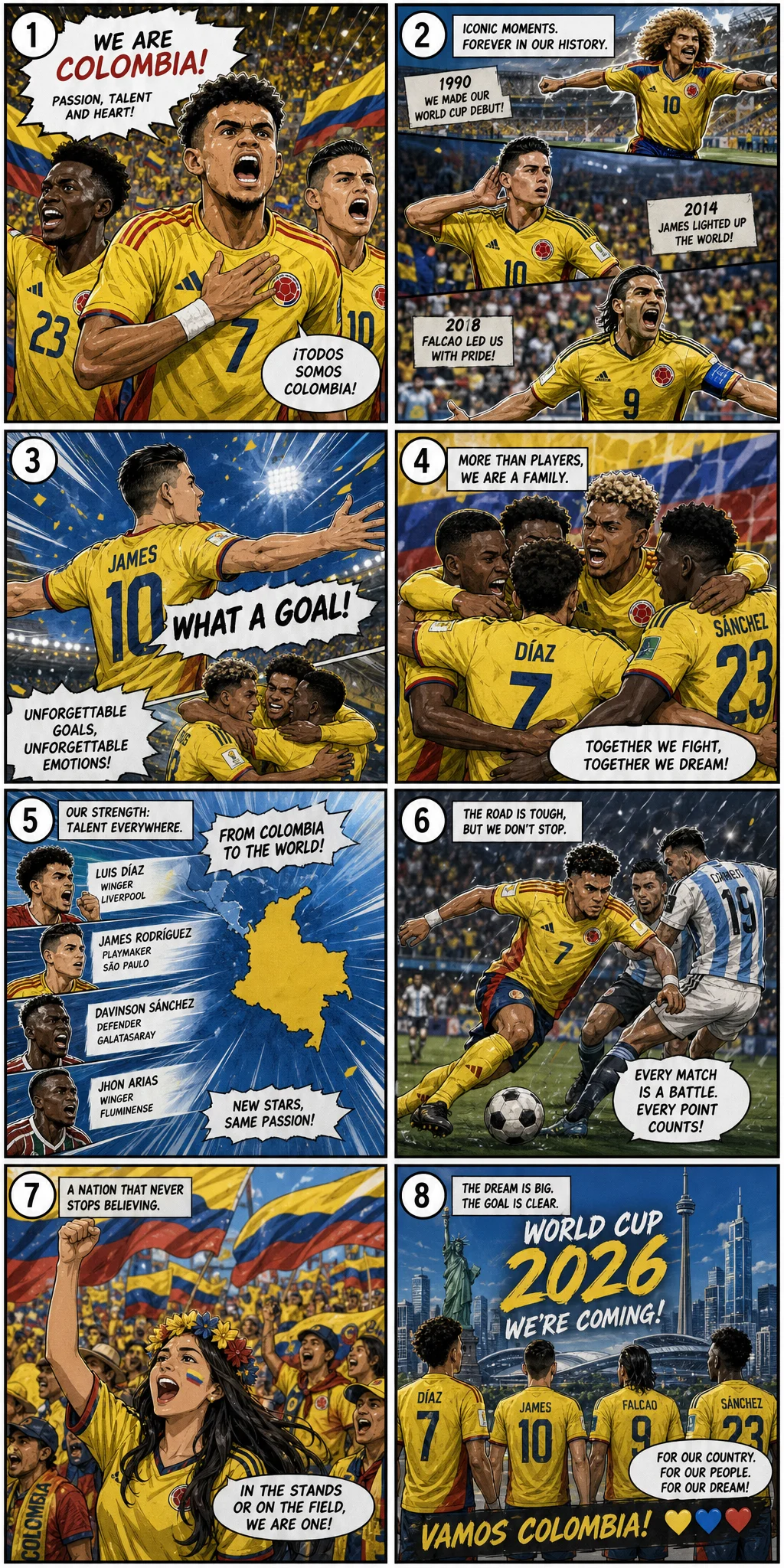
8-panel comic about Colombia national football team and their journey to the 2026 FIFA World Cup.
Published: June 5, 2026
Colombia National Football Team: The Spirit of Los Cafeteros
The Colombia national football team, known as "Los Cafeteros" (The Coffee Growers), carries the soul of a nation that lives and breathes football with an intensity matched by few. From the Caribbean coast to the Andean highlands, from the Amazon basin to the streets of Bogotá, Colombian football is a celebration of joy, creativity, and resilience. As they prepare for the 2026 FIFA World Cup, Los Cafeteros seek to build on a legacy that has produced some of football's most unforgettable moments and characters.
HISTORICAL FOUNDATIONS
Football arrived in Colombia in the early twentieth century through British railway engineers and Caribbean sailors, taking root first in the port city of Barranquilla. The Colombian Football Federation was founded in 1924, and the national team made its international debut at the 1938 Central American and Caribbean Games. But Colombia's true football awakening came during a period that remains legendary in global football history: the "El Dorado" era of the late 1940s and early 1950s.
El Dorado was a golden age of Colombian club football, made possible by a breakaway from FIFA that allowed Colombian clubs to sign players without paying transfer fees to foreign clubs. The result was extraordinary. Alfredo Di Stéfano, the Argentine who would become Real Madrid's greatest player, graced Millonarios of Bogotá. Heleno de Freitas, the tragic Brazilian genius, played for Junior de Barranquilla. Néstor Rossi, Adolfo Pedernera, and a constellation of South American stars descended on Colombia, creating a domestic league that briefly rivaled any in the world. The era ended when Colombia rejoined FIFA in 1954, but its legacy — the deep embedding of football in Colombian culture, the expectation of style and artistry — endures.
Colombia's first World Cup appearance came in 1962 in Chile, where they exited in the group stage but announced their arrival with a 4-4 draw against the Soviet Union, featuring a goal from Marcos Coll scored directly from a corner kick — an "Olympic goal" that remains one of the rarest feats in World Cup history. The tournament's most tragic moment also involved Colombia: the own goal scored by Luis Carlos Paz, an error that led to his vilification upon returning home and, according to dark legend, his murder — a story that, while disputed, captures the dangerous intensity of Colombian football passion in its early decades.
THE GOLDEN GENERATION AND DARK YEARS
The 1990s represented Colombia's emergence as a genuine world football power. Under coach Francisco "Pacho" Maturana, a former dental surgeon with a philosopher's temperament, Colombia developed a style of play that was technically sumptuous and tactically sophisticated. The team qualified for three consecutive World Cups (1990, 1994, and 1998), and at its peak was ranked among the world's top five teams.
The 1994 team, in particular, entered the World Cup in the United States tipped by Pelé himself as a potential champion. Carlos Valderrama, the unmistakable midfielder with the wild blond afro and preternatural passing ability, was the creative fulcrum. Faustino Asprilla brought unpredictability, flair, and explosive athleticism. Freddy Rincón provided midfield steel and late-running goal threat. René Higuita, the "sweeper-keeper" whose scorpion kick save at Wembley remains one of football's most iconic images, redefined what a goalkeeper could be.
The 1994 campaign ended in tragedy. A 2-1 loss to the United States, a 2-1 loss to Romania, and a 2-0 win over Switzerland saw Colombia eliminated in the group stage. The aftermath was devastating. Andrés Escobar, the popular defender whose own goal against the United States proved decisive, was murdered in Medellín ten days after the team's elimination, shot six times in a parking lot — each bullet, witnesses claimed, corresponding to a commentator's shout of "Gooooal." The murder remains Colombian football's deepest wound, a symbol of the toxic intersection of sport, narcotics, and violence that defined the nation's darkest years.
LEGENDS OF LOS CAFETEROS
Carlos Valderrama, "El Pibe," stands as Colombia's greatest player and its most recognizable icon. With 111 caps and a passing range that belonged to a different dimension, Valderrama was the artist who made Colombian football beautiful. His style — upright, unhurried, apparently detached — masked a football brain of extraordinary speed. He could thread passes through gaps that did not appear to exist, and his vision transformed teammates into better players. Off the pitch, his humility and his refusal to leave Colombian football for European riches made him a folk hero of rare authenticity.
Faustino Asprilla brought chaos and genius in equal measure. His hat-trick for Newcastle United against Barcelona in the Champions League, his dramatic goals, and his flamboyant lifestyle made him the most compellingly unpredictable Colombian player of his generation. René Higuita, with his sweeper-keeper style, his scorpion kick, and his occasional forays to the halfway line that left coaches clutching their chests, embodied Colombian football's commitment to beauty over caution.
The modern pantheon includes figures who have carried Colombian expectations across generations. Iván Ramiro Córdoba, the diminutive but defensively imperious center-back, won five Serie A titles and a Champions League with Inter Milan, his reading of the game compensating for what he lacked in height. Mario Yepes, Córdoba's long-time partner, provided the physical presence and organizational authority that balanced the Colombian defense for over a decade. Juan Pablo Ángel, Radamel Falcao García — the latter, before injuries, arguably the most lethal pure striker in world football during his peak at Porto and Atlético Madrid — and James Rodríguez, whose magical left foot and boy-band looks made him the face of Colombian football's modern resurgence.
THE MODERN ERA
The 2014 World Cup in Brazil marked the definitive rebirth of Colombian football. Under Argentine coach José Pékerman, Los Cafeteros reached the quarter-finals for the first time in their history, playing football that captured the world's imagination. James Rodríguez won the Golden Boot as the tournament's top scorer, his six goals including a chest-and-volley against Uruguay — struck with his weaker foot, no less — that won the Puskás Award as the year's most beautiful goal. The team's joyful celebrations, their choreographed dances after each goal, and the radiant smile of coach Pékerman became enduring images of a World Cup that rediscovered football's capacity for uncomplicated joy.
Colombia reached consecutive World Cup knockout stages in 2014 and 2018 — a first in the nation's history. The 2018 campaign in Russia ended in a round-of-16 loss to England on penalties, a match remembered for Yerry Mina's towering header in stoppage time that forced extra time, and for the physical, confrontational style that Colombia employed — a departure from the aesthetic purity of the Valderrama era but evidence of a team learning to compete at the highest level by any means necessary.
The 2022 World Cup qualification failure — Colombia missed the tournament in Qatar, finishing sixth in CONMEBOL qualifying — was a sobering reminder that progress is not linear. The post-Pékerman transition was bumpy, the generational handover from Falcao, James, and Juan Cuadrado to a younger cohort incomplete. The failure triggered introspection and renewal, with the Colombian federation investing in youth development, coaching education, and a longer-term vision that acknowledges the cyclical nature of football success.
THE MODERN SQUAD
Colombia's current generation blends experience with youthful dynamism. Luis Díaz, the Liverpool winger whose explosive dribbling and relentless work rate have made him one of the Premier League's most thrilling attackers, carries the creative burden that Valderrama and James once bore. Born in La Guajira, a remote indigenous region near the Venezuelan border, Díaz's journey from poverty to Premier League stardom embodies the transformative power of Colombian football.
James Rodríguez, now the elder statesman, continues to provide moments of creative genius. His left foot remains among football's most cultured instruments, capable of unlocking defenses with passes that others cannot see. Jefferson Lerma and Mateus Uribe provide the midfield steel that allows the creators to flourish. Dávinson Sánchez and Yerry Mina anchor the defense with the physicality that has become a Colombian trademark. The emergence of Jhon Durán, the teenage striker whose explosive power and confidence have drawn comparisons to a young Romelu Lukaku crossed with the fearlessness of Asprilla, provides a glimpse of the future.
Goalkeeper has historically been the team's Achilles heel, but the emergence of Camilo Vargas and others suggests that this vulnerability may be resolving. The Colombian league, improving in quality and professionalism, continues to supply players to the national team pool. The diaspora — Colombian-origin players in the United States, Spain, England, and beyond — expands the talent identification net.
TACTICAL EVOLUTION
Colombian football has evolved from the aesthetic idealism of the Maturana era through the pragmatic competitiveness of Pékerman to the balanced approach of current coach Néstor Lorenzo. The modern Cafeteros play with a 4-3-3 or 4-2-3-1, emphasizing high pressing, quick transitions, and wide attacking play that maximizes the team's strengths — Díaz's dribbling on the left, the overlapping of attacking full-backs, and the aerial threat from set pieces.
The tactical identity retains a Colombian soul. There is a commitment to attacking football, to expressing individual creativity within a collective structure. Players are encouraged to improvise, to attempt the unexpected. The high press is aggressive, the transitions are vertical, and the emotional intensity is palpable. Colombian teams of the past could be bullied, their technical elegance undone by physical intimidation. The modern iteration is different: still technical, still creative, but hardened by experience in Europe's most demanding leagues and unwilling to be anyone's victim.
FOOTBALL AND COLOMBIAN SOCIETY
Football in Colombia is inseparable from the nation's complex social fabric. During the decades of armed conflict, football provided rare moments of national unity, occasions when political divisions, regional rivalries, and class tensions were temporarily suspended. The 2014 World Cup campaign, coming at a moment when Colombia's peace process with the FARC guerrillas was advancing, offered a vision of a different Colombia — joyful, united, internationally respected — that reinforced the case for peace.
The relationship between football and narcotics remains the nation's most painful football narrative. The 1980s and 1990s saw narcotics money flooding into Colombian club football, with drug lords like Pablo Escobar owning clubs, financing player transfers, and using football as both money-laundering vehicle and popular legitimacy builder. The murder of Andrés Escobar was the nadir of this toxic entanglement. Colombian football has spent decades extricating itself from this legacy, and the modern game's governance, while imperfect, represents a profound break with the past.
Football and music intertwine in Colombian culture. Cumbia, vallenato, and salsa provide the soundtrack for football gatherings. Carlos Vives' "La Copa de la Vida," Shakira's global anthems, and the stadium chants that blend traditional rhythms with terrace passion make Colombian football culture uniquely musical. The Barranquilla Carnival, one of the world's great folk festivals, shares its spirit with the football played in the city's Estadio Metropolitano: colorful, rhythmic, joyful, and impossible to resist.
THE ROAD AHEAD
Colombia's 2026 World Cup qualifying campaign is a test of renewal. CONMEBOL qualifying, the most grueling in world football — an eighteen-match, two-year odyssey through South America's varied altitudes, climates, and football cultures — punishes transition and rewards continuity. The expanded 48-team World Cup format, with six automatic South American slots and a seventh playoff place, provides less margin for error while also offering more paths to qualification.
The generation of Díaz, Durán, and emerging talents represents Colombia's future. James Rodríguez, in the twilight of his international career, seeks one final dance on football's greatest stage. The nation watches with hope, with passion, and with the understanding — hard-earned through decades of triumph and tragedy — that football, like life, is beautiful precisely because it cannot be controlled. Los Cafeteros will play as they have always played: with joy, with courage, and with the belief that the beautiful game rewards those who dare to make it beautiful.