England: Journey to 2026
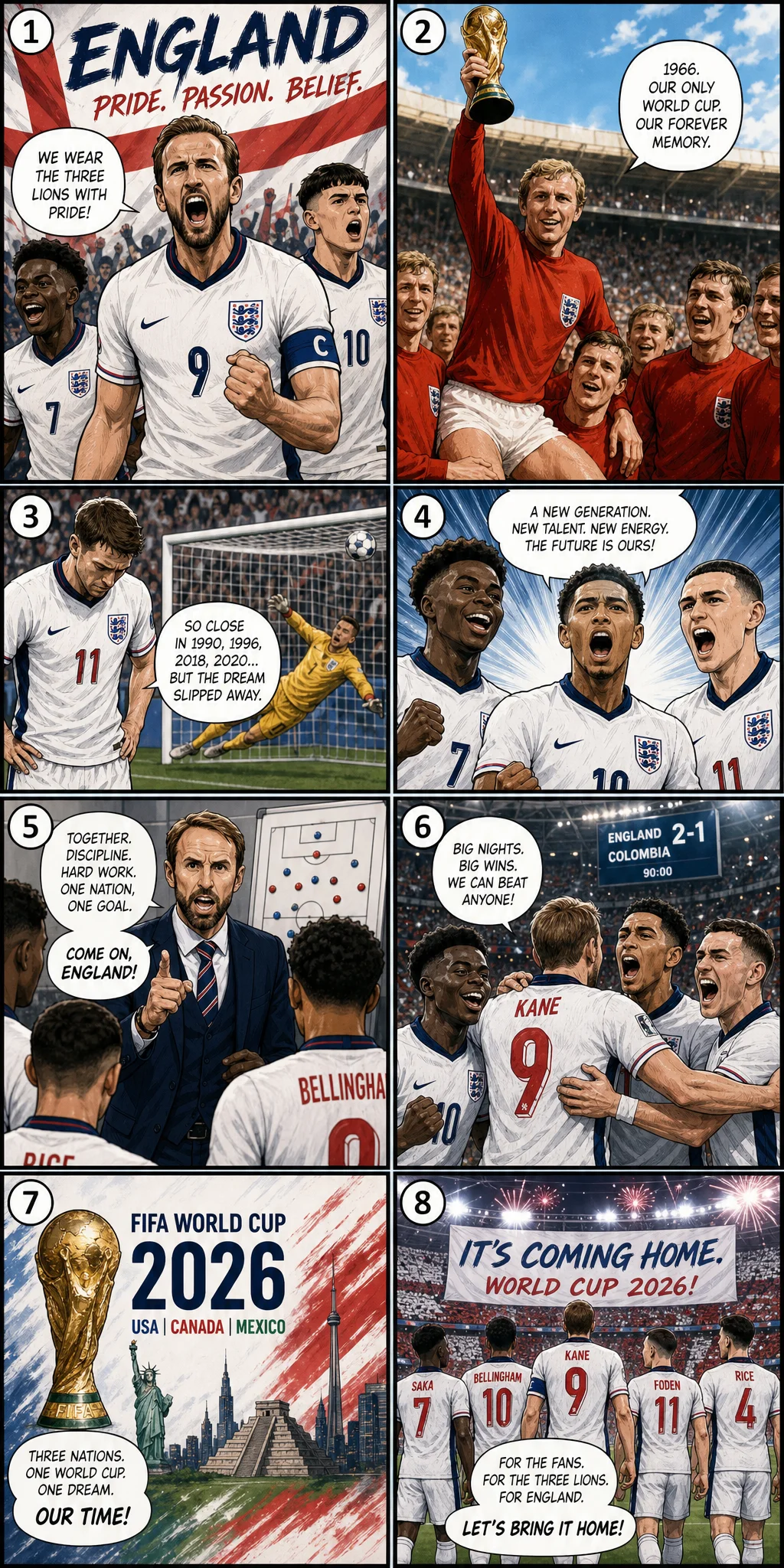
8-panel comic about England national football team and their journey to the 2026 FIFA World Cup.
Published: June 5, 2026
England National Football Team: The Eternal Pursuit of Football's Coming Home
The England national football team, known as "The Three Lions" for the royal crest they wear over their hearts, carries a burden unique in world football. As the birthplace of the modern game, England lives in the perpetual shadow of its own creation — a nation that gave football to the world and has spent most of the subsequent century and a half trying to prove it still belongs at the game's summit. As they prepare for the 2026 FIFA World Cup, the Three Lions stand closer to glory than at any point since 1966, yet the final step remains the most difficult one of all.
HISTORICAL FOUNDATIONS
England's claim as football's birthplace is not mere mythology. The Football Association, founded at the Freemasons' Tavern in London on October 26, 1863, codified the rules that would become the global game. The first international football match took place between England and Scotland in 1872 in Glasgow, ending in a 0-0 draw. The world's first league competition, first cup competition, and first professional clubs all emerged from English soil. The nation's football infrastructure — its pyramid of leagues, its network of professional and amateur clubs, its traditions of Saturday afternoon kick-offs and terraced stands — became the template that footballing nations everywhere would adapt.
England's early international dominance reflected this institutional primacy. From the first meeting with Scotland through the early twentieth century, England expected to beat every opponent, and usually did. The Home Championship, contested annually between England, Scotland, Wales, and Ireland (later Northern Ireland), was for decades the world's highest-level international competition. England's refusal to participate in the early World Cups — the FA withdrew from FIFA in 1928 over disputes about amateurism and didn't rejoin until 1946 — reflected a certain arrogance, a belief that the Home Championship was the true test of international football and that the World Cup was a continental novelty.
The shock of 1950 changed everything. England entered their first World Cup in Brazil as one of the favorites and promptly lost 1-0 to the United States, a team of semi-professionals, in one of the tournament's greatest ever upsets. The goal, scored by Haitian-born Joe Gaetjens, was so implausible that English newspapers initially assumed the 1-0 scoreline reported by wire services was a typo and printed a 10-0 England victory. The humiliation forced English football to confront the reality that the world had not merely learned the game — it had begun to surpass the teacher.
THE GOLDEN SUMMER OF 1966
The 1966 World Cup, hosted by England, represents the nation's solitary triumph on football's greatest stage and the reference point against which every subsequent English team has been measured. Under manager Alf Ramsey — a man of such understated confidence that he had announced upon his appointment that England would win the World Cup — the Three Lions navigated a tournament that remains the defining narrative of English football.
The team was built around Bobby Moore, the captain whose elegance, reading of the game, and unflappable temperament made him the Platonic ideal of the English defender. Moore's performance against Brazil in 1970 — particularly the tackle on Jairzinho that remains the most revered defensive intervention in World Cup history — demonstrated a quality that transcended national style. Alongside Moore stood Bobby Charlton, the attacking midfielder whose thunderous long-range shooting, ghostly off-the-ball movement, and gentlemanly conduct made him England's greatest-ever player in the eyes of many. Gordon Banks' save from Pelé's header in 1970 — diving low to his right to tip a ball bound for the bottom corner up and over the crossbar — is widely considered the greatest save in football history.
The final against West Germany at Wembley on July 30, 1966, contained enough drama for a century of football memories. England led 2-1 with minutes remaining when Wolfgang Weber equalized for West Germany, sending the match into extra time. Geoff Hurst's shot that struck the underside of the crossbar and bounced down — did it cross the line? The Soviet linesman Tofiq Bahramov, whose decision to award the goal has been debated for nearly sixty years, made the call that gave England a 3-2 lead. Hurst completed his hat-trick in the dying moments, becoming the only man to score three goals in a World Cup final, and Kenneth Wolstenholme's BBC commentary — "Some people are on the pitch, they think it's all over... it is now!" — entered the permanent lexicon of English language.
THE YEARS OF HURT
The five decades between 1966 and the modern era constitute English football's narrative of suffering, a drama of hubris, heartbreak, and the desperate search to recapture a moment that increasingly seemed to belong to a different world. Penalty shootouts became the nation's footballing trauma. The 1990 semi-final against West Germany in Turin, with Chris Waddle's penalty sailing over the crossbar and Paul Gascoigne's tears becoming the tournament's defining image. The 1998 round-of-16 against Argentina, with David Beckham's red card for a petulant kick at Diego Simeone and another penalty loss. The 2006 quarter-final against Portugal, with Beckham (now captain) injured and weeping on the bench, Wayne Rooney sent off for stamping on Ricardo Carvalho, and Cristiano Ronaldo's infamous wink to his bench as the penalties unfolded.
The agony was not limited to shootouts. Diego Maradona's "Hand of God" in the 1986 quarter-final — followed minutes later by the greatest individual goal in World Cup history, the same man having committed both the profane and the sublime — became the definitive statement on England's relationship with footballing fortune. The disallowed goal in the 2010 round-of-16 against Germany, Frank Lampard's shot clearly crossing the line but ungiven, sparked the introduction of goal-line technology. The 2016 European Championship, where England lost to Iceland — Iceland, population 330,000 — in the round of 16, represented a nadir so profound it prompted genuine institutional reform.
LEGENDS OF THE THREE LIONS
England's footballing pantheon extends far beyond the 1966 heroes. Bobby Charlton survived the Munich air disaster of 1958 that killed eight of his Manchester United teammates and went on to win the World Cup, the European Cup, and the Ballon d'Or — a career arc of almost mythological dimensions. Bobby Moore's 108 caps as captain, his sportsmanship, and his premature death from cancer at 51 made him a secular saint of English football.
Gary Lineker, the poacher whose goal-scoring instinct delivered the Golden Boot at the 1986 World Cup, played 80 times for England without ever receiving a yellow card — a statistic that captures both his intelligence and the values of a bygone era. Paul Gascoigne, "Gazza," possessed a talent so luminous that those who watched him play for England in 1990 and 1996 still speak of him in the language of lost love. His goal against Scotland at Euro 96 — flicking the ball over Colin Hendry's head and volleying past Andy Goram — was a moment of genius that encapsulated both his brilliance and, by his subsequent tragic career trajectory, its fragility.
David Beckham's England story is one of redemption. Sent off against Argentina in 1998 and vilified across the nation — an effigy of him was hung outside a London pub — he spent the next decade rebuilding his reputation through relentless work, iconic free-kicks, and the captaincy. His stoppage-time free-kick against Greece in 2001, curling a 30-yard shot into the top corner to secure World Cup qualification, was the moment Beckham completed the journey from villain to hero. Wayne Rooney, England's record goal-scorer until Harry Kane surpassed him, brought a raw, street-fighting intensity to the national team that reconnected it with working-class football culture in an era of increasing Premier League gentrification. His 53 goals in 120 appearances represented the output of a generational talent whose international career never quite reached the heights his club performances promised.
THE SOUTHGATE REVOLUTION
The appointment of Gareth Southgate as England manager in 2016, initially on an interim basis following Sam Allardyce's one-match tenure, proved transformational. Southgate, whose own playing career was defined by the missed penalty in the Euro 96 semi-final shootout against Germany, brought an emotional intelligence, a commitment to process over outcome, and a systematic approach to tournament football that broke England's cycle of failure.
The 2018 World Cup in Russia was a revelation. England reached the semi-finals for the first time since 1990, winning a penalty shootout against Colombia — the psychological barrier that had defined decades of failure, broken in a single night in Moscow. The run included a 6-1 demolition of Panama, Harry Kane winning the Golden Boot with six goals, and the emergence of a team that seemed genuinely to enjoy playing for England. The semi-final loss to Croatia, after taking an early lead, was painful but felt different from the heartbreaks of the past — less a failure than a step on a longer journey.
Euro 2020, played in 2021 across a pandemic-disrupted Europe, brought England closer to glory than at any point since 1966. The final at Wembley, against Italy, ended in the most devastating way imaginable. England led through Luke Shaw's second-minute goal, defended desperately, and conceded an equalizer to Leonardo Bonucci. The penalty shootout — Southgate's specialty, the thing that was supposed to be different this time — ended with three young Black players, Marcus Rashford, Jadon Sancho, and Bukayo Saka, missing their kicks and being subjected to a torrent of racist abuse online. The aftermath exposed the ugliest elements of English football culture while also provoking a national reckoning and an outpouring of support for the targeted players.
The 2022 World Cup in Qatar saw England reach a third consecutive major tournament quarter-final — consistency unprecedented in the nation's history — before losing to France in a match they arguably deserved to win. Harry Kane, having equalized with one penalty, blazed a second over the crossbar in the dying minutes. The cycle of what-might-have-been continued, but the underlying trajectory was unmistakable: England had become a team that competed at the business end of tournaments, not one that crashed out to Iceland.
THE CURRENT GENERATION
England enters the 2026 cycle with a squad of extraordinary depth and quality. Harry Kane, now the nation's all-time leading scorer, has evolved from a pure goal-scorer into a complete forward whose passing range and game intelligence make him one of the world's most complete number nines. Jude Bellingham, the Real Madrid midfielder who plays with the authority of a veteran at an age when most players are still establishing themselves, has already drawn comparisons to Zinedine Zidane — not for stylistic similarity but for the sense that he operates on a different plane from those around him.
The supporting cast is remarkable. Declan Rice anchors the midfield with the defensive coverage and progressive passing that modern elite football demands. Bukayo Saka, having overcome the trauma of the Euro 2020 final, has become one of the Premier League's most consistently excellent attackers, a winger who combines dribbling, creativity, and goal threat with a temperament that seems immune to pressure. Phil Foden, Jack Grealish, Cole Palmer — the creative options are almost embarrassingly rich. The full-back positions, with Reece James, Trent Alexander-Arnold, Luke Shaw, and Ben Chilwell, offer world-class quality when all are fit. John Stones and Harry Maguire, whatever their club form fluctuations, have consistently performed for England.
The tactical approach under Southgate's successor has evolved. England no longer plays the cautious, defense-first football that characterized the 2018 campaign. The system — typically a 4-3-3 or 4-2-3-1 — emphasizes controlled possession from the back, midfield dominance through numbers and quality, and attacking width through overlapping full-backs. The team's ability to dominate the ball against all but the very best opponents, combined with a defensive organization that has conceded few goals in tournament play, makes England a genuinely formidable tournament proposition.
FOOTBALL AND ENGLISH IDENTITY
English football exists in a perpetual identity crisis. The Premier League is the world's most commercially successful, globally watched, and internationally staffed domestic competition, yet its relationship with the national team has always been ambivalent. The league's riches and global talent pool arguably disadvantage English player development — why develop a young English midfielder when you can buy a ready-made Spanish or Brazilian one? — while simultaneously raising standards by exposing English players to elite competition.
The national team's fan culture has undergone a profound transformation. The hooliganism that made English supporters notorious in the 1980s and 1990s has largely been supplanted by a more diverse, inclusive, and self-consciously joyful supporter culture. The band, the songs, the inflatable unicorns — these are the symbols of a fan base that has reclaimed English patriotism from its most toxic associations. The sea shanty wave, sweeping around stadiums in slow motion before exploding into celebration, has become the modern Three Lions' signature.
"Three Lions (Football's Coming Home)," the song released by David Baddiel, Frank Skinner, and the Lightning Seeds for Euro 96, has become English football's unofficial anthem. Its chorus — "It's coming home, it's coming home, football's coming home" — captures the unique combination of hope, self-deprecation, and desperate longing that defines English football culture. The song is simultaneously ironic and sincere, an acknowledgment of decades of failure and an expression of undying faith.
THE ROAD AHEAD
England approaches the 2026 World Cup with a conviction that this time could genuinely be different. The talent is there. The tournament experience is there. The institutional infrastructure — St. George's Park, the FA's national football center and the physical manifestation of a more systematic approach to player and coach development — is there. The only thing missing is the trophy.
The psychological dimension remains the ultimate challenge. Can an England team play in a World Cup final without the weight of 1966 crushing it? Can a nation that has processed footballing heartbreak as a form of national identity allow itself to believe? The answer may lie in the generation of players who were not yet born in 1990, for whom 1966 is black-and-white history rather than living memory, and who seem genuinely liberated from the neuroses of their predecessors.
Football came home, in the song's telling, when England hosted Euro 96. But the trophy did not. The 2026 World Cup, co-hosted by the United States, Canada, and Mexico, will be played far from English shores. Yet for the Three Lions, home is not a place. Home is lifting the trophy that the nation gave to the world, and proving — 60 years after Bobby Moore held it aloft at Wembley — that the game's inventors still know how to play it better than anyone.