Croatia: Journey to 2026
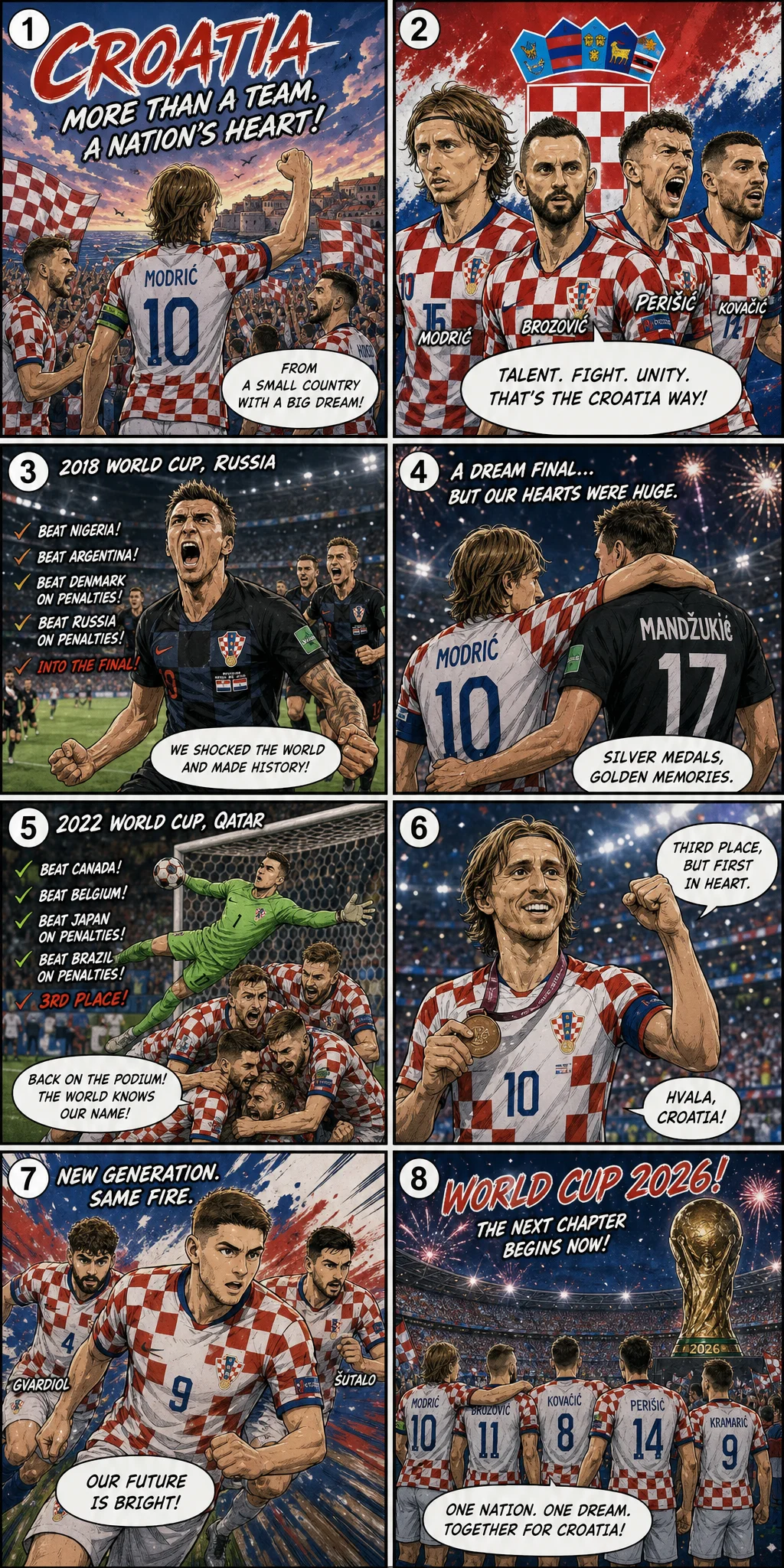
8-panel comic about Croatia national football team and their journey to the 2026 FIFA World Cup.
Published: June 5, 2026
Croatia National Football Team: The Checkered Ones and the Art of the Impossible
The Croatia national football team, known as "Vatreni" (The Fiery Ones) for the red-and-white checkered jerseys that have become one of football's most recognizable sights, represents one of the most extraordinary stories in international sport. A nation of barely four million people, independent only since 1991, Croatia has achieved what no country of comparable size has managed in modern football history: reaching a World Cup final and a World Cup semi-final in consecutive tournaments. As they prepare for the 2026 FIFA World Cup, the Vatreni carry the expectations that their own success has created — and the quiet confidence that their golden generation may have one more miracle left.
HISTORICAL FOUNDATIONS
Football in Croatia predates the modern nation by nearly a century. The game arrived in the late nineteenth century through Austro-Hungarian influence, with the first clubs forming in Zagreb, Split, and the coastal cities of Dalmatia. Hajduk Split, founded in 1911 by Croatian students studying in Prague who had been inspired by Czech football culture, became the club of the Dalmatian people, its name derived from the hajduk freedom fighters who resisted Ottoman rule. Dinamo Zagreb, the capital's club, emerged as Croatian football's other great institution. The Dinamo-Hajduk rivalry is the nation's eternal derby, a clash of central and coastal, urban and maritime, establishment and rebellion.
Within the Kingdom of Yugoslavia and then socialist Yugoslavia, Croatian footballers were both celebrated and constrained. The Yugoslav national team that reached the semi-finals of the 1930 World Cup relied heavily on Croatian players, and the tradition continued through the decades. Croatian footballers regularly starred for the Yugoslav national team — Stjepan Bobek, Bernard Vukas, and later the prodigious talents of the 1987 FIFA World Youth Championship-winning team, which included Robert Prosinečki, Zvonimir Boban, Davor Šuker, and Robert Jarni.
The political dimension of Croatian football was always present. The 1990 match between Dinamo Zagreb and Red Star Belgrade at Maksimir Stadium, which descended into a riot with Boban famously kicking a policeman who was attacking a Dinamo supporter, is retrospectively viewed as a symbolic moment in Croatia's march toward independence. When Croatia declared independence in 1991 and endured a brutal war, football became — as it has for so many nations in conflict — a vehicle for asserting national identity and international recognition. The Croatian Football Federation joined FIFA in 1992 and UEFA in 1993, and the national team's first major tournament, Euro 1996 in England, was an announcement that the checkered jersey had arrived.
THE GOLDEN GENERATION OF 1998
Croatia's 1998 World Cup campaign in France remains one of the most remarkable debuts in tournament history. Under the astute management of Miroslav "Ćiro" Blažević, a man of theatrical pronouncements and tactical cunning, Croatia reached the semi-finals and finished third, defeating the Netherlands 2-1 in the third-place playoff. Davor Šuker won the Golden Boot with six goals, his left foot proving among the deadliest weapons in the tournament. The image of Šuker, arms outstretched, checkered jersey billowing, became Croatian football's first globally recognized icon.
The 1998 team was an extraordinary collection of talent. Zvonimir Boban, the captain and AC Milan midfielder, brought the creative intelligence and competitive fire of a player forged in Serie A's most unforgiving era. Robert Prosinečki, the chain-smoking genius who remains the only player to have scored in World Cups for two different nations (Yugoslavia in 1990, Croatia in 1998), possessed a left foot that seemed to receive instructions from a different dimension. Slaven Bilić anchored the defense with the intensity that would later make him a charismatic national team manager. Igor Štimac brought aerial dominance and leadership. The team's 3-0 quarter-final demolition of Germany — the European champion, a football superpower reduced to rubble by the checkered onslaught — announced Croatia not as a plucky newcomer but as a genuine force.
THE MODEST YEARS AND THE SECOND COMING
The decade following 1998 was a period of relative decline, with Croatia failing to advance from the group stage in 2002 and 2006 and missing the 2010 World Cup entirely. The Vatreni remained a respected European side, qualifying consistently for European Championships, but the magic of 1998 seemed increasingly distant. The football infrastructure, hampered by a small population, limited domestic resources, and the perpetual challenge of competing with larger European nations for talent development, required reinvention.
The reinvention arrived in the form of a generation that would surpass even the 1998 team. Luka Modrić, born in 1985 in the Dalmatian hinterland, his childhood marked by displacement during the war and the murder of his grandfather by Serb forces, emerged from Dinamo Zagreb's academy and via Tottenham Hotspur to become the midfield heartbeat of Real Madrid and, eventually, the first man other than Lionel Messi or Cristiano Ronaldo to win the Ballon d'Or in a decade. His story — the refugee boy who became the world's best player — is the story of modern Croatia.
Alongside Modrić grew a cohort of extraordinary quality. Ivan Rakitić, born in Switzerland to Croatian parents, chose to represent Croatia and brought the technical precision and strategic intelligence that defined his years at Sevilla and Barcelona. Mario Mandžukić, the warrior striker whose relentless pressing, aerial combativeness, and knack for scoring crucial goals — including the winner against England in the 2018 semi-final and an own goal in the World Cup final that couldn't diminish his legend — embodied the Croatian spirit of never yielding. Dejan Lovren and Domagoj Vida formed a central defensive partnership built on aggression, communication, and an almost supernatural ability to win headers. Danijel Subašić, the Monaco goalkeeper, saved penalties in two consecutive knockout shootouts in 2018, his tribute to a friend who had died years earlier — revealing a photograph of the man beneath his jersey after each victory — adding a layer of human emotion that transcended sport.
THE 2018 MIRACLE
The 2018 World Cup in Russia was Croatia's masterpiece. The Vatreni won their group with maximum points, including a 3-0 demolition of Argentina that was as complete a performance as any in the tournament. Then came the knockout stage, a test of endurance that would have broken a larger, deeper squad. Three consecutive extra-time matches — against Denmark, Russia, and England — represented a cumulative physical burden that seemed impossible for a squad that was not, by any objective measure, among the tournament's deepest.
The round-of-16 match against Denmark saw Modrić miss a penalty in extra time that would have won the match, then step up to take and convert one in the shootout anyway. The quarter-final against hosts Russia went to penalties after another 2-2 draw. The semi-final against England, with Croatia falling behind early to a Kieran Trippier free-kick, looked like the end. Instead, it was the beginning of England's agony and Croatia's apotheosis. Ivan Perišić's equalizer, Mandžukić's winner in the 109th minute — the Vatreni, playing their third extra time in ten days, somehow looked fresher in the 120th minute than England did. The image of Modrić, the smallest man on the pitch, still sprinting in the dying moments, became the defining photograph of Croatian sporting history.
The final against France was a bridge too far — a 4-2 defeat in a match that felt closer than the scoreline suggested, with a controversial penalty and an own goal tilting fortune away from the checkered shirts. But Croatia had already won. The nation of four million had taught the world something about resilience, about the power of collective will, about the possibility of the small overcoming the large through sheer bloody-minded refusal to accept defeat.
THE 2022 CAMPAIGN AND BEYOND
The 2022 World Cup in Qatar demonstrated that 2018 was not a one-off. Croatia, with an aging but indomitable core, reached the semi-finals again, defeating Japan and Brazil on penalties before falling to Argentina. The quarter-final against Brazil — the tournament favorite, the five-time champion, the most glamorous name in football history — was a study in Croatian character. Brazil scored a goal of sublime quality in extra time, Neymar weaving through the defense and finishing past Dominik Livaković. The match seemed over. Croatia equalized in the 117th minute through Bruno Petković. They won the penalty shootout, Livaković becoming the first goalkeeper since Sergio Goycochea to save multiple penalties in a World Cup knockout match. Brazil, the beautiful game's most beautiful practitioners, were eliminated by a nation of four million whose football is built on something more elemental than beauty.
THE ART OF CROATIAN FOOTBALL
Croatian football possesses a distinctive aesthetic and philosophy. The technical quality is extraordinary — Croatian players are comfortable receiving the ball in tight spaces, under pressure, in any situation. This is a product of a youth development culture that prioritizes technique and decision-making above physical attributes. The famous "Croatian diamond" — Modrić, Rakitić, and the midfielders around them — operates on a wavelength that seems to transcend coaching, a collective intelligence born of countless hours playing together and a shared football culture.
But it is the mental fortitude that truly sets Croatian football apart. This team does not lose penalty shootouts — three consecutive shootout victories, against Denmark, Russia, and Japan, with a fourth against Brazil thrown in for good measure, is not a statistical anomaly but a reflection of extraordinary psychological preparation and collective nerve. This team does not quit when trailing — the comebacks against England in 2018 and Brazil in 2022 are among the greatest reversals in World Cup history. This team plays better the longer the match goes, the deeper into the tournament it progresses, the more impossible the situation appears.
The sources of this resilience are complex and intertwined with national identity. Croatia is a country forged in war, whose citizens have known genuine hardship within living memory. The players who grew up during the 1990s conflict carry an understanding that football, while deeply important, is not the most serious thing they have faced. There is a perspective, a refusal to panic, a belief that whatever happens on a football pitch is manageable compared to what their parents and grandparents endured. This is not romanticization — it is a documented psychological phenomenon that Croatian coaches deliberately cultivate: the team that has survived worse will survive this.
LEGENDS OF THE VATRENI
Luka Modrić is Croatia's greatest footballer and one of the supreme midfielders in the history of the sport. His 2018 Ballon d'Or — breaking the Messi-Ronaldo duopoly — was recognition of a player whose genius resides not in statistics but in the control of football matches at their most fundamental level. Modrić decides tempo. He decides when to accelerate and when to pause. He receives the ball in positions that would panic lesser players and emerges into space as if the pressure was never there. His longevity — still playing at the highest level well into his late thirties, still covering more ground than players a decade younger — is a monument to physical discipline and competitive obsession.
Davor Šuker's six goals in 1998 made him Croatian football's first global star, his left-footed finishes — chips, curlers, thunderous drives — demonstrating a variety of scoring techniques that few strikers in history have matched. Zvonimir Boban's leadership and creative vision defined the 1998 generation. Robert Prosinečki's mercurial talent — a player who could decide a World Cup match while seemingly operating at half-speed — made him a cult figure across European football. Mario Mandžukić's warrior spirit, his willingness to run himself to exhaustion and beyond, made him the emotional center of the 2018 team despite Modrić winning the individual accolades. Ivan Perišić's clutch goals in major tournaments — against England, against France, against Japan — have made him arguably the most underrated big-game player of his generation.
THE MODERN GENERATION
The post-Modrić transition is the central question of Croatian football entering 2026. The Vatreni have been built around a generational midfield core for so long that imagining life without it feels like imagining a different national team. But the transition is underway. Mateo Kovačić, now at Manchester City, has spent his career learning from Modrić at Real Madrid and the national team, absorbing the master's lessons about tempo control and defensive positioning while adding his own explosive dribbling ability. Marcelo Brozović, the metronome whose positional discipline and passing accuracy free others to create, remains the tactical linchpin.
Joško Gvardiol, the center-back whose 2022 World Cup performance, playing through a facial injury with a protective mask that made him look like a superhero, announced a generational defensive talent. His subsequent move to Manchester City for a fee that made him one of the most expensive defenders in history confirmed his status. Luka Sučić, the Red Bull Salzburg creative midfielder, represents the next wave of Croatian technical talent. The goalkeeper position, with Livaković's penalty-saving heroics providing a new dimension of security, is in safe hands.
THE ROAD FORWARD
Croatia's 2026 World Cup campaign asks a question that has never been asked of the Vatreni before: can they contend without being underdogs? The 1998 semi-final was a stunning debut. The 2018 final was a miracle. The 2022 semi-final was confirmation. But now Croatia enters a tournament as a known quantity, a team that opponents prepare for specifically, a nation that no longer surprises anyone. The psychology of expectation is different from the psychology of the underdog, and navigating it is the next test of Croatian football's maturity.
The nation's football infrastructure continues to develop. The Croatian league, dominated by Dinamo Zagreb but increasingly competitive, produces technically accomplished players at a rate that defies the country's population. The diaspora — Croatian communities in Australia, Germany, Switzerland, and beyond — expands the talent pool. But the fundamental reality remains: Croatia is a country of four million competing against nations of forty, sixty, two hundred million. It succeeds because it produces better footballers, pound for pound, than almost anyone, and because those footballers possess a collective character forged in a history that has taught them never to accept the limits that others would impose.
The checkered jersey will appear at the 2026 World Cup, as it has at every tournament since independence. The Vatreni will play with technical elegance and competitive ferocity. They will be outnumbered in the stands, out-resourced in the budget sheets, and outsized in the population statistics. And they will believe, with the quiet certainty that comes from having done the impossible before, that they can do it again. That is the Croatian way. That is what it means to wear the checkered shirt.