Ghana: Journey to 2026
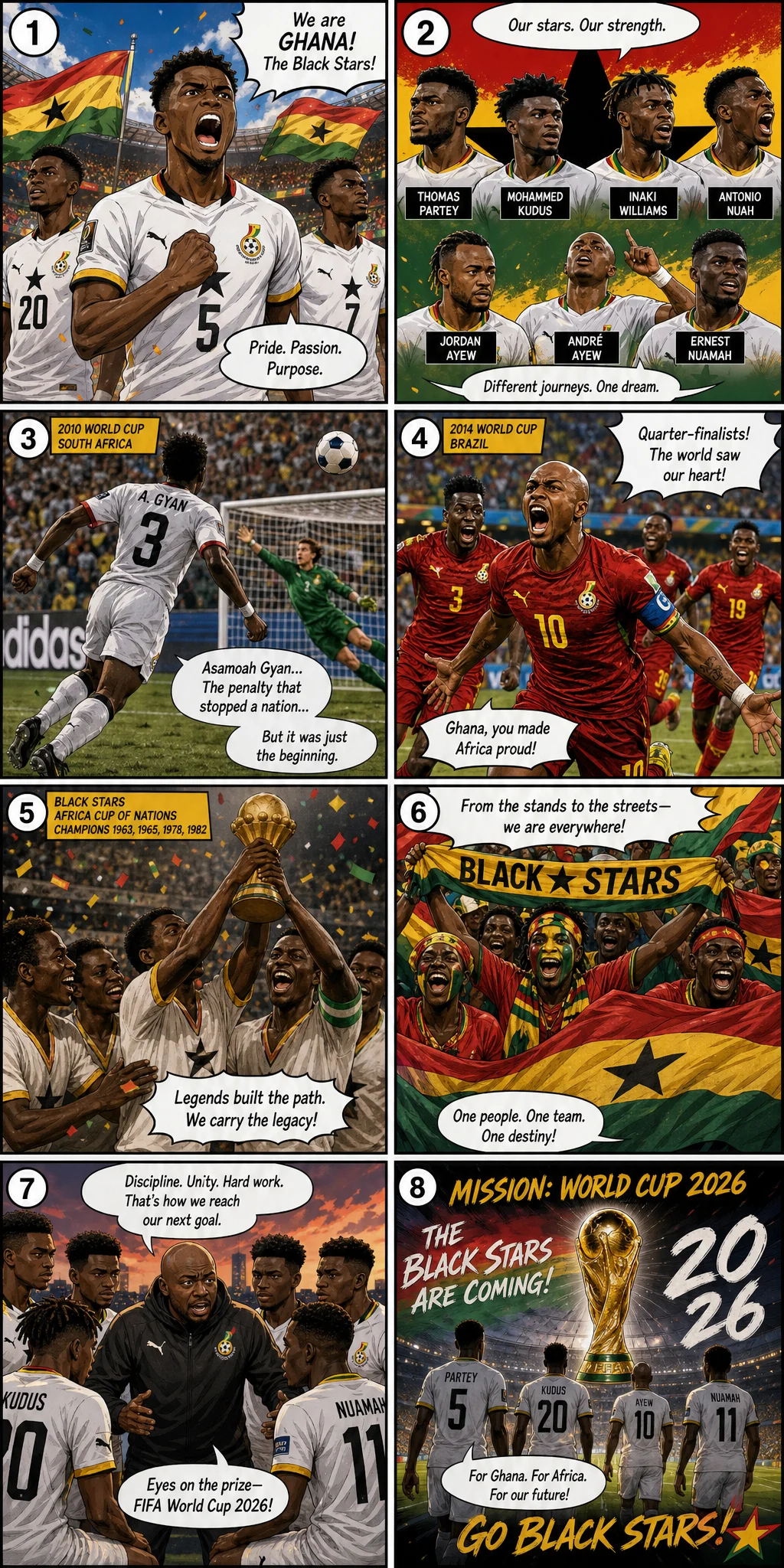
8-panel comic about Ghana national football team and their journey to the 2026 FIFA World Cup.
Published: June 5, 2026
Ghana National Football Team: The Black Stars Illuminating a Continent
The Ghana national football team, known as "The Black Stars" for the single black star that adorns the nation's flag — the lodestar of African independence and Pan-African aspiration — carries the hopes of a football-mad nation that has come closer than any other to bringing African football to the World Cup's ultimate stages. As they pursue qualification for the 2026 FIFA World Cup, the Black Stars seek to recapture the magic that made them Africa's most compelling World Cup story and to finally break through the barrier that stopped them in 2010.
HISTORICAL FOUNDATIONS
Football in Ghana traces its organized origins to the early twentieth century under British colonial rule. The game was introduced by European merchants, soldiers, and missionaries along the Gold Coast, spreading rapidly through the coastal cities of Accra, Cape Coast, and Sekondi. The Gold Coast Football Association was founded in 1920, and by the 1930s, the colony had developed a competitive club structure centered on the great institutions that still dominate Ghanaian football: Hearts of Oak, founded in 1911 in Accra, and Asante Kotoko, founded in 1935 in Kumasi. The Hearts-Kotoko rivalry is among Africa's oldest and most passionate, a cultural fault line that divides families, cities, and the nation itself on derby days.
Ghana achieved independence in 1957 under the visionary leadership of Kwame Nkrumah, who understood football's power as a vehicle for national unity and international recognition. Nkrumah invested state resources in football development, and the Black Stars quickly became a symbol of the new nation's ambition. Ghana won the Africa Cup of Nations in 1963 and 1965, establishing itself as a continental power just years after independence. The team of that era — featuring the legendary dribbler Osei Kofi, the prolific striker Wilberforce Mfum, and the commanding goalkeeper Dodoo Ankrah — announced that Ghana was not merely participating in African football but defining its possibilities.
Pan-African politics and football intertwined in Ghana throughout the Nkrumah era and beyond. The national team was explicitly positioned as a symbol of African capability and dignity, a rebuttal to colonial narratives of inferiority. When the Black Stars won, African people everywhere celebrated. This political dimension of Ghanaian football — the sense that the team represents not merely a nation but an idea — persists into the modern era and colors every World Cup campaign with deeper meaning.
THE GOLDEN GENERATIONS
Ghana's international football breakthrough came at youth level, where the nation's prodigious talent production first captured global attention. The Black Starlets, Ghana's under-17 team, won the FIFA U-17 World Championship in 1991 and 1995, defeating Spain and Brazil respectively. The 1991 team featured a core that would define Ghanaian football for a generation: Samuel Kuffour, the defender whose emotional collapse after Bayern Munich's last-minute Champions League final defeat in 1999 — pounding the turf in inconsolable anguish — remains one of football's most human images, and whose career (Bayern Munich, Roma, over 50 caps) established the template for Ghanaian success in Europe. The 1995 team produced Stephen Appiah, the future captain whose leadership and midfield generalship would carry Ghana to its first World Cup.
The U-20 team, the Black Satellites, won the African Youth Championship and the FIFA U-20 World Cup in 2009, defeating Brazil on penalties in a final held in Cairo that felt, to the overwhelmingly Egyptian crowd, like a home match. The team featured players who would form the spine of Ghana's 2010 World Cup quarter-final squad, including André Ayew, Jonathan Mensah, and Dominic Adiyiah, whose predatory instincts won him the tournament's Golden Boot.
Ghana's first World Cup qualification, for the 2006 tournament in Germany, was a landmark in national history. The Black Stars advanced from a group containing Italy, the Czech Republic, and the United States — defeating the Czechs and Americans — before losing to Brazil in the round of 16. The tournament announced Ghana to the global football audience and established the template for what would follow: technically proficient, physically imposing, tactically organized, and utterly unafraid of football's established powers.
THE 2010 CAMPAIGN: ZENITH AND HEARTBREAK
The 2010 World Cup in South Africa, the first held on African soil, was Ghana's moment. The Black Stars, carrying the hopes of an entire continent, advanced from a group containing Germany, Serbia, and Australia before defeating the United States 2-1 in extra time in the round of 16 — Asamoah Gyan's thunderous left-footed winner remains the goal against which all Ghanaian World Cup moments are measured.
The quarter-final against Uruguay in Johannesburg's Soccer City stadium on July 2, 2010, is one of the most famous and traumatic matches in World Cup history. The match was tied 1-1 deep into extra time. Ghana won a free-kick, delivered into the penalty area. A goalmouth scramble ensued. Dominic Adiyiah's header was goal-bound. Uruguay's Luis Suárez, standing on the goal line, deliberately blocked the ball with his hands — a professional foul of the most calculated kind, trading a certain goal for a red card and a penalty. Suárez was sent off. Asamoah Gyan, Ghana's penalty specialist whose nerveless finishing had defined the tournament, stepped up. His shot struck the crossbar and flew over. The match went to penalties, which Ghana lost. Suárez, watching from the tunnel, celebrated wildly. An entire continent mourned.
The aftermath of that night continues to reverberate. Gyan, one of Ghana's greatest players and a man of extraordinary resilience, has spoken of the psychological weight he carried for years. Suárez became, for African football fans, a villain of almost mythical dimensions. The question of what might have been — Ghana one penalty kick from becoming the first African World Cup semi-finalist, a barrier almost certainly broken had Gyan scored — haunts the nation's football consciousness.
LEGENDS OF THE BLACK STARS
Abedi "Pelé" Ayew is Ghana's greatest-ever player and one of African football's most influential figures. His elegance, creativity, and leadership for Marseille — where he won the 1993 Champions League, the first African player to lift the trophy as his team's creative fulcrum — made him a three-time African Footballer of the Year. His dribbling style, upright and unhurried, combined with a left foot capable of extraordinary power and precision, influenced a generation of West African playmakers. His sons, André and Jordan Ayew, have both captained the Black Stars, creating one of football's most distinguished dynasties.
Samuel Kuffour's international career spanned over a decade and 50 caps, his defensive performances for Bayern Munich making him one of the most respected African defenders in European football history. Michael Essien, the "Bison" whose physical power, technical quality, and indefatigable energy made him the world's most expensive African player when he moved from Lyon to Chelsea in 2005, set the standard for the modern box-to-box midfielder. Injuries limited his World Cup impact — he missed the 2010 tournament entirely — but his influence on Ghanaian football, as a symbol of what Ghanaian players could achieve in Europe's elite leagues, was profound.
Stephen Appiah's captaincy defined Ghana's breakthrough era. His leadership during the 2006 campaign, his emotional intelligence in managing a squad of strong personalities, and his clutch performances in crucial matches earned him a place among Ghana's most beloved football figures. Sulley Muntari, the tempestuous left-footer whose thunderous long-range strikes and confrontational style divided opinion, was nonetheless a critical component of the teams that reached back-to-back World Cups. Asamoah Gyan's 51 goals for the national team make him Ghana's all-time leading scorer, his redemption arc after the 2010 penalty miss — continuing to score crucial goals for the Black Stars, including at the 2014 World Cup — a testament to mental strength.
THE MODERN ERA
The decade following 2010 has been challenging for Ghanaian football. The 2014 World Cup campaign was overshadowed by a bonus dispute that saw players threatening to boycott a crucial match, the Ghanaian government flying three million dollars in cash to Brazil to satisfy the squad. The embarrassing episode exposed the governance weaknesses that have long undermined Ghanaian football's potential. The team exited in the group stage, and the sense of an opportunity squandered was palpable.
The 2018 qualification failure, Ghana missing the World Cup for the first time since 2006, prompted a period of introspection and renewal. The 2022 World Cup in Qatar saw Ghana return to the global stage, and the campaign — despite a narrow group-stage exit — offered encouragement. The young squad, featuring players like Mohammed Kudus and the emerging talents around him, competed competitively against Portugal, South Korea, and Uruguay. The match against Uruguay carried particular emotional weight — a chance to exorcise the ghost of 2010 — but a 2-0 defeat ended in group-stage elimination. The football, however, was the most cohesive Ghana had played in years.
The current generation represents a fresh start. Mohammed Kudus, the West Ham United attacking midfielder, is the most exciting Ghanaian talent since Essien. His close control, explosive acceleration, and goal-scoring instinct from midfield — he scored twice against South Korea in Qatar — make him the attacking focal point around which the modern Black Stars are built. Kamaldeen Sulemana, the Southampton winger with electric pace and fearless dribbling, provides width and unpredictability. Thomas Partey, when fit, anchors the midfield with the physical presence and passing range honed at Atlético Madrid and Arsenal — though his availability for the national team has been a recurring source of tension between club and country.
The defensive unit, historically Ghana's vulnerability, has shown signs of stabilization. Mohammed Salisu and Alexander Djiku form a center-back partnership of complementary qualities — Salisu's physicality and Premier League experience alongside Djiku's reading of the game and Ligue 1 pedigree. The full-back positions, with Tariq Lamptey's electric pace and Gideon Mensah's defensive solidity, offer balance. The goalkeeper position, long a source of anxiety, has benefited from improved youth development.
TACTICAL IDENTITY
Ghanaian football is built on a foundation of athleticism, technical quality, and tactical discipline — a combination that distinguishes the Black Stars from many African teams that emphasize one dimension at the expense of others. The modern team lines up in a 4-2-3-1 or 4-3-3, with the double midfield pivot providing defensive protection for the creative talents ahead. Kudus operates as the number ten or as a roaming attacking midfielder, tasked with finding pockets of space between the lines and linking midfield to attack.
Counter-attacking remains the team's most dangerous weapon. The pace of the wingers, the direct running of the full-backs, and Kudus's ability to carry the ball through midfield make Ghana lethal in transition. Set pieces, with the team's physical advantages over many opponents, represent a consistent scoring threat. The challenge has been breaking down organized defenses in possession — the patient, probing football required to unlock a low block has not always come naturally to a team built for explosive moments.
The mental dimension has been the subject of significant investment. The 2014 bonus dispute, the 2010 penalty trauma, the recurring episodes of internal conflict — Ghanaian football has been haunted by the sense that its own psychology is its greatest opponent. Recent coaching staff have prioritized team cohesion, transparent communication, and psychological preparation, recognizing that talent alone cannot overcome the self-inflicted wounds that have undermined past campaigns.
FOOTBALL AND GHANAIAN SOCIETY
Football is woven into the fabric of Ghanaian life more deeply than any other cultural institution. On any evening in any Ghanaian city, town, or village, the glow of television screens in bars, homes, and street-side viewing centers signals that football is being consumed. The English Premier League commands a following that rivals and often exceeds the local Ghana Premier League — a complex dynamic of postcolonial cultural consumption that Ghana shares with much of Anglophone Africa.
The domestic league, centered on the Hearts of Oak and Asante Kotoko rivalry, remains the nation's footballing foundation. The Accra Sports Stadium and the Baba Yara Stadium in Kumasi, the cathedrals of Ghanaian club football, generate atmospheres of extraordinary intensity. But the league has struggled with funding, infrastructure, and the perpetual challenge of retaining talent in the face of European and Asian financial power. The exodus of young Ghanaian players to obscure leagues in hopes of a European breakthrough — often facilitated by exploitative agents — represents a systemic challenge that the Ghana Football Association has struggled to address.
The Black Stars' significance transcends sport. In a nation marked by ethnic, regional, and political divisions, the national team serves as a rare unifying force. When Ghana plays in a World Cup, the entire nation pauses. Political differences are suspended. The accumulated frustrations of daily life — power outages, economic hardship, governance disappointments — are channeled into ninety minutes of collective hope. The team's success generates a national euphoria that no political event can match. Its failures produce a collective grief that can linger for days.
THE ROAD AHEAD
Ghana's path to the 2026 World Cup runs through African qualifying, which has been restructured to accommodate the expanded 48-team tournament. The nine automatic African slots provide more opportunities than the five of previous cycles, but the competition remains intense. The Black Stars must navigate a qualifying group and then a playoff structure that tests depth, organization, and mental resilience — the very qualities that Ghanaian football has inconsistently demonstrated.
The institutional challenges persist. The Ghana Football Association's governance, financial management, and relationship with the government require improvement if the nation's football potential is to be fully realized. The domestic league needs investment and professionalization. Youth development, while still producing talent at impressive rates, requires more systematic pathways from community football to professional academies to senior competition.
But the fundamentals of Ghanaian football remain strong. The talent pipeline — from the dusty pitches of Accra New Town and Kumasi Zongo to the academies that have produced Kudus, Sulemana, and countless others — continues to generate players of international quality. The passion of the supporters, the institutional memory of coming within a crossbar of a World Cup semi-final, and the burning desire to complete the journey that began in 2006 — these intangibles matter.
The Black Stars will arrive at the 2026 World Cup, should they qualify, carrying the star on their chests and the hopes of a continent on their backs. Africa's wait for a World Cup semi-finalist continues. Ghana, more than any other nation, knows how close it is possible to come. The next step is not about talent or tactics. It is about destiny — and whether the Black Stars can finally align their footballing gifts with the fortune that has so cruelly eluded them.