Panama: Journey to 2026
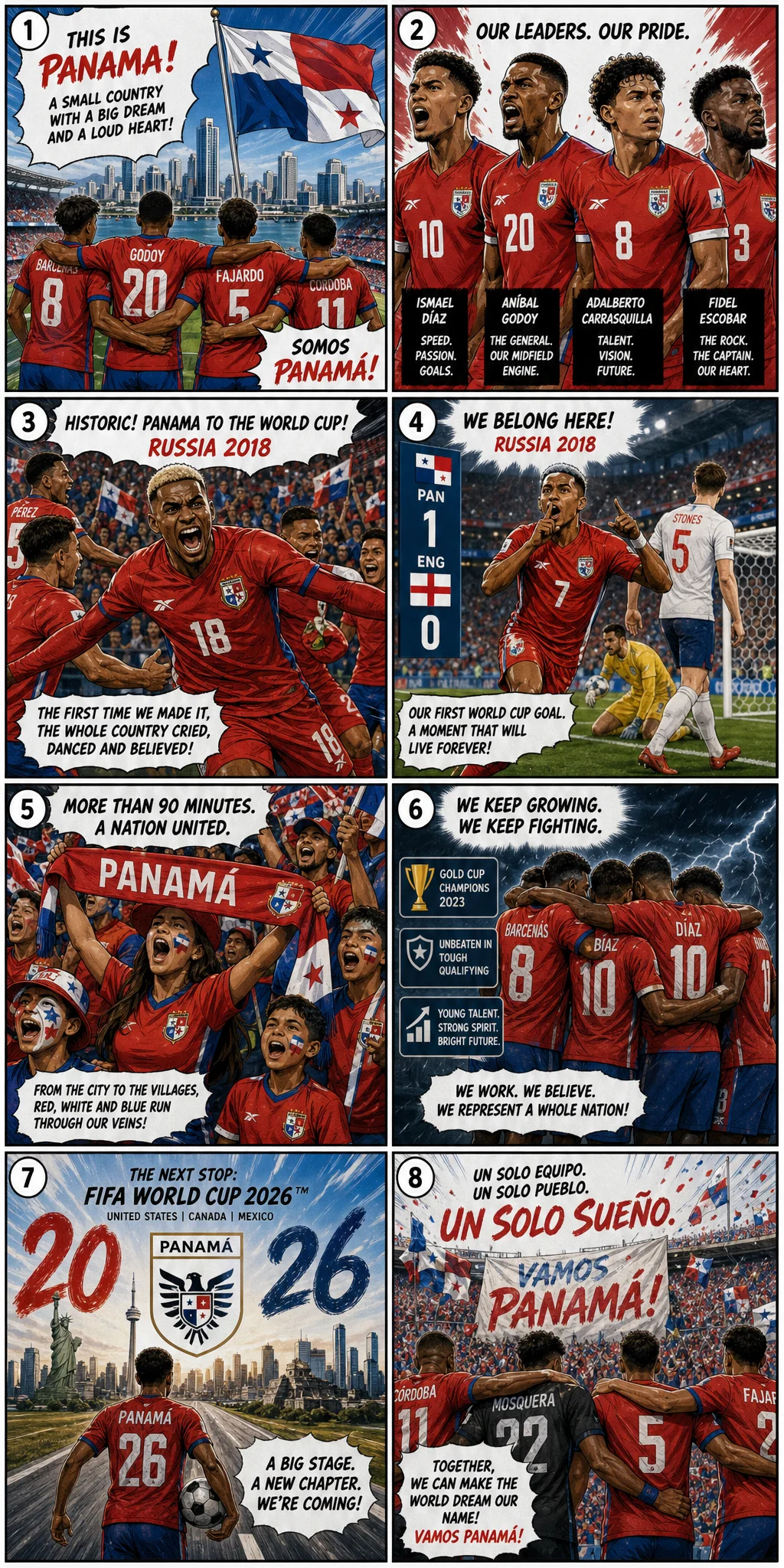
8-panel comic about Panama national football team and their journey to the 2026 FIFA World Cup.
Published: June 5, 2026
Panama National Football Team: The Canaleros' Impossible Dream
The Panama national football team, known as "Los Canaleros" (The Canal Men), represents one of the most improbable success stories in modern football. A nation of barely four and a half million people, long dismissed as a baseball country in a baseball region, Panama stormed into global football consciousness with a World Cup qualification that defied every expectation. As they pursue the 2026 FIFA World Cup, Los Canaleros embody the belief that football's frontiers are never truly fixed — that the game's growth is measured not only in trophies but in the dreams it makes possible.
HISTORICAL FOUNDATIONS
Football arrived in Panama in the early twentieth century, carried by the same transnational currents that shaped the nation itself. The Panama Canal, the engineering marvel that bisects the country and defines its geopolitical significance, brought workers, merchants, and travelers from across the globe. Among them were British West Indians, Europeans, and South Americans who brought footballs alongside their tools and trade goods. The game took root in the Canal Zone, the American-administered territory that existed as a state within a state, and in the port cities of Colón and Panama City.
Panamanian football developed in the shadow of the Canal Zone's peculiar colonial arrangement and the overwhelming cultural influence of the United States. Baseball, not football, was the sport of American influence, and for most of the twentieth century, Panama was defined as a baseball nation. The country's greatest sporting heroes were baseball players — Rod Carew, the Hall of Fame hitter born on a train traveling through the Canal Zone, and Mariano Rivera, the greatest closer in Major League Baseball history. Football existed in the margins, played passionately but without the institutional support, media attention, or national prestige accorded to baseball.
The early decades of Panamanian football were marked by occasional regional success. Panama won the CCCF Championship (the precursor to the CONCACAF Gold Cup) in 1951 and finished third in the Central American and Caribbean Games. But World Cup qualification remained a distant fantasy. The gap between Panama and the CONCACAF powers — Mexico, the United States, Costa Rica — seemed unbridgeable, a function of population, resources, and football infrastructure that no amount of passion could overcome.
THE RISE OF THE CANALEROS
Panama's football transformation began in the early 2000s, driven by a combination of factors that aligned with almost providential timing. The Panamanian Football Federation (FEPAFUT), under new leadership, invested in youth development, coaching education, and the professionalization of the domestic league. The Liga Panameña de Fútbol (LPF), though modest by international standards, provided a competitive foundation. The diaspora — Panamanian communities in the United States, Colombia, and beyond — expanded the talent identification network.
The generational shift was personified by a cohort of players who came of age together, developed together, and believed together. Román Torres, the imposing center-back whose physical presence and emotional leadership would define the team's identity, emerged from Chepo in the Panamanian interior. Luis Tejada, the prolific striker whose goal-scoring instincts had carried him through leagues across Latin America and the Middle East, became the attacking talisman. Blas Pérez, Tejada's strike partner, brought experience and aerial dominance. Gabriel Gómez, the midfield anchor, provided the tactical discipline that allowed the creative talents to flourish. Jaime Penedo, the goalkeeper whose cat-like reflexes and penalty-saving heroics would become legendary, provided the last line of a defense built on collective commitment.
The proximate cause of Panama's breakthrough was the leadership of two Colombian coaches who understood the CONCACAF landscape and the psychology of smaller football nations. Hernán Darío "Bolillo" Gómez, the chain-smoking tactician who had previously led Colombia and Ecuador to World Cups, installed the tactical discipline, defensive organization, and belief that Panamanian football had historically lacked. Julio César Dely Valdés, one of Panama's greatest-ever players — a striker who had scored prolifically in European football for Cagliari, Paris Saint-Germain, and Málaga — managed the national team and brought the credibility that only a genuine Panamanian football legend could command. His twin brother Jorge, also a legendary striker, and his nephew, the generation that followed, created a football dynasty that runs through Panamanian history.
THE NIGHT OF NOVEMBER 10, 2017
The defining moment of Panamanian football occurred on the night of October 10, 2017 — though it would become known, for reasons that require explanation, as the night the impossible happened. Panama entered the final matchday of CONCACAF World Cup qualifying needing a victory over Costa Rica, combined with other results, to reach the 2018 World Cup. The United States, the regional superpower, needed only a draw against last-placed Trinidad and Tobago to qualify. The mathematics were brutal: Panama's chances required a miracle.
What happened over the course of ninety minutes in Panama City and Port of Spain has become the foundational myth of modern Panamanian football. Panama took an early lead through Gabriel Torres, a goal scored with a shot that took a deflection, the sort of fortune that had never smiled on Panamanian football in its decades of qualification futility. Costa Rica, already qualified and fielding a rotated squad, equalized. The match entered its final minutes with the score tied 1-1, a result that would eliminate Panama regardless of other outcomes.
Then, in the 88th minute, Román Torres — the captain, the emotional heartbeat, the man who had played through injuries and setbacks and years of near-misses — received the ball inside the Costa Rican penalty area. His first touch was imperfect, the ball bouncing awkwardly. His second touch was a shot, a left-footed strike through a forest of legs. The ball found the corner of the net, and the Estadio Rommel Fernández detonated. Torres, having scored the goal, simply stood with his arms outstretched, a man who understood, in that crystalline moment, that he had just altered the course of his nation's history.
Simultaneously, 2,200 kilometers away in Trinidad, an own goal and a long-range strike gave the Soca Warriors an improbable 2-1 victory over the United States. The combination of results — Panama's victory and the American defeat — delivered Panama directly to the World Cup. The United States, CONCACAF's colossus, missed the tournament for the first time since 1986. Panama, the afterthought, was going to Russia. The footage of Román Torres, tears streaming down his face, being mobbed by teammates as the magnitude of the achievement settled over the stadium, became Panamanian football's defining image.
President Juan Carlos Varela declared October 11 a national holiday. The celebration that gripped the nation was cathartic — not merely a sporting achievement but a collective vindication, proof that Panama could compete and succeed on the world's largest stages, that the nation was more than a canal, more than a transit point, more than the limitations others had imposed upon it.
THE 2018 WORLD CUP
Panama's 2018 World Cup campaign, by purely competitive measures, was a disappointment. Los Canaleros lost all three group matches — to Belgium 3-0, to England 6-1, and to Tunisia 2-1 — and finished bottom of their group. The Belgium loss was expected; the European golden generation dismantled Panama with brutal efficiency. The England defeat was humbling; Harry Kane's hat-trick (two penalties, one deflection) suggested the gulf between World Cup debutants and established powers.
But the Tunisia match contained a moment that transcended competitive results. In the 35th minute, with Panama trailing 1-0, a challenge in the Tunisian penalty area drew appeals for a foul. While the Tunisian players protested, Panama took a quick free-kick. The ball reached Gabriel Torres, whose shot was parried. The rebound fell to a sliding Panamanian player who deflected the ball over the line — a goal, Panama's first in World Cup history, scored by an own goal. The scorer's identity mattered less than the fact. The ball was in the net. Panama had scored at the World Cup.
Then, in the 78th minute, came the moment that Panamanians will recount to their grandchildren. A set piece was delivered into the Tunisian penalty area. The ball was headed down, and Felipe Baloy — the 37-year-old defender, playing in his first and only World Cup at the end of a career that had spanned two decades — arrived at the far post. His right-footed volley crashed into the roof of the net. Baloy sprinted toward the corner flag, arms pumping, face contorted with an emotion that millions watching understood instantly. This was the first goal scored by a Panamanian at a World Cup, achieved by a player who had given his entire career to the national team, who had endured every near-miss and heartbreak, who was old enough to be the father of some of his teammates. The commentary around the world — the shock, the joy, the recognition that this was what the World Cup was truly about — confirmed that Panama had arrived not as a participant but as a contributor to the tournament's emotional tapestry.
LEGENDS OF LOS CANALEROS
Julio César Dely Valdés is the foundational figure of Panamanian football. His club career — 108 goals in European football, including a season where he finished as Serie A's second-top scorer behind Gabriel Batistuta — established that Panamanian players could compete at the highest level. His national team career, 32 goals in 49 appearances, made him Panama's all-time leading scorer. His coaching career, including his tenure as national team manager, bridged the gap between Panama's football past and its World Cup future. His twin brother Jorge, with 24 international goals, formed with Julio César the most lethal sibling partnership in CONCACAF football history.
Román Torres is the folk hero of Panamanian football. His goal against Costa Rica on that October night immortalized him beyond any statistical measure. His leadership, his physical presence — a man built like a heavyweight boxer playing center-back — and his emotional authenticity made him the embodiment of the Canaleros' spirit. When Román Torres cried, Panama cried with him. When he celebrated, the nation danced.
Luis Tejada, "El Matador," scored 43 goals for the national team, a record that placed him among CONCACAF's most prolific strikers. His career spanned clubs across a dozen countries — Panama, Colombia, Peru, Mexico, the United States, the United Arab Emirates — a journeyman's odyssey that reflected the reality of CONCACAF football outside the region's elite. He died in January 2024 at the age of 41, collapsing during a veterans' match, a tragedy that plunged Panamanian football into grief and prompted a national reckoning with his legacy. Luis Tejada, the boy from the San Miguelito district of Panama City who scored goals everywhere he went, will forever be remembered as the striker who showed Panama that the World Cup was possible.
Jaime Penedo's 135 international caps made him Panama's most-capped player. His performances in qualifying — the reflex saves, the command of his penalty area, the quiet confidence he projected — were foundational to the World Cup qualification campaign. Blas Pérez, the combative forward who turned the physical confrontation with defenders into an art form, partnered Tejada for over a decade. Gabriel Gómez, the midfield general, provided the tactical intelligence and positional discipline that allowed more attacking talents to express themselves. Felipe Baloy's goal against Tunisia transformed a competitive defeat into a national celebration, ensuring his place in the pantheon.
THE MODERN ERA
The post-2018 era has been a period of transition for Panamanian football. The heroes of the qualification campaign have aged out or retired. The task — rebuilding a squad capable of qualifying for an expanded 2026 World Cup while developing the institutional infrastructure to sustain the nation's football growth — is generational.
The current squad is built around a core of players competing in leagues across the Americas and Europe. Michael Amir Murillo, the right-back whose overlapping runs and defensive tenacity have made him a fixture at Anderlecht and Marseille, represents the modern Panamanian footballer: technically accomplished, tactically intelligent, and comfortable in elite European environments. Aníbal Godoy, the Nashville SC midfielder in Major League Soccer, provides the experience and composure that anchors the team. Adalberto Carrasquilla, the Houston Dynamo midfielder, brings creative passing and the ability to dictate tempo — qualities that Panamanian teams of previous generations often lacked.
Edgar Yoel Bárcenas, the winger whose pace and direct running stretch defenses, and José Fajardo, the striker whose physical presence and goal-scoring instinct evoke memories of Tejada and Pérez, represent the attacking threat. Harold Cummings, the veteran center-back, provides continuity with the 2018 generation. The goalkeeper position has seen the emergence of Luis Mejía and others who aim to fill the void left by Penedo's retirement.
The youth pipeline shows promise. Panama's qualification for the 2023 FIFA U-20 World Cup and competitive performances at regional youth tournaments suggest that the 2018 breakthrough was not an isolated event but the beginning of sustained football development. The FEPAFUT's investment in youth academies, coaching education, and infrastructure — funded in part by the financial windfall of World Cup participation — is beginning to bear fruit.
TACTICAL IDENTITY
Panamanian football is built on defensive organization, physical commitment, and opportunistic attacking — the classic profile of a smaller football nation maximizing limited resources. The 4-4-2 that characterized the 2018 qualification campaign, with two banks of four defending compactly and two strikers tasked with holding the ball and waiting for support, reflected the pragmatic approach that Bolillo Gómez installed and his successors have largely maintained.
The modern team has evolved toward a 4-2-3-1 or 4-3-3, reflecting the improved technical quality of the player pool. Carrasquilla's emergence as a genuine creative midfielder has allowed Panama to play with more possession and progressive passing than the purely counter-attacking style of the Gomez era. The full-backs, particularly Murillo, provide width and crossing ability. The set-piece threat remains central — Panama's physical advantages over many CONCACAF opponents make every dead-ball situation a scoring opportunity.
The mental resilience that defined the 2018 qualification campaign — the refusal to accept defeat until the mathematics made it impossible — has been institutionalized as a core component of Panamanian football identity. The Canaleros believe they can compete, they believe they deserve to compete, and they play with an intensity that reflects that belief.
FOOTBALL AND PANAMANIAN SOCIETY
Football's rise in Panama represents a profound cultural shift. A nation historically defined by baseball, by the Canal, and by its role as a transit point for global commerce has embraced football as an expression of national identity in a way that was unimaginable two decades ago. The Estadio Rommel Fernández, named for the Panamanian striker who played in Spain's La Liga in the 1980s, has become a genuine football fortress — the crowd noise, the red sea of supporters' shirts, the collective belief that anything is possible.
The football-baseball dynamic remains complex. Baseball retains deep roots in Panamanian culture, particularly in the interior provinces and among older generations. But football has captured the younger generation with an intensity that baseball cannot match. The global nature of football, its accessibility — all you need is a ball and space, whereas baseball requires equipment — and the transcendent achievement of 2018 have tilted the national sporting identity decisively toward the round ball.
The economic dimension is significant. World Cup qualification in 2018 generated tens of millions of dollars for Panamanian football through FIFA payments, commercial revenue, and increased interest. The challenge is deploying those resources effectively — investing in infrastructure, youth development, and institutional capacity rather than allowing them to be consumed by short-term demands. The FEPAFUT's governance, while improved, remains a work in progress, and the transparency of football administration is a recurring topic of public debate.
THE 2026 OPPORTUNITY
The 2026 World Cup, co-hosted by the United States, Canada, and Mexico, offers Panama an unprecedented opportunity. The expanded 48-team format, with CONCACAF receiving six automatic qualification slots (up from three and a half) and two additional playoff slots through intercontinental playoffs, fundamentally changes the calculus of qualification. Panama, which has consistently ranked between fourth and seventh in CONCACAF, now faces a qualification path that is mathematically more favorable than at any point in its history.
The proximity of the host nations adds another dimension. Panamanian supporters, who traveled to Russia in surprisingly large numbers despite the distance and expense, would flood American and Mexican stadiums. The diaspora — hundreds of thousands of Panamanians living in the United States, particularly in New York, Florida, and Texas — would create de facto home crowds for Canaleros matches. The cultural and linguistic affinity with co-host Mexico, and the geographic proximity to the United States, would make a Panamanian World Cup campaign feel almost like a home tournament.
Qualification in 2026 would confirm that 2018 was not a fluke, not a one-off alignment of stars that would never repeat. It would validate the institutional investment of the past decade. It would inspire a new generation of Panamanian children — children who were too young to remember Román Torres's goal but who have grown up in a world where Panama at the World Cup is not fantasy but fact.
The Canaleros' journey from baseball's shadow to football's greatest stage is a story about the transformative power of belief. Panama had no right to reach the World Cup in 2018 — the population, the resources, the history all argued against it. But belief, when combined with talent, organization, and the refusal to accept predetermined outcomes, can accomplish what logic insists is impossible. The Canaleros have taught the football world this lesson once. They are determined to teach it again.