AT&T Stadium: Where Texas Dreams Are Built
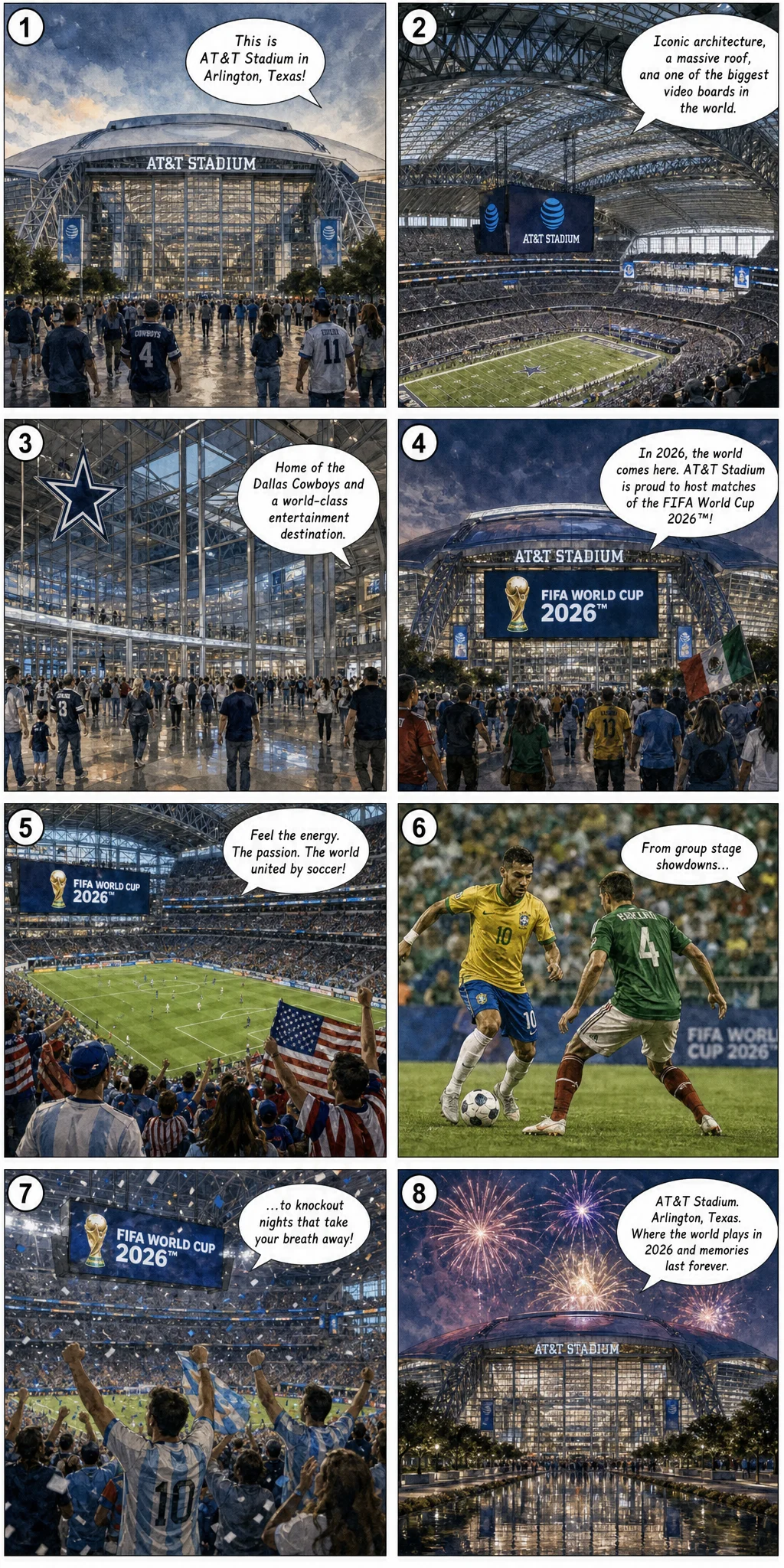
An 8-panel comic exploring the grandeur, engineering marvels, and unforgettable moments of AT&T Stadium — the 1.3-billion-dollar home of the Dallas Cowboys and a 2026 World Cup semifinal venue.
Published: June 6, 2026
AT&T Stadium: The Steel Carcass of a Texas Dream
On August 21, 2009, before AT&T Stadium's first preseason game kicked off, Tennessee Titans punter A.J. Trapasso booted a ball during warmups — straight into the giant video board hanging over the center of the field. The ball struck the screen and dropped straight down. The referee blew the whistle.
That screen was 175 feet long, larger than a basketball court, a forty-million-dollar Mitsubishi monolith suspended from the stadium dome like something out of a science fiction film. After the game, Trapasso shrugged at reporters: "I was just trying to kick it high."
Nobody had told him that in the palace Jerry Jones built, everything is several times larger than normal.
Arlington, Texas. If you drive west from downtown Dallas on I-30, about twenty minutes in, two silver-white arcs rise on the horizon like the exposed ribs of some giant creature. That is AT&T Stadium. Locals call it "Jerry World" — naming an entire world after Cowboys owner Jerry Jones, which, when you think about it, is not much of an exaggeration.
Rewind to 2005. Jones decided to build a new stadium to replace the aging Texas Stadium. He initially said it would cost six hundred fifty million. The final bill came to one point three billion dollars — not one hundred thirty million, one point three billion. Arlington voters approved a tax hike to help foot the bill. The city issued over three hundred twenty-five million in bonds. The NFL loaned one hundred fifty million. Jones covered the overruns himself.
To clear the site, over one hundred fifty homes were seized through eminent domain and demolished. Bulldozers rolled in on November 1, 2005. One resident described the negotiation as "giving me pennies and telling me to get out." During construction, one worker was electrocuted. Three were injured by a collapsing crane. A worker fell twenty feet. On the eve of Super Bowl XLV, seven construction workers were injured by ice sliding off the roof while rushing to install temporary seating.
No stadium is born clean.
The architecture was entrusted to HKS, with lead designer Bryan Trubey who said he wanted to build not a stadium but something "almost like a civic structure." Two steel arches, each nearly three hundred feet tall, span the dome, anchored at all four corners, holding the entire roof suspended in midair. The roof opens — glass doors by Haley-Greer sit between the arches, their cost alone enough to make your eyes water. The field is Hellas Matrix artificial turf on twenty-six interchangeable panels. Football to soccer to basketball to concerts to rodeos to monster trucks — it handles almost anything.
But what really dilates human pupils is that screen.
The 2010 NBA All-Star Game was held here. One hundred eight thousand, seven hundred thirteen people. A Guinness World Record. There is one shot from that broadcast you can never unsee: the basketball court lying directly beneath the screen, looking like a child's toy. An entire basketball court, dwarfed by a television. If you sit in the upper deck, you are not so much watching the game as watching the game being broadcast on the screen — the real players are too far away, the pixels closer and sharper.
February 6, 2011. Super Bowl XLV. Packers versus Steelers. Over one hundred three thousand in attendance — well, most of them. About four hundred ticket-holding fans showed up and found they had no seats. The temporary seating sections failed fire marshal inspection and were cordoned off. Over a thousand fans later sued the NFL, the Cowboys, and Jerry Jones. The lawsuit dragged on for years.
You have almost certainly seen a moment from this stadium without knowing it. Manny Pacquiao became the first eight-division world champion here. Canelo Álvarez threw punches before seventy-three thousand — an American indoor boxing attendance record. WrestleMania 32 drew one hundred one thousand, seven hundred sixty-three. Taylor Swift sold out three consecutive nights, two hundred ten thousand, six hundred seven total — the first artist ever to do so. George Strait's farewell concert: one hundred four thousand, seven hundred ninety-three people, eighteen point two million dollars at the gate, a stage crowded with Jason Aldean, Kenny Chesney, Miranda Lambert, and a dozen other country stars.
During the pandemic in 2020, the Rose Bowl moved here — the first time since 1942 it had been played outside Pasadena. This building is like a shape-shifter on amphetamines, switching forms at will, swallowing everything whole.
The 2026 World Cup gives AT&T Stadium nine matches — more than any of the sixteen venues. Group stage: Netherlands versus Japan. England versus Croatia. Argentina versus Austria. Then the knockout rounds, all the way to the semifinal on July 14. Per FIFA rules, it will temporarily be called "Dallas Stadium" — even though it is not in Dallas at all.
Back to Trapasso's punt that hit the screen. It became a thing. Every punter who comes here now looks up at that screen during warmups, wondering if they could hit it too. Jones has been asked more than once whether he would raise the board. His answer never changes: "No. If someone hits it again, they earned it."
That is Texas logic for you: you build a television bigger than a basketball court, and if someone kicks a ball into it, that is their problem.
Stand outside this stadium, the two steel arches carving into the sky, and you feel certain contradictions very clearly: colossal cost and the shadow of forced evictions, glory and lawsuits, dreams and pennies. These things coexist without needing to be reconciled. Much like Texas itself — big, loud, beautiful, dirty, and never asking whether something is right or wrong, only whether you have the nerve to try.