Estadio Azteca: The Temple Where Ghosts Play Football
The Colossus at 2,200 Meters — the only stadium to host 3 World Cups (1970, 1986, 2026). A ghost story of Pelé and Maradona, the altitude, the boxing record, and the 2026 opening match.
Published: June 6, 2026
Estadio Azteca: The Temple Where Ghosts Play Football
The Estadio Azteca is haunted by two ghosts.
One is named Pelé. The other is named Maradona.
This is not a metaphor. If you walk into this stadium on a night at 2,200 meters above sea level — not a match night, nobody there, just the wind rolling down from the highest seats of the upper deck — you will feel them. Pelé stands in the center circle, arms spread wide, exactly as he did on that golden afternoon in 1970. Maradona leans against the entrance to the players' tunnel, one foot on the ball, his eyes holding something you don't dare look at directly.
They don't speak. The stadium speaks for them.
Santa Úrsula, Mexico City. Two thousand two hundred meters above sea level. That is higher than most clouds. The New York Times put it plainly: "Visitors gasp." Not a figure of speech. A physiological fact. Your red blood cells work harder here. Every breath is a small theft of air. In 1961, architects Pedro Ramírez Vázquez and Rafael Mijares Alcérreca began digging the foundations. They were not digging into ordinary earth — they were cutting into the volcanic soil where Tenochtitlan, the capital of the Aztec Empire, once stood. Five years later, on May 29, 1966, President Gustavo Díaz Ordaz kicked the ceremonial first ball. One hundred seven thousand people packed into a freshly poured concrete bowl. The photographs from that day are all black and white, but you can almost smell the wet cement through the grain.
Then came 1970. June 21.
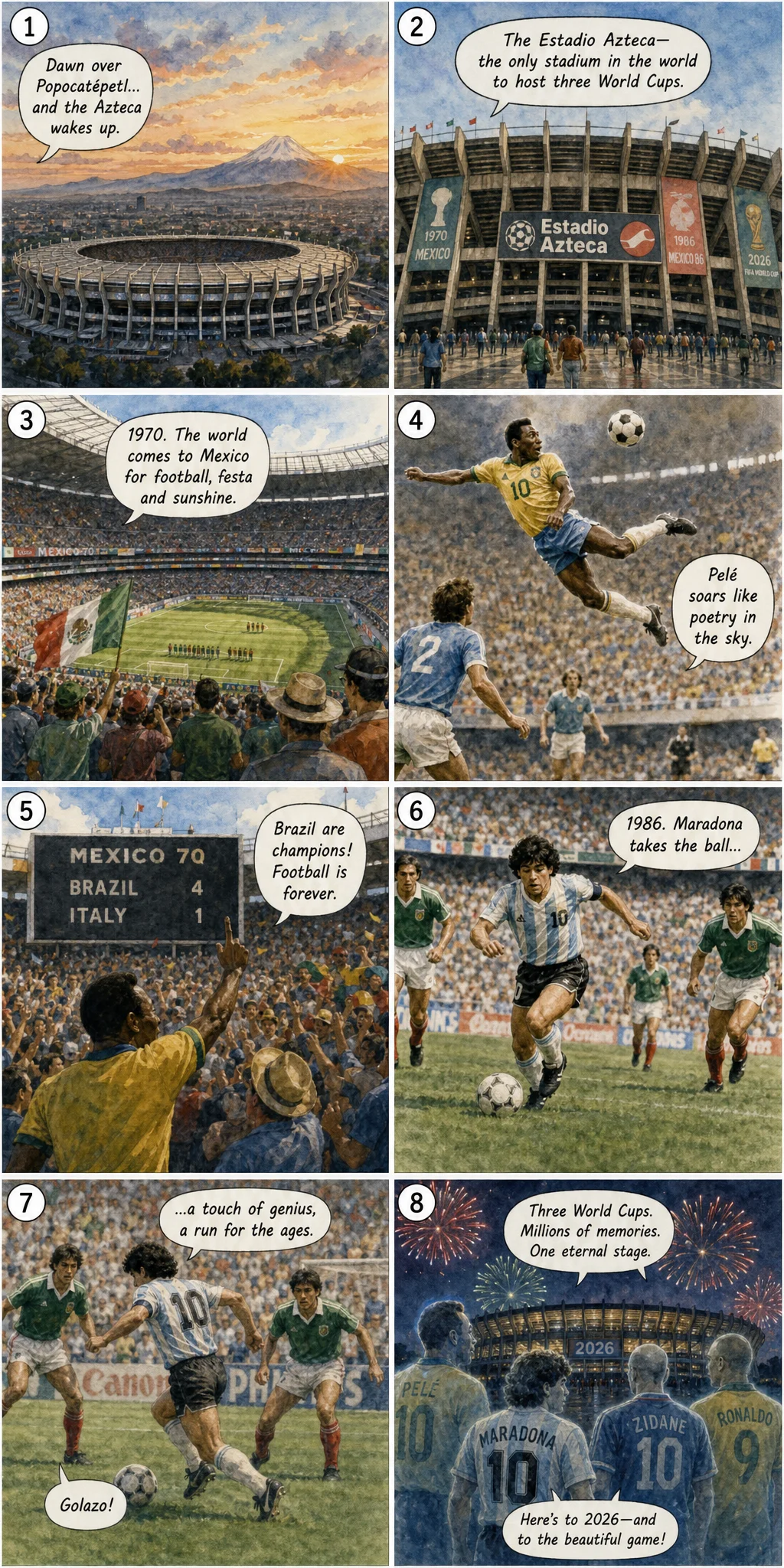
The World Cup Final. Brazil versus Italy. You know the score — 4-1. But numbers carry nothing. Numbers do not tell you that the sunlight that day turned to liquid gold because of the altitude. Numbers do not say that after the final whistle, Italian defender Tarcisio Burgnich — the man assigned to mark Pelé for ninety minutes — walked over and asked for his shirt. The greatest forward the world has ever seen, and the defender he had just destroyed, exchanging a sweat-soaked jersey at 2,200 meters. This stadium watched Pelé lift his third World Cup. He knelt in the center circle, both hands pointing to the sky. One hundred seven thousand four hundred twelve people watched. One of the ghosts moved in that day and never left.
Sixteen years later, the other arrived.
June 22, 1986. Argentina versus England. Maradona. I do not need to tell you what happened in that match — the entire planet knows. But one thing is often overlooked: the "Hand of God" and the "Goal of the Century" happened in the same game, four minutes apart. Four minutes. One goal with a fist. One goal with two feet slaloming through five Englishmen. One hundred fourteen thousand six hundred people produced two completely different sounds — first a buzzing wave of snickering and controversy, then a sound that was pure scream. After that day, the stadium had its second ghost. Maradona is not leaving. Why would he? This is where he became a god.
But this stadium is not only football.
February 20, 1993. Julio César Chávez versus Greg Haugen. One hundred thirty-two thousand two hundred forty-seven people. Not a football match — a boxing match. Try to picture it: a stadium large enough to swallow a small town, and at its dead center, a six-meter-square boxing ring. Two men throwing punches inside that tiny white square. One hundred thirty-two thousand people smoking cigarettes, waving flags, roaring with thin air at 2,200 meters. Guinness World Record. Bigger than any Ali-Frazier fight. Bigger than the Roman Colosseum ever held. Haugen had said before the fight that Chávez's opponents were "all Tijuana taxi drivers." He was beaten badly. Witnesses said the roar made the press tables vibrate.
This stadium was never built for comfort. It was built to make you feel alive. On a Club América match night, the drumming rises from the bowels of the stands, red smoke from flares coils under the roof, and the Olé wave chases its own tail around the bowl. A taco vendor climbs seventy-degree steps with a full tray on his shoulder, his lungs burning in the thin air at 2,200 meters. Cruz Azul plays here too. The Mexico national team plays here — over one hundred international matches. Every single one at the same altitude, the same elevation that makes visiting players' calves cramp by the thirtieth minute.
Then the renovation came.
2024 to 2026. New Panasonic LED screens installed. Hybrid turf laid down. Steel structure reinforced. Capacity dropped from 105,000 to 87,523. The stadium was aging; its bones needed work. The most controversial part of the renovation was not any engineering detail — it was the name. In 2025, the stadium was rebranded "Estadio Banorte." A bank. The fans' reaction can only be called fury. Graffiti outside the gates read: "SIEMPRE SERÁ EL AZTECA" — It Will Always Be the Azteca. During the World Cup, FIFA rules require calling it "Mexico City Stadium." Nobody cares what FIFA requires.
March 2026. The stadium reopened. Mexico versus Portugal, a friendly. The first people to walk into the renovated stadium said the grass smelled different — new turf, still carrying the raw sweetness of soil. But the concrete was the same concrete. Pelé's ghost was still there. Maradona's ghost was still there.
June 11, 2026.
The opening match of the World Cup. Mexico versus South Africa.
Fireworks. Flags. Eighty-seven thousand five hundred twenty-three living hearts beating together. The television broadcast will reach four and a half billion people. But no one watching on a screen will smell the air at 2,200 meters — dry, cold, thin as a blade. And no one will feel the people in the stands who are not in the stands: Pelé's number 7 Brazil shirt rippling in the wind, Maradona's left foot echoing in the players' tunnel. This stadium is the only venue on Earth to host three World Cups. 1970. 1986. 2026. There is no second.
Two ghosts. Fifty-six years. Three World Cups.
The night is deep. The match is over. The crowd is gone. The staff have turned off the lights. The cleaners have swept away the last cigarette butt. But at the center of the pitch, if you are quiet enough, you will hear two sets of footsteps. One is light, almost dancing. The other is heavy, every step carrying rage. They will never leave.
This is the Azteca. The temple on the high plateau. The closest thing to eternity that football has ever built.