MetLife Stadium: The Swamp That Swallowed the World Cup Final
The story of how a failed Olympic bid, Cablevision's political maneuvering, and a compromise between two rival NFL teams created the most unlikely World Cup Final venue. Built on a New Jersey swamp for $1.6B with no roof, shared by the Giants and Jets, MetLife Stadium should never have existed. Now it hosts the 2026 World Cup Final. A New York story of ambition, betrayal, and accidental glory.
Published: June 6, 2026
MetLife Stadium: The Swamp That Swallowed the World Cup Final
This stadium was supposed to be in Manhattan.
Not East Rutherford. Not the Meadowlands. Not New Jersey. Manhattan. The West Side of Manhattan, to be precise — a $2.2 billion glass cathedral straddling the Hudson Rail Yards, Olympic stadium for 2012, crown jewel of New York's grandest ambitions. Renderings showed sunlight streaming through retractable roof panels, the Empire State Building visible from the upper deck, a gleaming monument to New York's self-regard.
It died on June 6, 2005.
Killed by Cablevision. Killed by James Dolan. Killed by a cable company that owned Madison Square Garden two miles away and did not feel like competing with a new venue for concerts. Killed by a state assembly speaker named Sheldon Silver who blocked the $300 million state contribution because he could. Killed by the New York way — money, spite, and the kind of political knife-fighting that makes Tammany Hall look like a knitting circle.
The Jets had nowhere to go. The Giants had a crumbling Giants Stadium in the Jersey swamplands. And so, Plan B was born: a shared stadium in East Rutherford, built on the same parking lot as the old one, paid for by two teams that hated each other but hated being homeless more.
$1.6 billion. No public money for construction — the first fully privately financed NFL stadium since the league started printing cash. 82,500 seats. And no roof.
The roof died in another fight. The funding was there, the engineering was there, but the Giants and Jets could not agree on who would pay what, and so they built it open to the sky — a decision that everyone involved would later call "character-building." In reality it meant 82,500 people freezing their asses off at Super Bowl XLVIII, which, come to think of it, was the most honest thing that ever happened to this building.
This is the stadium that shouldn't exist, hosting the game that everyone wants.
Let us back up.
The Meadowlands. The name itself sounds like a marketing department's nervous breakdown. "Meadow" — pastoral, bucolic, sheep grazing on gentle hills. "Lands" — vast, dramatic, Tolkien-esque. The reality: a tidal marsh off the New Jersey Turnpike, surrounded by warehouses, a racetrack, and the perpetual scent of low-tide estuary mixed with diesel exhaust. Over the decades it hosted the Giants, the Jets, Bruce Springsteen marathons, a pope or two, and a series of increasingly elaborate attempts to pretend New Jersey was New York.
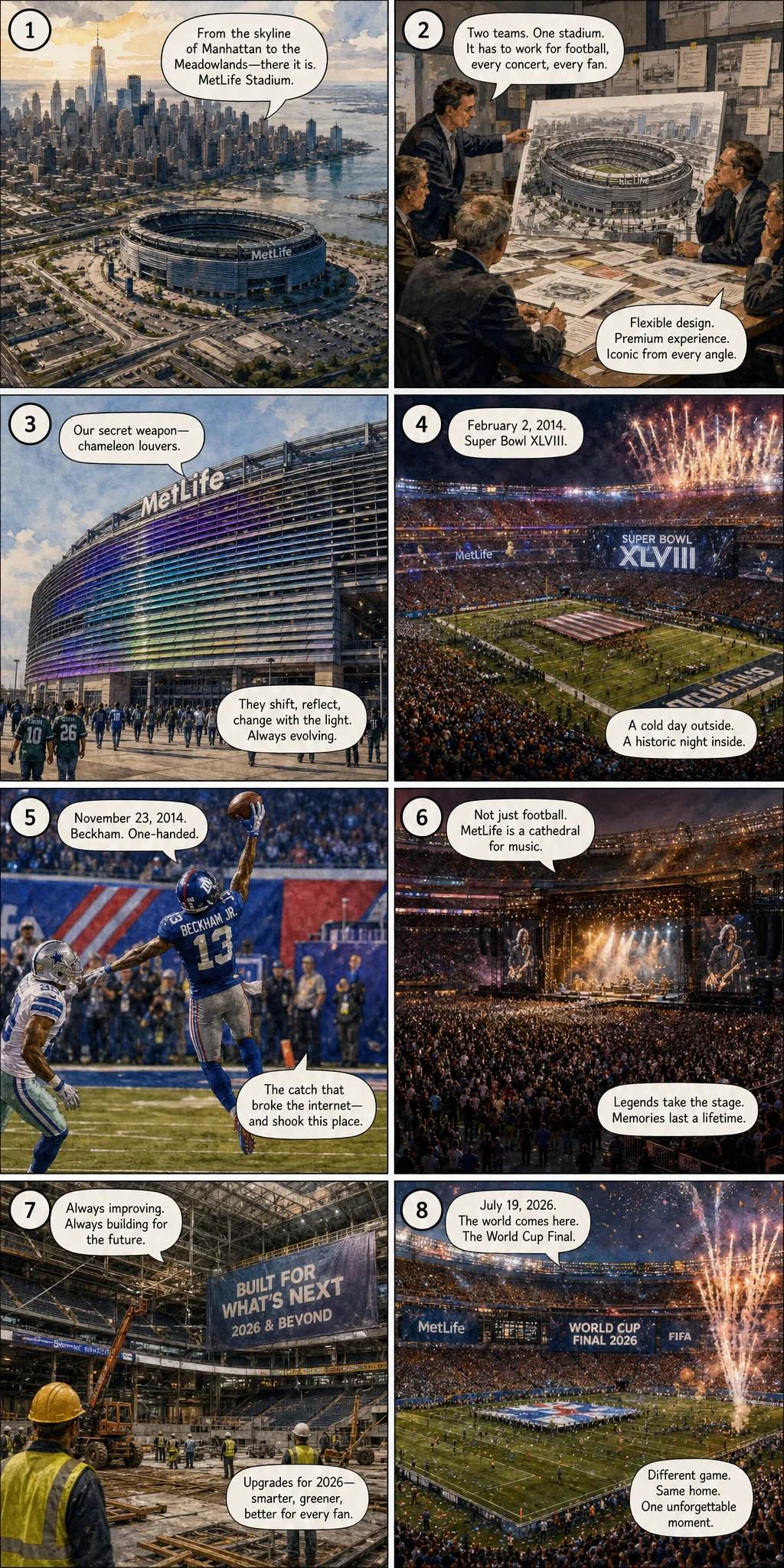
When the new stadium opened in 2010, the pretense got a facelift. 360 Architecture, EwingCole, Rockwell Group, and Bruce Mau Design produced something that looked less like a stadium and more like a radiator grille — a aluminum-and-glass fortress with louvers that shift colors depending on who's playing. Blue for Giants. Green for Jets. The architects had visited Bayern Munich's Allianz Arena and returned to New Jersey with the conviction that what the Meadowlands really needed was a chameleon's skin. They were not wrong.
The louvers rotate. The lighting shifts. The entire building changes identity overnight, a trick that costs more in electricity and programming than most American sports franchises spend on player development. If you fly into Newark at dusk on game day, you can see it from the air — a glowing monolith on the marsh, pulsing either blue or green, the color of whichever billionaire's team is home this Sunday.
This stadium has seen things.
December 19, 2010. The Giants led the Eagles 31-10 with seven minutes and twenty-eight seconds left. Eagles fans were heading for the exits. Giants fans were celebrating. Then: DeSean Jackson's 65-yard punt return touchdown — the one where he ran along the goal line before stepping in, because why not twist the knife. The Eagles scored 28 unanswered points in under eight minutes. Final: 38-31. They call it the Miracle at the New Meadowlands. Giants fans call it something unrepeatable.
November 23, 2014. Sunday Night Football. Giants versus Cowboys. Eli Manning drops back, launches a 43-yard pass toward the sideline. Odell Beckham Jr. — rookie, 22 years old — goes up with one hand. The ball sticks. Three fingers on the ball, the other hand being held by a defender, his body bent backward at an angle that violates several laws of physics. Touchdown. The catch that broke the internet before we had a verb for breaking the internet. 82,000 people making a sound that was not quite a cheer and not quite a scream — the noise humans make when they have just witnessed something impossible.
The stadium has also hosted disasters.
February 2, 2014. Super Bowl XLVIII. The first cold-weather open-air Super Bowl in NFL history — a distinction nobody asked for but everyone had to pretend was historic. Temperature at kickoff: 49 degrees Fahrenheit, which the NFL PR machine called "brisk" and everyone else called an argument against outdoor February football. On the first play from scrimmage, the ball sailed over Peyton Manning's head into the end zone for a safety. Twelve seconds in, Seattle led 2-0. It did not get better for Denver. Final: Seahawks 43, Broncos 8. Bruno Mars at halftime. The largest television audience in American history at that point, all watching a game that was essentially over after twelve seconds.
The NFL never admitted the cold was a problem. The NFL also never held another cold-weather open-air Super Bowl.
Then the concerts. Taylor Swift sold out three consecutive nights in 2018 — 165,564 tickets gone in minutes, the first woman to do three straight sellouts in this building. Ed Sheeran packed 89,106 into a single show, a venue record that still stands. BTS became the first Korean act to headline here in 2019, 98,000 ARMY bombs lighting up the Jersey night. WrestleMania 29. WrestleMania 35. The Copa América Centenario final in 2016 — Chile versus Argentina, Messi versus the crossbar, 0-0 after 120 minutes, Chile winning on penalties, Messi walking off the field alone, briefly retiring from international football that night, a decision he would later rescind but a moment this stadium absorbed and kept.
This building has seen triumph. It has seen heartbreak. It eats both the same way.
But the 2026 World Cup — this is different. This is the thing the stadium was never built for, never budgeted for, never imagined. Eight matches. Eight. The final on July 19. FIFA demanded renovations: the four corners of the seating bowl demolished, 1,740 seats ripped out and replaced, a grass field rolled in over the artificial turf. The stadium will not even be called MetLife Stadium during the tournament — FIFA's sponsorship rules require a sterile temporary name, "New York/New Jersey Stadium," which is honest in a way the building's entire history has never been. Yes, it's not in New York. Yes, it's in New Jersey. Here is the hyphen. Deal with it.
The Group Stage schedule is absurdly cinematic. June 16: France versus Senegal, the former colonizer against the former colonized, Kylian Mbappe's France against the nation that stunned the world in 2002. June 17: Portugal versus Congo DR. June 22: Norway versus Senegal. The knockout rounds climb toward July 19 like a drumroll getting faster.
Think about the full arc. The West Side Stadium — glass, retractable roof, Hudson River views, Olympics-ready — died in a political knife fight in 2005. The compromise: a stadium in a swamp, shared by two teams that can barely stand each other, no roof because the adults couldn't agree on the check. The cold Super Bowl, the Beckham catch, the color-changing louvers, the Taylor Swift sellouts. The slow, improbable accretion of history on a patch of reclaimed marshland off Exit 16W.
And now, on July 19, 2026, the final whistle will blow — or maybe it'll go to penalties, the way these things do — and a World Cup champion will be crowned in the stadium that was never supposed to exist, in the state that the team names never admit they're in, on a grass field that was installed only because FIFA made them.
The swamp got the final.
You couldn't write a better punchline for American sports infrastructure. Twenty years ago, New York gambled on a Manhattan cathedral and lost to a cable company. The backup plan — the compromise, the afterthought, the stadium in the Jersey wetlands that nobody really wanted — now hosts the biggest sporting event on the planet. There is a specifically New York lesson here: the thing you settle for might outlast everything you dreamed of.
The louvers will be neutral for the final. No Giants blue, no Jets green. Just white light, FIFA-standard, beamed onto 82,500 people from every country that qualified. The hyphen in "New York/New Jersey" will appear on every broadcast, in every language, a small grammatical admission that nothing about this stadium was ever straightforward.
But the stadium will stand there, as it always has — in the wrong state, on the wrong side of the river, built for the wrong reasons, with the wrong roof situation — and crown a world champion anyway.
The swamp that swallowed the World Cup final.
Only in New Jersey. Which is to say: only in New York.