Mercedes-Benz Stadium: The Mechanical Flower of the New South
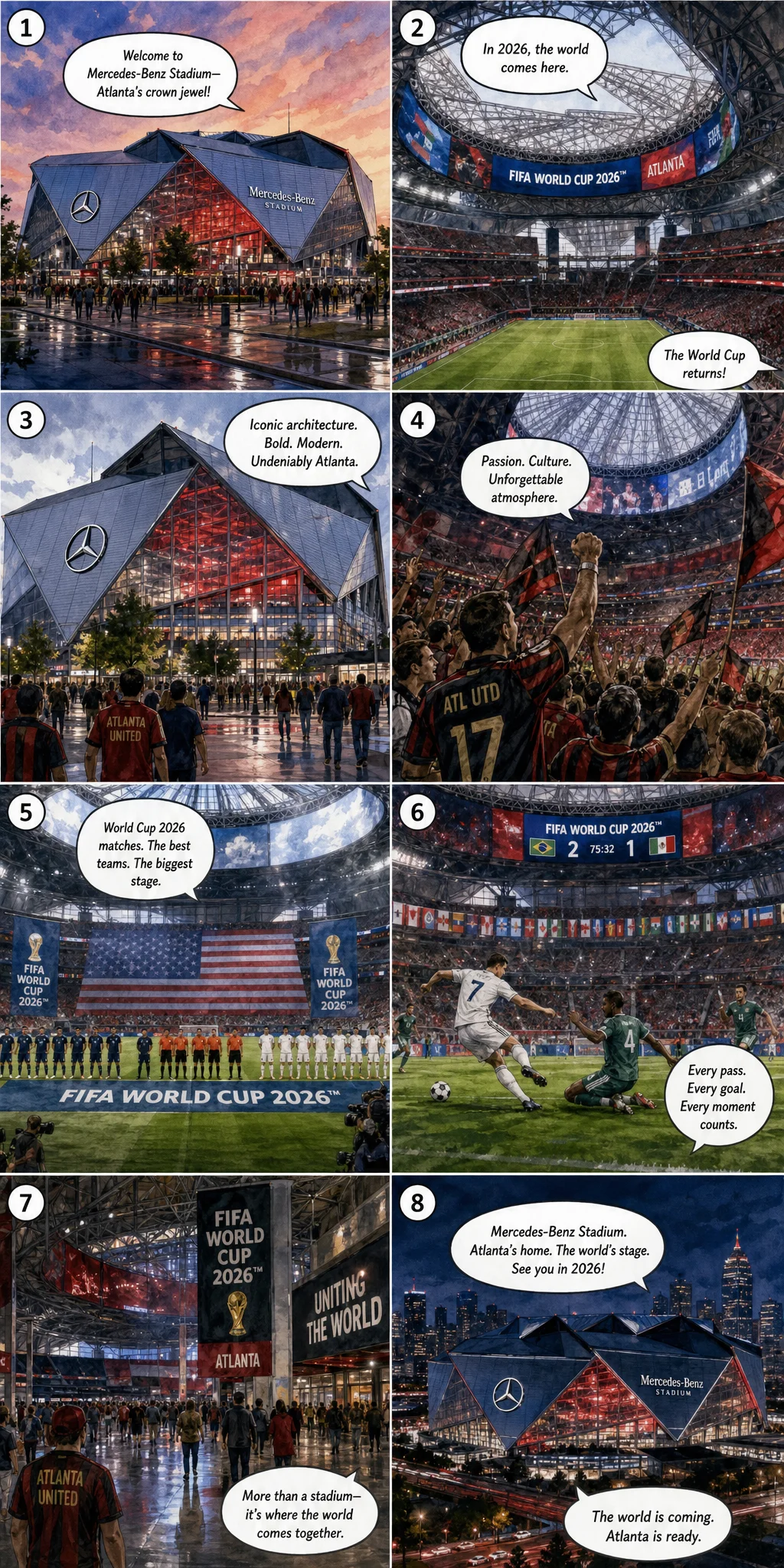
An 8-panel comic exploring the $1.6B marvel in downtown Atlanta — the pinwheel roof that opens like a camera aperture, the 73,000-pound falcon, Arthur Blank's $2 hot dogs, the MLS record crowd of 73,019, and the World Cup semifinal coming in July 2026.
Published: June 6, 2026
Mercedes-Benz Stadium: The Mechanical Flower of the New South
The roof opens like a flower remembering the sun.
Eight triangular panels, each the size of a city block, slide on parallel rails in a motion that seems physically impossible — a camera aperture scaled to the size of a cathedral. It takes eight minutes. The steel petals spiral outward, tracing the geometry of Atlanta's own ambition, and when they settle into their final position, the Georgia sky pours through the opening like water through a broken dam.
The first time you see it happen, you stop whatever you were doing. You stop talking, stop eating your hot dog, stop checking your phone. Because this is not a stadium roof. This is a mechanical flower blooming in the middle of downtown Atlanta. This is the Pantheon of the New South, redesigned by people who grew up watching Transformers.
The architects at HOK — the firm formerly known as 360 Architecture, working alongside tvsdesign and a small army of engineers — had been given an impossible brief. Arthur Blank, the co-founder of Home Depot who bought the Atlanta Falcons in 2002, wanted something that had never existed. A retractable roof that did not retract. A building that opened not like a sliding door but like an eye. A stadium that felt less like a sports venue and more like a civic monument.
So they went looking for inspiration and found it in Rome, in a dome built by Emperor Hadrian in 126 AD. The Pantheon. A temple to all gods, crowned by a circular oculus that opens to the sky. Two thousand years later, Atlanta would build its own version — not with concrete and Roman brick, but with steel, ETFE, and 62,350 square feet of high-definition video board wrapped into a ring they call the Halo.
The Halo deserves its own paragraph. It is a 58-foot-tall, 1,100-foot-long oval of LED screens suspended from the roof structure, weighing more than a fully loaded Boeing 757. When Atlanta scores, the Halo does not merely display the replay — it engulfs the stadium in light, a digital sun rising inside a steel sky. It is three times larger than any video display ever installed in an NFL stadium. If you are sitting in the upper deck, you are not watching the game on the field. You are watching the game on the Halo, and the experience is somehow better.
---
But before the roof. Before the Halo. Before the $1.6 billion and the LEED Platinum certification and the $2 hot dogs. Before any of that, there were two churches.
Friendship Baptist Church sat on this land since 1862. It was here, in its basement, that the first classes of Spelman College were held in 1881 — the oldest private historically Black liberal arts college for women in America. Morehouse College, the all-male institution that would produce Martin Luther King Jr., was also born in Friendship's basement, six years before it moved to its own campus. This patch of red Georgia clay was not just real estate. It was hallowed ground, the cradle of Black higher education in the American South.
Mount Vernon Baptist Church stood here too, its congregation tracing roots to 1915.
When the Georgia World Congress Center Authority and the Falcons came looking for a stadium site in 2013, the two churches sat squarely in the footprint. Negotiations were difficult. Congregants protested. Eventually, both churches accepted buyouts — Friendship received $19.5 million, Mount Vernon $14.5 million — and relocated. The buildings were demolished in 2014.
The story could end there, as it so often does in America, with a church bulldozed to make way for commerce. But Arthur Blank did something unusual. He made sure the new stadium would remember. The design team incorporated memorial elements. The stadium's community engagement programs would carry forward the legacy of those congregations. The complicated truth of Atlanta — a city of Black mayors, civil rights landmarks, and relentless gentrification — is baked into the building's foundation, whether the Halo lights acknowledge it or not.
---
Ground was broken on May 19, 2014. The stadium opened on August 26, 2017. In between: 200,000 cubic yards of concrete, 27,000 tons of structural steel, and one of the most audacious roofing mechanisms ever engineered.
The roof's eight triangular panels do not fold or hinge. They slide — each panel riding on two parallel rails, moving like a drawer being pulled open, except each "drawer" weighs approximately 500 tons. The panels are translucent ETFE, a fluorine-based polymer that looks like glass but weighs a fraction as much and lets in diffused sunlight. When closed, the roof creates a climate-controlled bubble against Atlanta's notorious summer humidity. When open, the field sits under a perfect rectangle of sky, framed by the open aperture like a living postcard.
It can stay open in light rain — the field has a sophisticated drainage system — which means Atlanta United soccer matches often play under an open roof with raindrops catching the stadium lights like falling diamonds.
The entire mechanism was designed to feel organic. The architects studied the way flowers open, the way a camera lens iris adjusts. They wanted the roof's motion to be hypnotic, something people would film on their phones not because it was a stadium feature but because it was beautiful.
---
December 8, 2018. MLS Cup.
Atlanta United, a club that did not exist two years earlier, faced the Portland Timbers before 73,019 people — the largest single-game attendance in Major League Soccer history. The roof was open. The Halo burned red and gold. The noise, by multiple accounts, registered on seismographs. When Josef Martinez scored the opening goal in the 39th minute, a train horn — an actual train horn, installed to honor Atlanta's origin as a railroad terminus — blasted through the stadium, and the sound bounced off the steel petals and came back around again.
Atlanta won 2-0. The city, which had been told for decades that it was not a soccer town, that the South only cared about college football, that MLS would never work here, threw a parade.
Arthur Blank watched from his suite, the same man who had insisted on $2 hot dogs, $5 beers, and free refills for fountain drinks — "fan first pricing" that cut stadium concession revenue by a third and turned the Mercedes-Benz Stadium into the most affordable major sports venue in America. Blank, a self-made billionaire who grew up working in his family's grocery store in Queens, understood something that most team owners forget: the people in the upper deck matter as much as the people in the suites.
A family of four can eat at Mercedes-Benz Stadium for under $30. Think about that. In an era of $14 stadium beers and $12 hot dogs, Arthur Blank serves a $2 hot dog and a $5 beer. When Atlanta scores and the train horn sounds and the Halo erupts, everyone celebrates together — not because they all paid the same price for their seats, but because they all paid the same price for their dinner.
---
The falcon stands guard outside, and it is impossible to ignore.
Gabor Miklos Szoke, a Hungarian sculptor, was commissioned to create the world's largest freestanding bird sculpture. His answer: a 41-foot-tall, 70-foot-wingspan, 73,000-pound bronze and stainless steel falcon — an Atlanta Falcon, of course — perched atop a 13-foot pedestal outside the stadium's main entrance. The bird clutches a bronze football in its talons. Its wings are spread wide, not in threat but in welcome. It weighs more than 10 Toyota Camrys. If you stand beneath it and look up, your brain struggles to process the scale. It is simultaneously majestic and faintly ridiculous — which is to say, it is perfectly Atlantan.
---
February 3, 2019. Super Bowl LIII.
The New England Patriots beat the Los Angeles Rams 13-3. It was, by near-universal consensus, the most boring Super Bowl ever played. The roof was closed. The Halo displayed a combined 16 points over three hours. Maroon 5 performed a halftime show so forgettable that the most memorable moment was Adam Levine taking his shirt off and revealing nipples that the internet immediately decided looked Photoshopped.
Atlanta, a city that knows how to throw a party, had thrown the most expensive party in American sports, and the guests had fallen asleep on the couch. It is perhaps the only time Mercedes-Benz Stadium has ever been associated with quiet.
But the Super Bowl did prove one thing: the building worked. The roof mechanism, which had been a source of anxiety for engineers — what if it jams? what if a panel gets stuck? — performed flawlessly. The Halo functioned. The $2 hot dogs were still $2. The falcon stood watch. The stadium had passed the biggest stress test American sports could throw at it.
---
In June 2024, the stadium reconfigured itself again, this time for the Copa America opener. Argentina, the reigning World Cup champions, faced Canada on a temporary grass pitch laid over the artificial turf. Lionel Messi walked onto the field, and 70,000 people made a sound that was equal parts roar and prayer. The grass, trucked in and meticulously maintained, held up under the Georgia sun. The stadium, originally designed for American football, had become an international soccer venue without a single architectural compromise.
Six matches of the 2025 FIFA Club World Cup came next. Atlanta was now a global soccer city, and Mercedes-Benz Stadium was the proof.
---
July 15, 2026. A Wednesday night. The World Cup semifinal.
The roof is fully open to the Atlanta summer sky. The Halo glows, showing every detail of the match in crystalline 4K. 75,000 fans from every continent on Earth fill the seats — which FIFA will officially call "Atlanta Stadium" for the duration of the tournament, because global football governance does not recognize corporate naming rights.
The train horn has been temporarily replaced by — well, by everything. Vuvuzelas. Drums. Chants in a dozen languages. The sound fills the open bowl and spills upward through the aperture, into the Georgia night, past the falcon and the downtown skyline. The eight World Cup matches hosted here — including this semifinal — will connect Atlanta to football history in a way that no Super Bowl or MLS Cup ever could.
The roof panels are frozen in their open position, the steel petals resting against the night sky. From above, the stadium looks exactly like what it was always meant to be: a mechanical flower in full bloom, a camera aperture through which the whole world is now watching.
Outside, the 73,000-pound falcon keeps watch. The ghosts of Friendship and Mount Vernon, hopefully, rest a little easier. And somewhere in the upper deck, a family of four is eating hot dogs that still cost two dollars apiece, because Arthur Blank made a promise, and in Atlanta, a promise is a promise.
The train horn will sound again. But tonight, let the world sing.