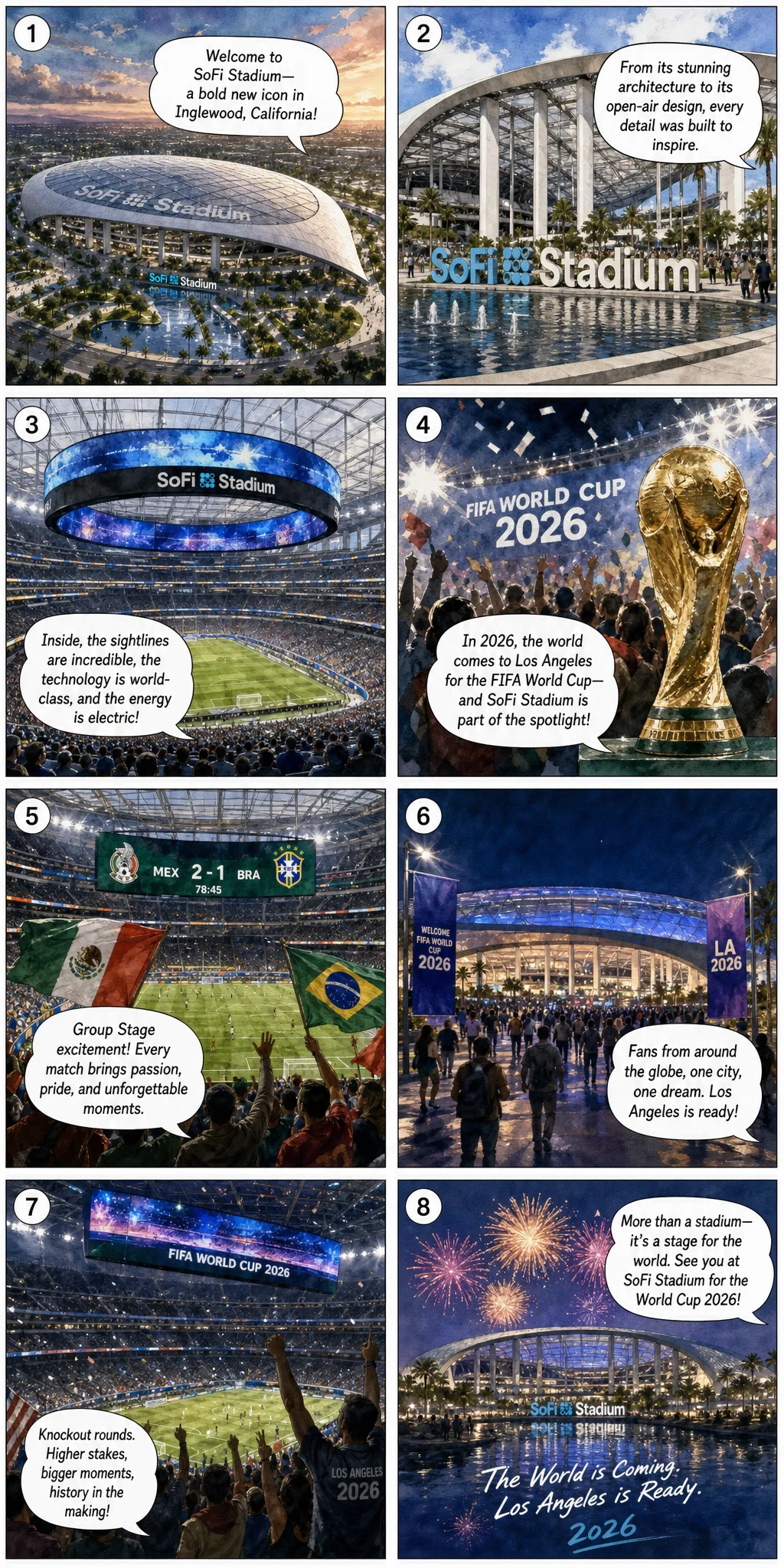
SoFi Stadium: The Five-Billion-Dollar Mirage
An 8-panel comic exploring SoFi Stadium — the $5.5 billion architectural marvel in Inglewood, California. From the ghosts of Hollywood Park Racetrack to the 2.2-million-pound Infinity Screen, from BTS selling out four nights to Kroenke almost killing the World Cup deal, from Super Bowl LVI's home-team triumph to the USMNT's World Cup opener against Paraguay on June 12, 2026. The most expensive stadium ever built, told through the lens of Los Angeles — where everything costs more than it should and nothing is quite what it seems.
Published: June 6, 2026
SoFi Stadium: The Five-Billion-Dollar Mirage
Five billion, five hundred million dollars.
That number is so large it stops meaning anything. You can break it down -- $30 million a year just for naming rights, $400 million for the Infinity Screen alone, enough to fund a small country's annual budget -- and still, it is just paper. What the money actually bought is harder to see, because the most expensive stadium ever built was designed to look like it weighs nothing at all.
The first thing you notice flying into LAX is not the Hollywood sign or the Pacific. It is a white, wing-shaped canopy floating over Inglewood like a sheet of paper suspended in midair. From thirty thousand feet, SoFi Stadium is a mirage: a million square feet of translucent ETFE, 302 panels, 46 of which can open to the sky, 27,000 LED pucks embedded in the membrane like stars punched through plastic. At sunset, the whole thing glows amber, a hundred-acre lantern you can see from Orange County. It is the largest cable-supported ETFE roof on Earth and it weighs less, per square foot, than the skin of an airplane.
The architect, HKS -- the same firm that built Jerry Jones his billion-dollar glass palace in Arlington -- outdid itself here. But unlike AT&T Stadium, which announces itself like a linebacker at a dinner party, SoFi is subtle. It is sunk 100 feet into the ground. You don't walk up to it; you descend into it. The effect is of a crater, a canyon, a secret. This is Los Angeles architecture: the most expensive thing in the room pretending it just woke up like this.
At the center of the crater, suspended from the canopy by cables you can barely see, hangs the Infinity Screen. Ovular. Double-sided. Two point two million pounds -- heavier than a navy destroyer, heavier than the Dallas Cowboys offensive line stacked in a pyramid. Samsung built it: 80 million pixels, 260 speakers, 56 5G antennas, all hanging from a roof that is itself a screen. When BTS played four sold-out nights here, the screen displayed faces in such excruciating detail that fans in the nosebleeds could count eyelashes. The ARMY light sticks filled the bowl with purple galaxies, and somewhere overhead the LED pucks in the canopy broadcast the moment to planes descending into LAX. The gate was $33.3 million -- the highest-grossing concert engagement in California history. Not bad for a K-pop group that, ten years earlier, was performing in basketball gyms.
But the screen is only the most visible monument to excess. The backstory is richer.
SoFi Stadium sits on the bones of Hollywood Park Racetrack, which opened in 1938 -- the year Seabiscuit beat War Admiral -- and hosted thoroughbreds for seventy-five years before closing in 2013. The track was regal in its day: Bing Crosby was a founding shareholder. Walt Disney watched races from the Turf Club. The Triple Crown winners Citation, Seattle Slew, and Affirmed all ran here. When the bulldozers arrived, workers found horseshoes in the soil. The ghost of a racetrack, paved over by the ghost of a tech campus (that was Kroenke's original pitch -- a "Hollywood Park entertainment district"), now hosting the ghost of a football stadium that barely qualifies as indoor or outdoor.
That ambiguity is by design. The roof keeps the sun off but the sides are open, which means when lightning strikes -- and it does, this is Southern California's monsoon season we are talking about -- everyone has to evacuate. The first Rams home game at SoFi, against the Cowboys in September 2020, began with a lightning delay. You spend five and a half billion on a roof and the sky still finds a way to interrupt.
Stan Kroenke, the billionaire who built this thing, is not a man who gives many interviews. He owns the Rams, the Denver Nuggets, the Colorado Avalanche, Arsenal FC, and roughly sixty million square feet of real estate. His wife is a Walmart heir. In 2016, he moved the Rams from St. Louis back to Los Angeles after twenty-one years, a relocation that St. Louis sued over, a relocation that NFL owners approved 30-2, a relocation that required Kroenke to tell St. Louis fans -- in a 29-page relocation application -- that their city was "no longer a viable market for professional football." The NFL eventually paid St. Louis $790 million to settle the lawsuit. Kroenke paid the NFL.
SoFi is, in other words, a monument built on three layers of departure: the horses are gone, the Raiders left LA in 1994, the Rams left St. Louis to come back here, and the Chargers -- also tenants -- left San Diego for a city that has never quite loved them. The stadium is shared by two NFL teams, the only such arrangement besides MetLife in New Jersey, and Chargers home games are routinely overrun by visiting fans. This is LA sports: nothing ever fully belongs to anyone.
The World Cup almost did not come here.
In September 2023, Kroenke threatened to withdraw SoFi from the 2026 World Cup over a revenue-sharing dispute with FIFA. The specifics were never made public, but the dispute centered on how much of the tournament's commercial revenue would flow back to the venue. Kroenke, a man who does not lose negotiations, stared down FIFA -- the organization that once made an entire country rebuild its airports -- and FIFA blinked. The deal was saved. SoFi would host eight World Cup matches, including the US Men's National Team opener against Paraguay on June 12, 2026, and a quarterfinal.
The irony is that FIFA had already criticized the stadium. The American football field is narrower than a FIFA-regulation soccer pitch. To fit the world's game, SoFi had to remove seats from the lower bowl. The most expensive stadium in history was, technically, the wrong shape.
Construction was not clean. In February 2020, a crane collapsed. In June 2020, an ironworker named Eleobardo Moreno-Santibanez fell from the roof and died. He was thirty-one. His family sued. No stadium is born without blood, but SoFi's price tag makes its toll feel particularly pointed. Five and a half billion dollars and someone still fell.
Let us return to what the money actually bought.
It bought Super Bowl LVI, on February 13, 2022, when the Los Angeles Rams beat the Cincinnati Bengals 23-20 and became only the second team in NFL history to win a Super Bowl in their home stadium. Confetti flooded the field. The Infinity Screen showed every tear. The canopy's 27,000 LED pucks spelled "RAMS HOUSE" in letters you could read from airplanes descending into LAX. Odell Beckham Jr. caught a touchdown and then tore his ACL and sat crying on the sideline, still in uniform, watching his team win without him. Matthew Stafford -- the quarterback Detroit gave up on -- threw the game-winning touchdown to Cooper Kupp, a receiver from Eastern Washington nobody drafted in the first round. This is the LA sports story in miniature: redemption purchased at premium, former disappointments becoming icons, everything costs more than it should and somehow the math works out anyway.
It bought WrestleMania 39: $21.6 million gate, the highest-grossing WWE event ever.
It bought Taylor Swift's Eras Tour: six sold-out nights in August 2023, the stadium shaking so hard from seventy thousand people jumping to "Shake It Off" that seismographs at Caltech registered it.
It bought the 2028 Olympics opening and closing ceremonies, plus swimming -- and here is the truly absurd detail: SoFi will contain a temporary 38,000-seat aquatic venue inside the stadium. A swimming pool inside a football stadium inside what used to be a horse track. You cannot make this up.
And on June 12, 2026, it buys the United States Men's National Team's World Cup opener against Paraguay. Seventy thousand fans. American flags mixed with World Cup banners. Christian Pulisic and Gio Reyna walking onto a field that had to be surgically widened to fit them. The Infinity Screen rendering every bead of sweat in 80 million pixels. The canopy spelling "USA" in LED pucks visible from LAX. Five billion, five hundred million dollars, finally earning its moment.
The real achievement of SoFi Stadium is not the money or the engineering. It is the illusion. In a city built on illusions -- movies, plastic surgery, the promise that you are one audition away -- SoFi is the most Los Angeles building ever constructed. It looks weightless. It is unimaginably heavy. It pretends to be open and transparent. It is locked in perpetual legal and financial armature. It sold itself as the future of stadium design. It had to be physically altered to accommodate the world's most popular sport.
Stand outside SoFi at dusk, the canopy glowing gold, planes descending one after another into LAX like a procession of low-orbit satellites, and you can feel the contradiction without needing to resolve it. The horses are still running somewhere underneath. The ironworker's family still grieves. Kroenke is already onto the next deal. And in a few weeks, the World Cup will begin here, and for ninety minutes none of that will matter -- only the ball, the grass, the goal.
That is five billion, five hundred million dollars, and in this city, on this night, it might actually be worth it.