NRG Stadium: Seven Minutes to Open the Sky
The House That Rodeo Built — a $352M stadium where the roof opens in 7 minutes, Beyoncé headlined the first NFL Christmas halftime show, the Patriots completed the 28-3 Super Bowl comeback, 80,000 cowboys fill the seats every March, and 7 World Cup matches are coming including a July 4th knockout.
Published: June 6, 2026
NRG Stadium: Seven Minutes to Open the Sky
Seven minutes. In seven minutes, a piece of Texas sky appears above your head.
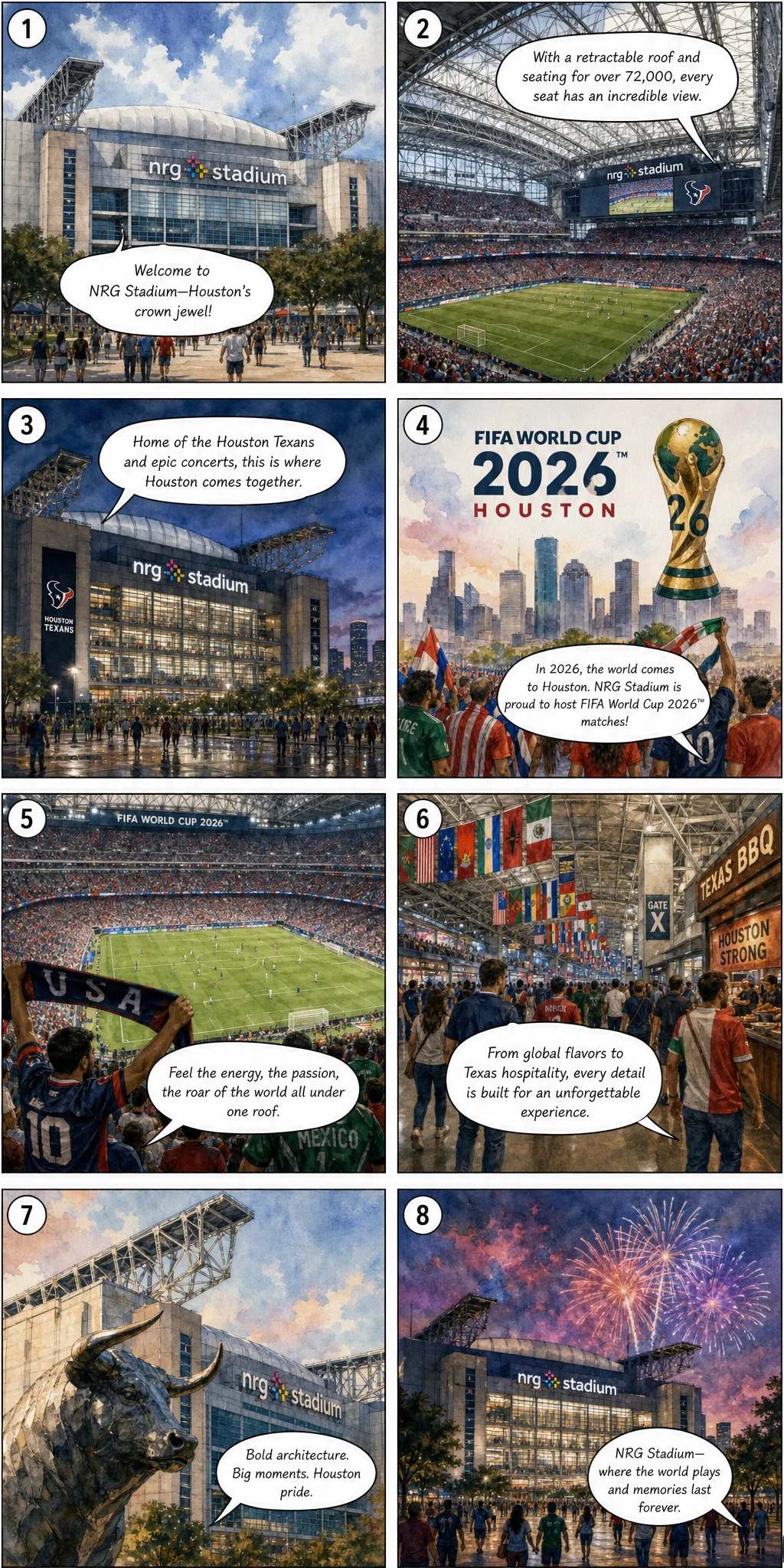
This is not a metaphor. Walk into NRG Stadium on a September Sunday at noon, the Texans about to kick off, 72,000 people settling into their seats with nachos and Shiner Bock — and then the roof starts moving. Two massive fabric panels, each weighing more than you can imagine, begin their silent slide apart at the 50-yard line. The motors hum at a frequency you feel in your chest. Sunlight begins as a sliver, then a blade, then a flood. By the time you count to four hundred and twenty, the Houston sky is your ceiling. The clouds drift by as if they were invited. The 675-foot super-trusses — the bones of this building — catch the light and throw long shadows across the field. This is the first NFL stadium with a retractable roof, and it still feels like the future.
They call it "The House That Rodeo Built."
That isn't marketing. That is accounting. The Houston Livestock Show and Rodeo has been co-tenant since 2003, and every March, this stadium transforms into the world's largest rodeo arena. The dirt floor goes down. The livestock pens under the north end fill with bulls and broncos. The 42-foot hydraulic concert stage — built into the south end zone — rises from its hiding place like a mechanical beast waking up. And then 80,000 people in cowboy hats fill every seat, the smell of barbecue drifting through the concourses, the barrel racers kicking up dust, the rodeo clowns risking their necks. Cody Johnson played here in March 2026 to a record 80,203 — the biggest rodeo crowd in history. The stadium's soul isn't football. The stadium's soul wears boots.
But the football gods did not ignore this place. They chose it for two of the most insane nights in NFL history.
Super Bowl XXXVIII, 2004. Patriots 32, Panthers 29. The game was tight, the halftime show was Janet Jackson and Justin Timberlake, and the aftermath of that wardrobe malfunction changed television forever. But that was only the warm-up act for what came thirteen years later.
Super Bowl LI. February 5, 2017. The Patriots are losing 28-3 to the Atlanta Falcons with two minutes left in the third quarter. It is over. Falcons fans are hugging each other. The confetti cannons are being prepped with red and black. And then — something snaps. Tom Brady engineers the greatest comeback in Super Bowl history, tying the game at 28, and then in overtime — the first overtime in Super Bowl history — James White dives across the goal line. Patriots 34, Falcons 28. The confetti that falls is blue and silver. The Falcons fans stand frozen in their seats, unable to move, unable to comprehend what their eyes just witnessed. This stadium held that silence. That particular, awful, beautiful silence of 28-3 becoming forever.
Then Beyoncé came home.
December 25, 2024. Christmas Day. The first NFL Christmas Day halftime show in history. And Houston gave the world its queen. Beyoncé rode in on a white horse — a white horse, in a football stadium, on Christmas — wearing a white cowboy hat and a stunning Houston-inspired outfit. She performed tracks from Cowboy Carter for the first time live. Her daughter Blue Ivy danced beside her. 72,000 phones lit up the stands like a constellation. For thirteen minutes, this was not a football game. This was a cathedral of Houston pride, and the high priestess was the girl from Parkwood Drive who conquered the world and came back to open the roof. The moment the show ended, the Texans played the second half, and nobody remembers a single snap. That's the power of Beyoncé in Houston.
The stadium has scars, too. September 2008. Hurricane Ike roars ashore with 110-mile-per-hour winds. The roof — that famous retractable marvel — takes a direct hit. Five fabric panels of the cladding are torn away. The wind howls through the stadium bowl like a wounded animal. Water pours in. The damage totals millions. But the structure holds. The super-trusses hold. The rodeo dirt floor — not yet spread — stays dry underneath. The building was designed for this, engineered to bend without breaking. When Ike passed and the sky cleared, the stadium stood. A little bruised, a little bare, but standing. That is Texas engineering. That is Houston resilience.
The Gold Cup final came in 2025. CONCACAF's biggest prize. Mexico versus the United States. The stadium split down the middle — red, white, and blue on one side, green, white, and red on the other. 70,925 voices creating a wall of sound. Mexico won 2-1. The goal that decided it came in the 88th minute, a strike that silenced half the stadium and detonated the other half. The aftermath was not just joy and heartbreak — it was a preview. This is what a World Cup knockout match will feel like in this building. This is what Houston can do when the world is watching.
Now it is June 2026. The workers are rolling in the temporary grass — FIFA-grade, every blade measured. The FIFA banners are replacing the NRG signage. The stadium is now called "Houston Stadium" for 39 days. The rodeo stage is hidden beneath the south end. The livestock pens are empty and scrubbed clean. The Texans locker room has been converted for whichever national team draws the short straw. The smell of paint is everywhere — fresh lines, fresh logos, fresh dreams. Seven World Cup matches will be played here. The climax: a July 4th Round of 16 knockout match. Independence Day. Fireworks visible through the open roof. The Texas flag flying beside the World Cup flag. A building born from rodeo dirt and football violence, transformed into a theater for the world's game.
Seven minutes. That's how long it takes for this stadium to open the sky. But it has taken twenty-four years — from 2002 to 2026 — for the world to understand what Houston already knew. This is not just a stadium. This is a rodeo arena with a Super Bowl habit. A concert hall that Beyoncé calls home. A hurricane survivor with scars on its roof. A cathedral where 28-3 became a verb and where Mexico and the USA fought a soccer war. And on July 4, 2026, under a piece of Texas sky opened in seven minutes, a new chapter begins.
The roof will open. The fireworks will burst. The world will watch. And somewhere in the steel bones of this building, the ghost of a rodeo bull will nod in approval.
Welcome to NRG Stadium. The house that rodeo built. The house that Texas kept.