Levi's Stadium: The Misplaced Cathedral
A stadium designed for San Francisco's fog and wind, built 40 miles south in the Silicon Valley sun. Candlestick's soul couldn't be transplanted. Now: 6 World Cup matches.
Published: June 6, 2026
Levi's Stadium: The Cathedral Built in the Wrong Zip Code
The fog never came.
That was the first thing everyone noticed. Candlestick Park had fog — the kind that rolled in off the Pacific in the seventh inning, swallowed right field, and made baseball feel like a gothic novel. When the 49ers played there, wind whipped through the tunnels with enough force to knock a kicker's trajectory sideways. Candlestick was cold and damp and miserable and absolutely, irreplaceably San Francisco. People brought blankets in August.
Levi's Stadium, by contrast, sits in a Santa Clara parking lot. Forty miles south. Same sun that bakes the strip malls and the semiconductor fabs. Zero fog. Zero wind off the bay. Zero San Francisco.
When the stadium opened in 2014 — $1.3 billion, designed by HNTB, 68,500 seats — the 49ers' marketing department performed an extraordinary act of geographical denial. They kept the name "San Francisco 49ers." The stadium address: Santa Clara, California. Google Maps puts them forty miles apart. That's roughly the distance from London to Oxford. From Paris to Fontainebleau. From reality to the press release.
The heat was the first betrayal. At the 2014 preseason opener, a fan collapsed and died of heat exhaustion. Nobody had thought to add shade. The design had been conceived for Candlestick Point — where the fog does the work for you — and then transplanted, blueprint by blueprint, into a climate that required an entirely different building. The architects at HNTB knew this, presumably. The 49ers ownership knew this. The Santa Clara city council, which had lured the team south with tax breaks and land deals, definitely knew this. But the stadium got built anyway, and the sun kept shining, and they never did add enough shade.
Then came the pilots. The stadium's LED scoreboards — massive, brilliant, state-of-the-art — pointed directly into the approach path of San Jose International Airport. Forty-three pilot complaints in the first year. "Blinding," they said. "Hazardous," they said. The FAA got involved. The 49ers agreed to dim the boards during night landings. A stadium so bright it could be seen from space, but only if space wasn't trying to land a 737.
The turf at Super Bowl 50 was a disaster. February 7, 2016. Broncos 24, Panthers 10. Coldplay, Beyoncé, and Bruno Mars put on a halftime show that outshone the game itself — the stadium's tech-forward identity, its Silicon Valley adjacency, finally made sense. But the playing surface was so bad that players were sliding around like they were on a frozen pond. The NFL had trucked in grass and laid it over the artificial turf, and the grass didn't take. It never does when you rush it. The players knew. The coaches knew. The TV audience, watching Peyton Manning's final game, mostly didn't notice they were watching a championship played on sod that belonged in a compost pile.
And yet.
June 27-28, 2015. The Grateful Dead played their 50th anniversary shows here. "Fare Thee Well." Three original members — Bob Weir, Phil Lesh, Bill Kreutzmann — plus Trey Anastasio, plus 151,650 Deadheads across two nights. Tie-dye from horizon to horizon. The parking lot smelled like patchouli and nostalgia. For two evenings, Levi's Stadium became the most San Francisco place on Earth, precisely because it wasn't in San Francisco. The Dead had started in the Haight-Ashbury, played the Fillmore and the Avalon, and ended — if this was the end — in a billion-dollar stadium in Santa Clara. Jerry Garcia had been dead for twenty years. But the music, that weekend, was alive.
WrestleMania 31 came on March 29, 2015. Seth Rollins cashed in Money in the Bank mid-match — the first and only time it's ever happened during a main event — and won the WWE Championship in what the company still calls "The Heist of the Century." 76,976 fans. The stadium as spectacle factory. It didn't matter where the building was. It mattered what was happening inside it.
Copa America Centenario, 2016. The opening match: USA vs Colombia. Four matches total. And one that still haunts Mexican football: Chile 7, Mexico 0. Not a close game. Not a bad day. An annihilation. La Roja quarterfinal. In Santa Clara, California. The Mexican fans, who had filled the stadium, sat in stunned silence as a Chilean team at the absolute peak of its golden generation — Alexis Sanchez, Arturo Vidal, Eduardo Vargas — carved them apart. Vargas scored four goals. Nobody who was there has ever fully recovered.
There were other indignities. The youth soccer park that was promised to the community, then traded away in a deal that made the 49ers' balance sheet happier and Santa Clara's kids angrier. The season ticket holder restrictions that required buying a "stadium builder's license" — a seat license — that cost more than most people's cars. The luxury lounges, visible from the upper deck, inexplicably half-empty during games while real fans roasted in the sun. The corporate atmosphere that felt less like football and more like a tech campus cafeteria, everyone checking their phones, nobody really present.
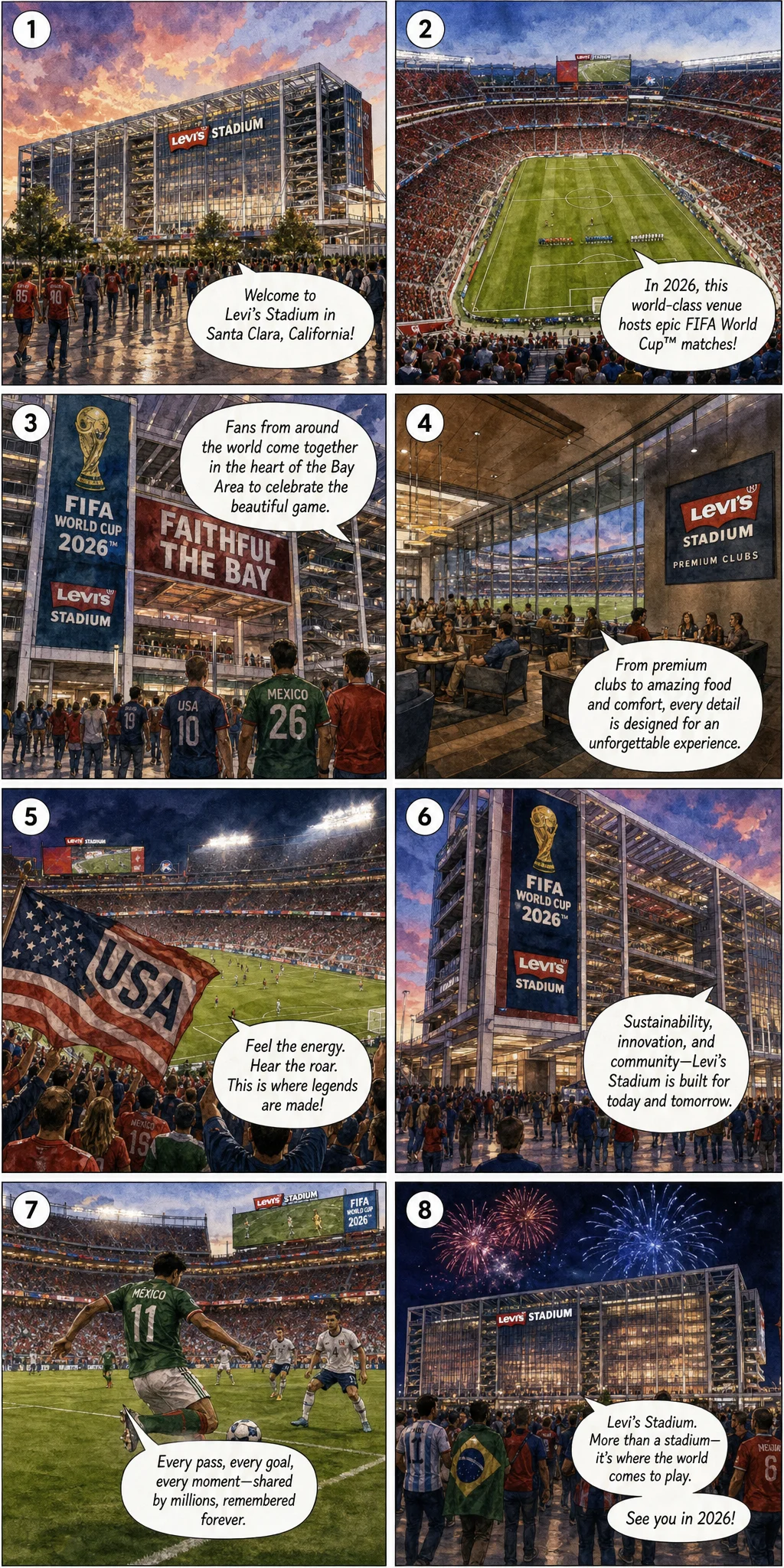
The 2026 World Cup brings six matches. Group stage. Round of 32. FIFA will call it "San Francisco Bay Area Stadium" — a name so desperate to triangulate geography that it uses a body of water as its anchor. Opening with Qatar vs Switzerland on June 13. For the first time, Levi's Stadium will host international football on the biggest stage available to the sport, and it will do so with proper grass, manageable June temperatures, and sixteen years of lessons learned since the day that fan died from the heat.
Will it finally feel like San Francisco? No. It never will. Candlestick is gone — demolished in 2015, the same year the Dead said goodbye, the same year WrestleMania came to Santa Clara, the same year the stadium's identity was still being negotiated. The fog, the wind, the damp, the miserable poetry of Candlestick — none of that can be transplanted forty miles south.
But for six matches in the summer of 2026, Levi's Stadium gets to drop the act. No 49ers branding. No corporate "faithful" pageantry. No luxury-lounge half-emptiness. Just football. Just 68,500 people watching the world's game in a building that has spent its entire existence trying to be something it wasn't, finally getting to be what it is: a stadium. A place where people gather to watch sport. Nothing more. Nothing less.
And maybe, if the light is right, and the crowd is loud enough, and the match is good enough — maybe, just maybe, the ghost of Candlestick will decide not to haunt it that day.