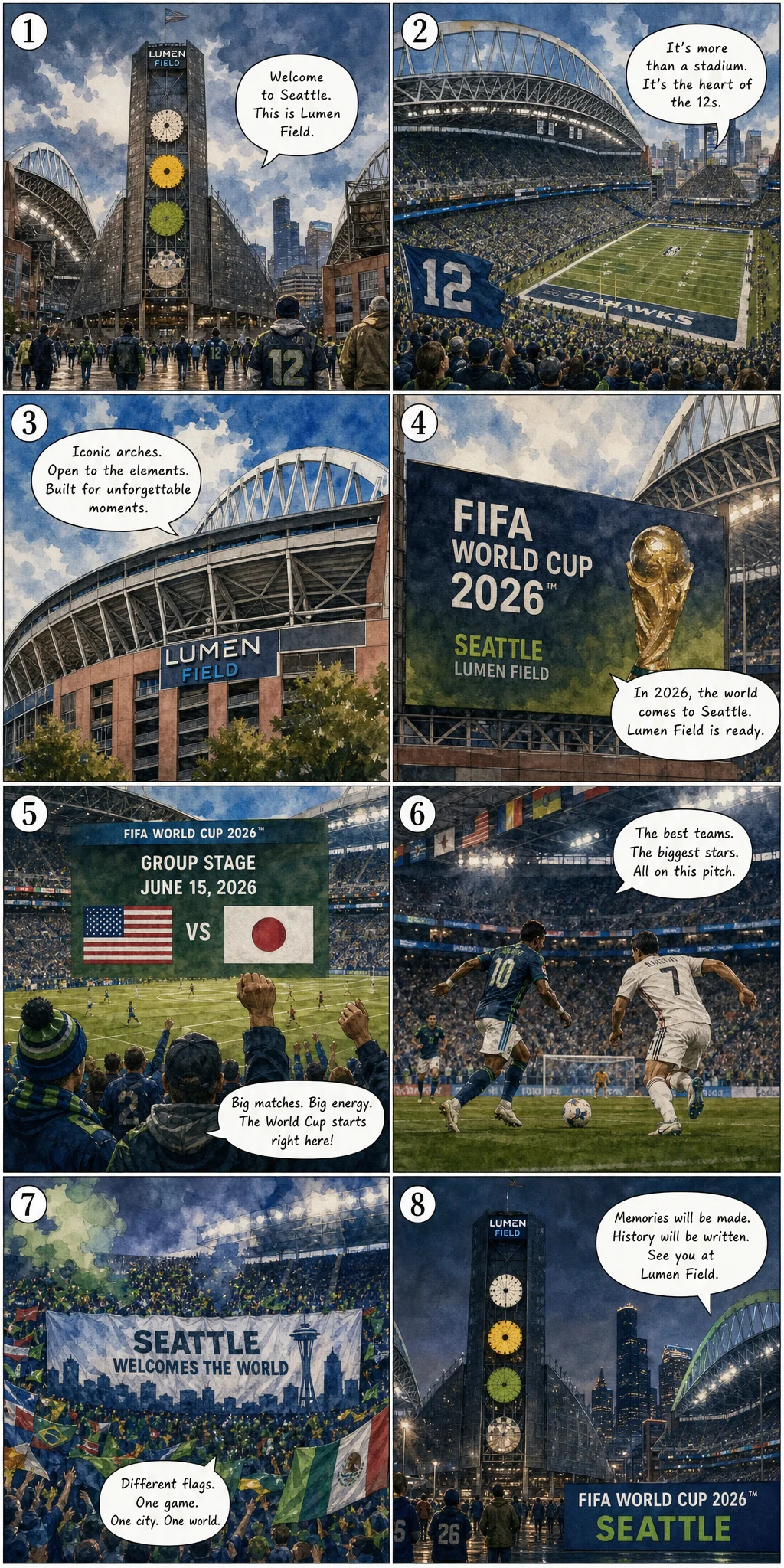
Lumen Field: Where the Earth Moves
The Earthquake Factory — where the 12th Man causes seismic events. The stadium that recorded 137.6 decibels, survived an earthquake during construction, and will host the USMNT at the 2026 World Cup.
Published: June 6, 2026
Lumen Field: Where the Earth Moves
On January 8, 2011, a seismograph one kilometer from Lumen Field registered a magnitude 2.0 earthquake.
There had been no geological event. No tectonic shift. No fault line slipping. The cause was a running back named Marshawn Lynch breaking through the New Orleans Saints defense — eight tackles evaded, sixty-seven yards, one stiff-arm that sent Tracy Porter into the earth — and 68,000 people screaming so hard the ground shook.
Seismologists at the Pacific Northwest Seismic Network had installed the instrument to monitor Mount Rainier. Instead, it recorded a football play. They named it the Beast Quake.
This is Lumen Field. This is what happens when you build a stadium on a tidal marsh, drive 2,200 pilings fifty to seventy feet into the mud, and fill it with people who have been waiting all week — in the rain, in the gray, in the coffee-fueled quiet of the Pacific Northwest — for the chance to make noise.
And they do make noise. On December 2, 2013, during a game against the New Orleans Saints (the Saints again — there is something about those gold helmets that Seattle takes personally), the crowd hit 137.6 decibels. That is louder than a jet engine at takeoff. Louder than a rock concert. Louder than the threshold of human pain. Guinness World Record certified it: loudest crowd roar at a sports stadium. Visiting offenses committed 143 false starts between 2002 and 2012. The New York Giants committed eleven in a single game in 2005. Eleven. Their left tackle was so rattled he jumped before the snap had even left the center's hands. Not a reaction to the count — a reaction to the noise, which had become a physical substance, a wall of pressure pushing against his eardrums so hard he could not think.
The 12th Man is not a marketing slogan. It is a retired number. The Seahawks retired the number 12 in 1984, permanently, in honor of their fans. Before every home game, a local legend raises the 12th Man flag at the south end of the stadium. The crowd goes silent — the same crowd that produces 137.6 decibels, completely silent — and then the flag goes up, and the silence breaks into something tectonic.
But before the flag, before the noise, before the Beast Quake, there was almost nothing. There was almost no team.
Rewind to 1996. Ken Behring, the Seahawks' owner at the time, had already moved the team's practice equipment to Anaheim. Trucks were literally loaded. The Los Angeles market was calling. Seattle was about to lose its football team the way it had lost the Supersonics — quietly, to a wealthier city, to the logic of money. Enter Paul Allen.
Paul Allen co-founded Microsoft. He was, by that point, one of the richest human beings alive. But he was also a Seattle native. He had gone to Lakeside School. He had watched the Seahawks play in the Kingdome — a brutalist concrete cylinder that looked like a nuclear reactor with a roof, built in 1976, a building so ugly and so deeply loved that Seattle forgave it entirely. Allen looked at the situation and did what almost no billionaire does: he spent his own money. He bought the team in 1997 for $194 million to keep it in Seattle. Then he spent more.
The Kingdome was obsolete. The roof leaked. The concrete was crumbling. It had to go.
March 26, 2000. 8:30 a.m. Twenty-one thousand pounds of dynamite. The Kingdome — the largest single-concrete-structure implosion in human history — collapsed in 16.8 seconds. The dust cloud rose two hundred feet and drifted over Pioneer Square. People watched from office buildings, from highway overpasses, from the decks of ferries crossing Puget Sound. A building that had defined Seattle's skyline for twenty-four years vanished into rubble and powder. The ground shook. Another earthquake, but this one was on purpose.
Paul Allen's new stadium rose from the same site — well, not exactly the same site. The Kingdome had stood on the same tidal marsh. The new stadium would sit adjacent to it, on ground so soft you could not build anything on it without sinking. The answer: 2,200 concrete-and-steel pilings, each one driven fifty to seventy feet into the glacial till below the mud. The pilings form a forest beneath the stadium, an invisible grid of columns holding everything up, like the roots of a redwood transferred to engineering.
Architects Ellerbe Becket and LMN Architects designed a U-shaped bowl with an open north end. The open end frames downtown Seattle — the Space Needle, the skyscrapers, the gray-blue of Elliott Bay. On a clear day, Mount Rainier floats above it all, a 14,410-foot volcanic cone so massive and so white it looks like a hallucination. The roof covers 70 percent of the seats but leaves the field open to the sky. This is the Pacific Northwest. If you can't play in the rain, you can't play here.
Construction began in 2000. In February 2001, while the steel skeleton was still bare, the Nisqually earthquake struck — magnitude 6.8, epicenter thirty-five miles away. The stadium's structural system was designed with friction pendulum dampers: giant bearings that allow the roof to move independently of the supporting pylons during an earthquake. The roof slid a few inches on its bearings. The structure held. The design worked. The stadium had literally been engineered to survive the earth moving beneath it — which, for a building on a tidal marsh in earthquake country, was not optional.
The stadium opened on July 28, 2002, with a Seahawks preseason game. Construction cost: $430 million. Paul Allen personally covered the cost overruns. The total public contribution was $300 million; everything else came from Allen's checkbook. He never asked for the money back.
Lumen Field was the first NFL stadium with FieldTurf — an artificial surface that plays faster than natural grass and drains water like a sieve. This matters in Seattle. The rain that falls on the open field does not puddle. It disappears into the underlayers, into the pilings, into the marsh below. The players stay upright. The ball skids true. The game goes on.
The Sounders arrived in 2009, bringing MLS to the same building. Seattle already had a soccer tradition — the NASL Sounders of the 1970s had drawn massive crowds in the Kingdome — but the MLS Sounders took it somewhere no one expected. In 2022, they became the first MLS team to win the CONCACAF Champions League in its modern format. May 4, 2022. 68,741 people. The final whistle. Seattle, a city that the rest of the country sometimes forgets exists, had done what no American club had ever done. The seismograph did not spike that night, but if you were there, you felt something move.
The 2016 Copa America Centenario brought USA vs Ecuador to Lumen Field for a quarterfinal. The 2025 FIFA Club World Cup brought six matches and more than 210,000 total fans. Real Madrid. Manchester City. Club football royalty, playing under the blue-painted steel arches of a stadium in the upper-left corner of America.
And now: 2026. The World Cup.
For the tournament, the stadium will be called "Seattle Stadium" — FIFA's naming rules strip the corporate sponsor. Temporary grass will be laid on twelve to fourteen inches of sand, a surface engineered to World Cup specifications but foreign to a stadium built on artificial turf. The US Men's National Team will play a group match here. Six matches total. The stands will fill with 69,000 people. The noise will register on instruments. The Space Needle will watch from the open north end. Mount Rainier will float on the horizon, indifferent to the spectacle, as volcanoes are.
Somewhere beneath all of it, the 2,200 pilings — driven into tidal marsh, holding everything up, invisible and essential — will absorb the vibration of every cheer.
Paul Allen died in 2018. He did not live to see the World Cup come to the stadium he built. But on the day the USMNT walks onto the pitch at Seattle Stadium, when the 12th Man flag goes up (replaced, for that afternoon, by the Stars and Stripes), when 69,000 people produce a sound that should, by all scientific measures, register as a geological event — Paul Allen will be there. He will be in every rivet of the blue steel arches. In every one of those 2,200 pilings. In the rain, if it rains, falling on the open field and draining away, leaving only the game.
Seattle is a city that almost lost football. Now it hosts the world. That is not a coincidence. That is what happens when you build something strong enough to move the earth — and then fill it with people who have been waiting all week to scream.