Lincoln Financial Field: Cheesesteaks, Miracles, and 4th-and-26
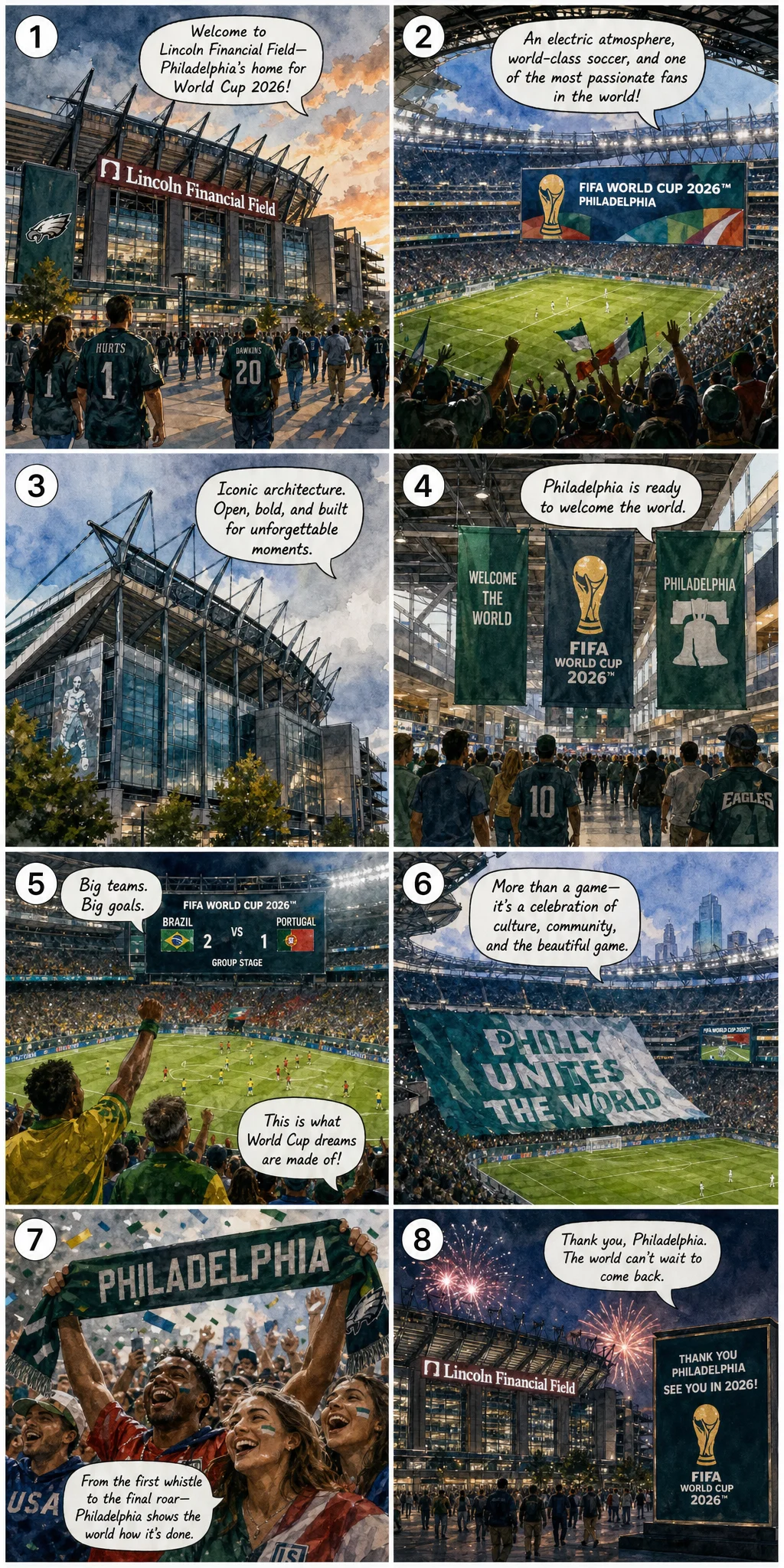
The House That Cheesesteaks Built — where Eagles fans are so passionate the city had to build a courtroom IN the stadium. Where Donovan McNabb completed 4th-and-26. Where WrestleMania XL drew 145,298 over two nights. Where the first thing the Eagles did was ban hoagies and cheesesteaks (and got laughed at so hard they reversed it in ONE WEEK). A stadium with 11,000 solar panels, 14 wind turbines, and the most intimidating fan base in America. And now: 6 World Cup matches including a July 4th knockout.
Published: June 6, 2026
Lincoln Financial Field: Cheesesteaks, Miracles, and 4th-and-26
In 2003, the Philadelphia Eagles made a decision so monumentally stupid it remains the gold standard for institutional tone-deafness in American sports. They banned cheesesteaks.
Not guns. Not fireworks. Not the guy in section 217 who has been painting his entire body green since the Carter administration. Cheesesteaks. The food that defines a city more thoroughly than any flag, any bell, any cracked and revered liberty. The thing you get at Pat's at 2 a.m. after you've made a series of questionable decisions and need exactly one more. The sandwich that has been the grease-powered backbone of Philadelphia identity since Pat and Harry Olivieri threw some chopped beef on a roll in 1930 and accidentally invented the only food that makes a Wawa hoagie look like health food.
The Eagles, in their infinite corporate wisdom, decided that allowing fans to bring outside food into the brand-new Lincoln Financial Field — which had just replaced the concrete tomb known as Veterans Stadium — would somehow compromise the fan experience. So they banned hoagies. They banned cheesesteaks. They banned Tastykakes. They banned anything that wasn't purchased from an approved vendor inside the stadium's gleaming new concourses.
Here is what happened next: Philadelphia lost its mind.
Talk radio lines melted. Newspapers ran editorials that read like declarations of war. The mayor — who understood exactly which side his bread was buttered on, ideally with Cooper Sharp — called the ban "un-Philadelphian." Fans showed up to the first preseason game carrying hoagies like protest signs. Somebody in section 104 unfurled a bedsheet that read "YOU CAN TAKE OUR CHEESESTEAKS FROM OUR COLD GREASY HANDS."
The ban lasted one week.
One. Week.
The Eagles reversed it. The team that once booed Santa Claus — and if you bring this up in Philadelphia, someone will explain to you, at length, that the Santa in question was a drunk replacement in a cheap suit during a miserable 1968 season, and frankly he deserved it — the team that built a courtroom inside their own stadium because their fans kept committing crimes, the team whose fan base is so famously intimidating that opposing players have admitted they lied about injuries to avoid playing at the Vet, this team tried to tell Philadelphia what it could and could not eat. And Philadelphia said no.
This is the building we are talking about. This is Lincoln Financial Field.
The Linc. Opened August 3, 2003, on eleven acres of South Philadelphia land that used to be a Navy Yard — the first thing that happened here wasn't even an Eagles game. It was Manchester United beating Barcelona 3-1 in front of 68,396 people, a friendly that served notice: this stadium was built for football, both kinds, from day one.
But to understand what the Linc is, you have to understand what it replaced.
Veterans Stadium. The Vet. Opened in 1971, a multi-purpose concrete circle that looked like an ashtray and smelled like one too. The Vet was brutalist architecture's gift to sports — all gray concrete, exposed ramps, and a playing surface that was essentially green-painted asphalt. The Phillies played there. The Eagles played there. The field had more seams than a Frankenstein monster. Players hated it. Fans loved it the way you love a dive bar that hasn't cleaned its taps since Reagan. The Vet had a courtroom in the basement — an actual, functioning courtroom — because on game days the arrest rate was so high it made logistical sense to process people on site. Judge Seamus McCaffery presided. He had his own black robe. He had a holding cell. He once processed 150 cases in a single afternoon. The Philadelphia court system had a branch office in the bowels of an NFL stadium. This was not a joke. This was efficiency.
When the Vet was demolished in 2004 — imploded, actually, 2,800 pounds of dynamite bringing down thirty-three years of concrete and chaos in sixty-two seconds — people bought tickets to watch. They tailgated for a demolition. You cannot make this up.
And from the dust rose the Linc.
NBBJ, the architecture firm that designed it, took one look at the Vet and decided to do the opposite of everything. Where the Vet was round, the Linc is angular. Where the Vet was enclosed, the Linc has three open corners that frame the Philadelphia skyline — you can see the Walt Whitman Bridge from the upper deck, the Delaware River on a clear day, the refineries of South Philly glowing at dusk like a dystopian Christmas tree. Where the Vet was gray concrete, the Linc is red brick and glass, an exterior that deliberately echoes Philadelphia's colonial architecture — Independence Hall, only with 67,000 seats and a lot more profanity.
The eagle-wing canopies spread over the east and west stands, giving the stadium its signature silhouette. 172 luxury suites. 10,828 club seats. A capacity of 67,594 that, on the right Sunday in January, feels like twice that.
And in the basement? They kept the courtroom. Of course they kept the courtroom. You don't fix what isn't broken. The Eagles — and this is the most Philadelphia thing about this entire story — looked at their own history of having to arrest so many of their own fans that an on-site judicial facility was necessary, and said: "We're going to need that again."
They were right.
Let me tell you about January 11, 2004. NFC Divisional Playoff. Eagles versus Packers. The Linc is four months old, the paint barely dry, and the Eagles are down 17-14 with 1:12 left. Fourth and 26. Twenty-six yards. Fourth and twenty-six. The situation is mathematically impossible — the conversion rate for 4th and 26 in NFL history was basically "don't bother." The Packers defense knows what's coming. Every single person in the stadium knows what's coming. Donovan McNabb drops back. The pocket collapses. He scrambles. He launches a prayer toward the middle of the field.
Freddie Mitchell catches it.
I am not going to describe this with the clinical detachment of a sportswriter. I am telling you: 67,000 people made a sound that registered on seismic equipment. The stadium physically shook. Mitchell caught the ball exactly past the first-down marker, the Packers secondary frozen like they'd seen a ghost, and the Eagles went on to tie the game and win in overtime. David Akers kicked the field goal. The Linc had its miracle. Fourth-and-26 entered the permanent lexicon of Philadelphia sports mythology — right up there with Rocky running up the Art Museum steps, right up there with Wilt's 100-point game, right up there with the Phillies winning in '08. This was the moment the new stadium stopped being a building and started being a cathedral.
The Eagles have played in three Super Bowls since moving to the Linc. They lost to New England in 2005. They beat New England in 2018 — Nick Foles, the backup quarterback, outdueling Tom Brady in a game that ended with a trick play called "Philly Special," a touchdown pass caught by the backup quarterback from a tight end on fourth down, the kind of play you draw in the dirt and pray the football gods aren't watching. Philly Special is now taught in schools. I am not exaggerating. Philadelphia schools literally teach the play as an example of creative thinking and teamwork. This is what football means here. It is not a sport. It is a curriculum.
The Eagles won again in 2025 — Jalen Hurts, Saquon Barkley, a defense that played like it was personally offended by the concept of forward progress. Two Lombardi trophies. Two parades down Broad Street. Two days when the city collectively called in sick and the rest of the country looked at Philadelphia and thought: they're going to burn it down, aren't they. And they didn't. They just drank everything.
But the Linc is not just an Eagles building. This is where WrestleMania XL happened in April 2024 — two nights, 145,298 combined attendance, a record for the event's forty-year history. The stadium transformed into a wrestling cathedral. Roman Reigns versus Cody Rhodes in the main event, the Bloodline storyline reaching its operatic conclusion, the entrance ramp stretching the length of the field, pyro lighting up the South Philly sky. The Rock showed up. He cut a promo. He called Philadelphia "the city of brotherly love and sisterly affection" and the crowd booed him anyway because that's what you do here. You boo the Rock. You boo Santa. You boo the visiting team's bus as it pulls into the parking lot. You boo the concept of politeness itself.
This is the city where Kevin Hart became the first comedian to sell out an NFL stadium for stand-up comedy. August 30, 2015. 53,000 people came to watch a man from Philadelphia tell jokes about Philadelphia in a stadium in Philadelphia. The meta of it could choke a horse. Hart walked on stage, looked at the crowd, and said something to the effect of "I used to sell sneakers two miles from here." The Linc has range. Football. Wrestling. Comedy. Music.
The music. Taylor Swift — who has a complicated relationship with Philadelphia that deserves its own dissertation — became the first act to sell out three consecutive nights at the Linc on a single tour. Eras Tour, May 2023. Three nights. Every ticket gone. The Swifties descended on South Philly like a glitter bomb and the city, to its credit, handled it with the same infrastructure it uses for NFC Championship games. Ed Sheeran holds the single-night record: 77,900. The Linc has hosted Kenny Chesney, Beyoncé, U2, Bruce Springsteen — the Boss, who is technically from New Jersey but spiritually from the same blue-collar church as everyone in that stadium.
This is also a green machine. 11,000 solar panels. Fourteen wind turbines — those spiral-shaped vertical-axis ones that look like DNA helixes from the future, spinning along the stadium's perimeter. Together they generate approximately 30% of the building's electricity. The Linc has topped PETA's list of vegan-friendly NFL venues four years running, which is hilarious if you have ever attended an Eagles tailgate, where the only vegetable is the onion on a cheesesteak and even that is considered a concession to weakness. The stadium was certified LEED Gold. It has a native-plant meadow. It recycles 99% of its waste. The building that replaced the concrete ashtray is one of the greenest sports venues in North America, and it did this without ever once asking fans to compromise.
And now: the world's game.
Let me tell you what is about to happen here. Lincoln Financial Field — though FIFA will call it "Philadelphia Stadium" during the tournament, because FIFA's sponsorship rules are a form of corporate poetry — will host six World Cup matches in 2026.
Six.
Including a Round of 16 knockout match on July 4th.
July 4th. American Independence Day. In Philadelphia. The city where the Declaration of Independence was signed — you can walk from the Linc to Independence Hall in about fifteen minutes, assuming you don't stop for a cheesesteak, and you will stop for a cheesesteak. The city where the Constitution was debated, ratified, and argued about by men in wigs who would be genuinely horrified by the fourth-down trick plays the Eagles eventually invented. The birthplace of American democracy will host a World Cup knockout match on the nation's birthday. There will be fireworks over the Delaware River. You'll be able to see them through the open corners of the stadium. 67,000 flags from every qualified nation waving in the summer heat. America, playing football — the real football, the one the rest of the world has been telling us we don't understand — on the most American day possible, in the most American city possible.
This is not a coincidence. FIFA knows exactly what it's doing.
The Linc has done international soccer before. 2016 Copa America Centenario: USA 1-0 Paraguay. The USMNT needed a result to advance, and they got it — a tense, grinding, thoroughly un-American performance of defensive discipline and tactical patience. The crowd was a wall of red, white, and blue. Clint Dempsey scored. The stadium shook — not the way it shakes for a touchdown, but deeper, a lower frequency, the sound of a sport that is still growing roots in American soil finding purchase. International soccer took over an NFL fortress that night and the fortress held.
2025 FIFA Club World Cup: eight matches including a quarterfinal. Liverpool versus Arsenal played a friendly here in July 2024 that drew 69,879 — the soccer attendance record for the building. The grass field was rolled in over the turf. The corners were opened to the Delaware breeze. It worked. The football stadium played football and it worked.
And now the big one. The World Cup. The actual World Cup.
Here is the thing about Philadelphia that people who are not from Philadelphia do not understand: this city has a chip on its shoulder the size of the Walt Whitman Bridge. It is the sixth-largest city in America but it carries itself like the overlooked middle child of the Northeast Corridor — sandwiched between New York's arrogance and DC's self-importance, constantly having to remind people that it exists, that it mattered before either of those cities did, that the country was literally invented here while New York was still New Amsterdam and Washington was a swamp.
Philadelphia does not ask for respect. Philadelphia demands it, and when it doesn't get it, Philadelphia makes you remember why you should have given it.
This is the city where a boxing statue replaces a mayor's statue because the people voted with their feet. Where the art museum steps are more famous than the art inside. Where the drinking water is regularly described as "fine, actually" in tones that suggest it is anything but. Where the sports radio callers have PhDs in grievance and post-doctoral training in being right about things. Where the phrase "go birds" functions as hello, goodbye, and an entire political platform.
And now this city — this loud, proud, grudge-holding, cheesesteak-defending, Santa-booing, courtroom-in-the-basement-having city — gets to host the world on its birthday.
July 4, 2026. Round of 16. Philadelphia Stadium. The fireworks start at dusk. The game starts earlier. By the time the night sky over the Delaware lights up, someone will have advanced to the World Cup quarterfinals and someone will have gone home. The open corners of the Linc will frame the explosions. The Walt Whitman Bridge will be lit in whatever colors the occasion demands. The wind turbines will be spinning. The solar panels will have charged all day in the July sun. The building will be running on its own power — literally and figuratively.
There is a line from the Declaration of Independence that everyone knows: "We hold these truths to be self-evident." But Philadelphia knows the less-quoted parts. The part about how governments derive "their just powers from the consent of the governed." The part about the right — the duty — to "throw off such Government" when it becomes destructive. Philadelphia was founded on the idea that you don't have to take it. Whatever "it" is. A cheesesteak ban. A bad call. A 4th-and-26. The world's skepticism about whether an NFL stadium in South Philly can host the biggest sporting event on Earth.
The Eagles reversed the cheesesteak ban in one week because Philadelphia taught them a lesson that applies to everything this city does: you cannot tell us what we can't do. You cannot tell us what we can't eat. You cannot tell us what we can't host. You cannot tell us what we can't be.
The Linc stands at the corner of Pattison Avenue and Darien Street in South Philadelphia, built on Navy Yard land, facing the Walt Whitman Bridge, its brick facade glowing in the sunset, its eagle-wing canopies spread, its solar panels humming, its wind turbines spinning, its basement courtroom ready, its 67,594 seats waiting.
The world is coming to Philadelphia on its birthday.
Go Birds.