Hard Rock Stadium: Nine Names, Six Super Bowls, One Miami
Hard Rock Stadium: Nine Names, Six Super Bowls, One Miami This stadium has had nine names. NINE. Joe Robbie Stadium. Joe Robbie Stadium again (yes, twice). Pro Player Park. Pro Player Stadium. Dolphins Stadium. Dolphin Stadium. Land Shark Stadium. Sun Life Stadium. New Miami Stadium. Hard Rock Stadium. Nine names in thirty-nine years. That is not a stadium. That is a witness protection program with a football field. Most buildings collect dust. This one collects identities — shedding them lik
Published: June 6, 2026
Hard Rock Stadium: Nine Names, Six Super Bowls, One Miami
This stadium has had nine names. NINE.
Joe Robbie Stadium. Joe Robbie Stadium again (yes, twice). Pro Player Park. Pro Player Stadium. Dolphins Stadium. Dolphin Stadium. Land Shark Stadium. Sun Life Stadium. New Miami Stadium. Hard Rock Stadium. Nine names in thirty-nine years. That is not a stadium. That is a witness protection program with a football field.
Most buildings collect dust. This one collects identities — shedding them like a Miami con man sheds aliases, each one a slightly different shade of the same hustle. And somehow, through every rebrand, every renovation, every improbable reinvention, it has survived. Not just survived. Thrived. This is the most adaptable building in American sports. It has been a football cathedral, a baseball diamond, a tennis center, a racetrack, a concert hall, and a wrestling coliseum. It has hosted more Super Bowls than any stadium in history. And in the summer of 2026, it adds one more incarnation: World Cup host.
The story starts in 1985 with a man named Joe Robbie. He owned the Miami Dolphins. He wanted a stadium. Miami-Dade County wanted rent — high rent, the kind of rent that says "we own you." Robbie, who had clawed his way from poverty in South Dakota to law school to NFL ownership, looked at the numbers and made a decision that no sports owner had ever made before: he would build it himself. With his own money. $115 million. No public bonds. No tax subsidies. No government handout. The first privately financed stadium in American professional sports.
He broke ground in what was then unincorporated Dade County — farmland, basically, with palm trees and snakes and nothing else. People called it "Joe Robbie's Folly." The location was nowhere. The financing was insane. The man was seventy years old. But when the stadium opened on August 16, 1987, it existed because one man refused to be told no.
The architecture was deliberate. HOK Sport — the firm that would later become Populous, the stadium-design titan — gave Robbie a building wider than standard NFL specifications. Robbie wanted baseball. He wanted soccer. He wanted a building that could become anything. The east-west orientation was hell for spectators (the north stand faces brutal tropical sun), but it fit a regulation soccer pitch. Joe Robbie was playing the long game, and the long game is still being played.
Then the names started coming.
Joe Robbie died in 1990. The naming rights carousel began: Pro Player (the sports apparel brand), Dolphins Stadium (brand synergy), Dolphin Stadium (singular, somehow different), Land Shark (a Jimmy Buffett beer, because of course Miami), Sun Life (the insurance company, dignified), New Miami Stadium (an attempt at civic branding that lasted approximately seventeen minutes), and finally Hard Rock — the restaurant chain with the guitar logo, which paid $250 million for the name and has kept it since 2016. Each name change was a small death and rebirth. Each time, the building absorbed the new signage, the new paint, the new corporate personality, and went on with its business.
The business was winning.
Six Super Bowls. SIX. That ties the record for any stadium in history — the Superdome in New Orleans is the only other building that can say that. XXIII: Montana's 49ers beat the Bengals with a 92-yard drive in the final minutes. XXIX: Steve Young threw six touchdown passes against the Chargers. XXXIII: Elway's Broncos, his final game. XLI: Peyton Manning's Colts beating the Bears in the rain — the first Super Bowl played in wet conditions, because the field was open to the sky and Miami's sky does what it wants. XLIV: Drew Brees and the Saints, the city of New Orleans winning a Super Bowl five years after Katrina. LIV: Mahomes and the Chiefs, the beginning of a dynasty. Six championship games on one field. Six different decades. Six versions of America watching the same 120 yards of grass.
But here is the cruelest, most brilliant detail about this building. In 2015-16, Stephen Ross — the Dolphins' current owner — spent $350 million on a renovation. The centerpiece: a canopy. A massive, angular shade structure that covers the seats. NOT the field. The field stays open to the rain and the sun. The field is exposed, as football fields should be, as soccer pitches must be. But the seats? The seats are in shade.
Except the visiting team's bench.
The canopy is positioned so that the Dolphins sideline sits in full, cool shade. The visiting sideline bakes in direct Miami sunlight. Factor in the fact that Miami wears white at home — forcing opponents into dark colors. Factor in a tropical climate where heat index regularly exceeds 100 degrees. Factor in that the east-west orientation means the north stand absorbs relentless sun. Stephen Ross didn't just renovate a stadium. He built a climate weapon. Legal. Architectural. Absolutely diabolical.
This same stadium hosted the Miami Marlins from 1993 to 2011. The Marlins won two World Series here — 1997 and the improbable 2003 championship, Josh Beckett on the mound, 67,498 fans packed into a building that was designed for football but made itself wide enough for baseball. Mark McGwire hit his 57th home run of the 1998 season here — the record-breaking one, the one that had America holding its breath, before steroids became the story and the story became complicated. Ken Griffey Jr. hit his 600th home run here in 2008. Roy Halladay threw a perfect game here in 2010 — 27 batters up, 27 batters down. A football stadium. A perfect game. The building's versatility is not a feature. It is the entire identity.
And then it went further.
The Miami Open tennis tournament built 29 permanent courts in the parking lots. Twenty-nine. The stadium itself became center court — the same field that hosted Super Bowls now hosting Serena Williams serving aces and Novak Djokovic sliding on hardcourt. A tennis Grand-Slam-adjacent event, happening in a football stadium's parking lot, while monster trucks do backflips in the end zone and Formula One cars scream past on a temporary circuit built around the grounds. The Miami Grand Prix has run here since 2022. WrestleMania XXVIII drew 78,363 for The Rock vs. John Cena — "Once in a Lifetime," they called it, and 78,363 people watched two men pretend to hate each other in a building that had seen real battles between 49ers and Bengals and Broncos and Chiefs.
On July 14, 2024, the Copa America final came to Miami. Argentina vs. Colombia. Lionel Messi — in what many believed would be his final major international tournament — lifted the trophy under the Hard Rock canopy. 65,300 fans filled the stadium that Joe Robbie built on farmland. Colombia had beaten Uruguay in the semifinal. Argentina had beaten Canada. The final was marred by crowd control failures — fans without tickets breaching the gates, the kickoff delayed by eighty-two minutes — but when the match finally happened, when Lautaro Martinez scored the winner in extra time, when Messi embraced his teammates with tears in his eyes, the building held another immortal moment. South American football's biggest prize, decided on American soil, in Miami. Of course Miami. Where else would South America come to settle its scores?
And now, 2026.
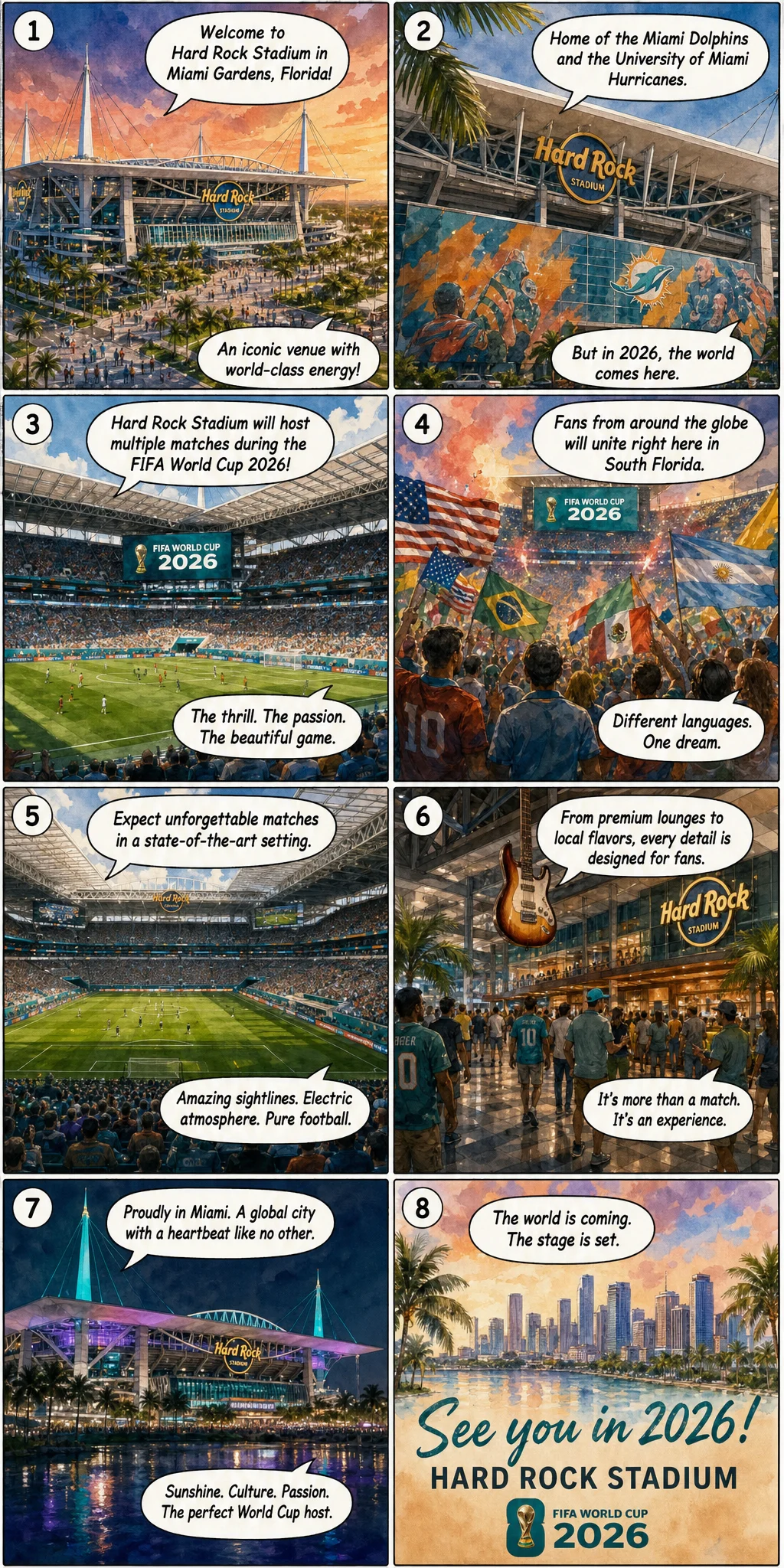
For the World Cup, FIFA will call it "Miami Stadium" — stripping the corporate name, as FIFA does. The F1 track will be dismantled. The tennis courts will be hidden. The canopy will still shade the seats and leave the field open to Miami's tropical sky. Joe Robbie's wide building — designed for baseball and soccer before soccer was even a realistic American dream — will host multiple World Cup matches. Thirty-nine years after Robbie stood on empty farmland and said "I'll do it myself," the world's game arrives at the world's most adaptable building.
Nine names. Six Super Bowls. Two baseball World Series. One perfect game. Twenty-nine tennis courts. One F1 track. One canopy that fights dirty. And one man who refused to pay rent.
Miami, baby. This is Miami.