Bosnia & Herzegovina: Journey to 2026
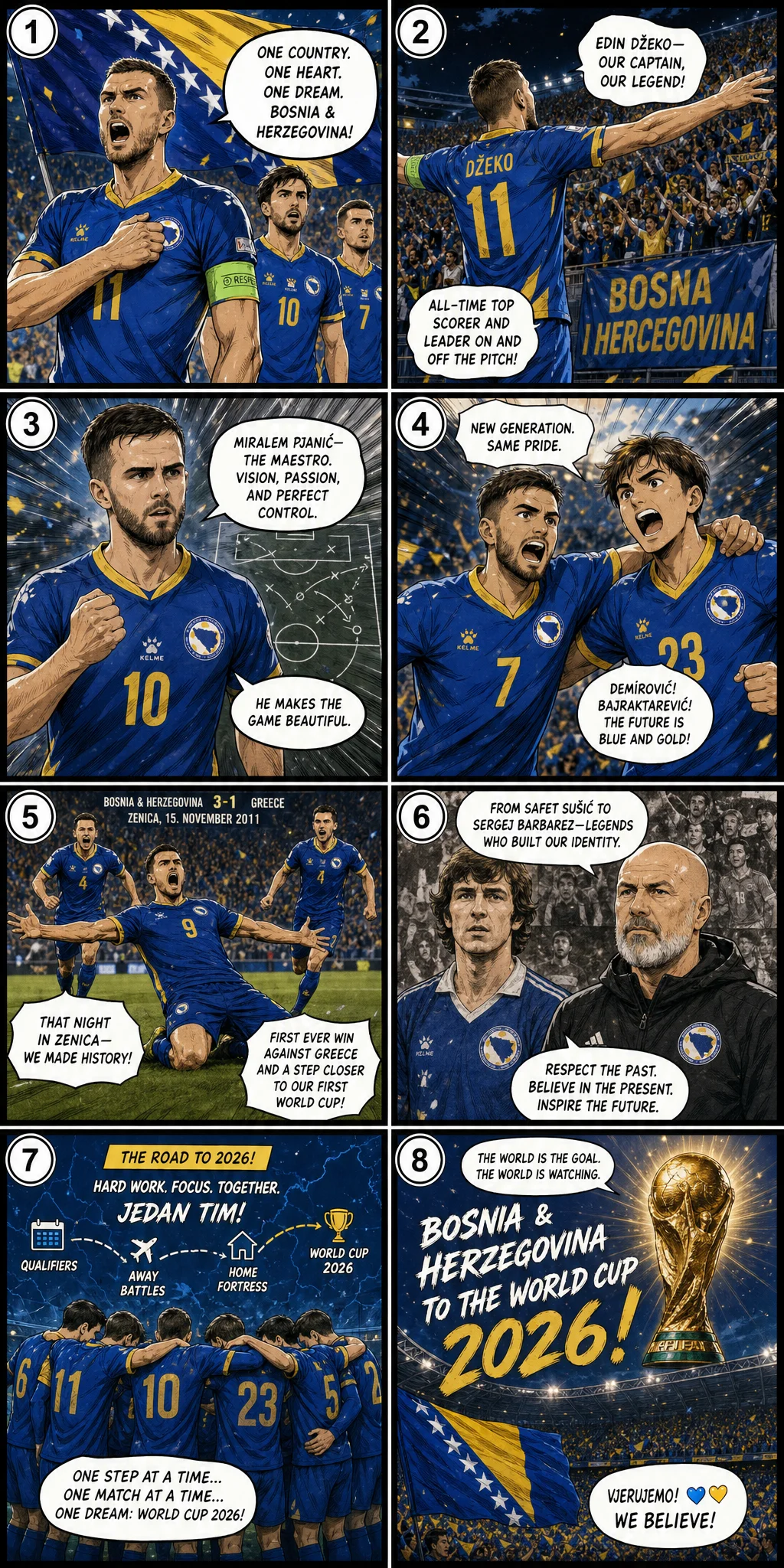
8-panel comic about Bosnia & Herzegovina national football team and their journey to the 2026 FIFA World Cup.
Published: June 5, 2026
Bosnia and Herzegovina National Football Team: The Dragons' Fire
The Bosnia and Herzegovina national football team, known as "Zmajevi" — the Dragons — and sometimes as "Zlatni Ljiljani" — the Golden Lilies — carries the hopes of a small Balkan nation with a complex history and an outsized passion for the beautiful game. Since gaining independence in 1992 and FIFA recognition in 1996, Bosnia and Herzegovina has packed a remarkable amount of football history into three short decades. Their participation in the 2026 World Cup represents the latest chapter in a story of resilience, talent, and the unifying power of sport.
HISTORICAL FOUNDATIONS
Football arrived in Bosnia and Herzegovina during the Austro-Hungarian period in the early twentieth century, spreading through the gymnasiums and cafes of Sarajevo, Mostar, and Banja Luka. The first clubs — FK Sarajevo, FK Željezničar, HŠK Zrinjski Mostar — were founded in the years before World War I, establishing local rivalries and football traditions that would survive wars, political upheavals, and the dissolution of states.
During the Yugoslav era, Bosnian football operated within the larger framework of Yugoslav football, contributing players, coaches, and passion to the national team. Bosnian-born footballers including Vahid Halilhodžić, Safet Sušić, and Faruk Hadžibegić starred for Yugoslavia in major tournaments, their technical elegance reflecting the distinctive Bosnian footballing philosophy: play with intelligence, touch, and creativity above all else. The Yugoslav league featured Bosnian clubs like FK Sarajevo and FK Željezničar competing against the giants from Belgrade, Zagreb, and Split, with Sarajevo winning the Yugoslav title in 1967 and 1985.
The Bosnian War of 1992-1995 devastated the country and its football infrastructure. Stadiums were damaged, youth development systems were shattered, and the human toll was catastrophic. In the aftermath, football became one of the forces of reconstruction — a way to rebuild communities, to give young people hope, and to project a new national identity to the world. The national team's first official match, a 2-0 victory over Albania in 1995, was more than a sporting event; it was a declaration that Bosnia and Herzegovina existed, that it would persevere, and that its people would take their place in the international community.
LEGENDS OF THE DRAGONS
Safet Sušić, known as "Pape," is widely regarded as Bosnia's greatest ever footballer. A midfield artist of rare vision and technique, Sušić played for FK Sarajevo before a glittering career at Paris Saint-Germain, where he became a club legend. His 21 goals in 54 appearances for Yugoslavia included a hat-trick against Italy — a performance of such complete mastery that it remains a reference point for Balkan football excellence. As Bosnia's first national team coach after independence, Sušić guided the team to its historic first World Cup qualification in 2014, bridging the Yugoslav era and the independent nation.
Edin Džeko stands as the most prolific goalscorer in Bosnian history, with over 65 international goals. His journey from the war-scarred streets of Sarajevo to the summit of European football — winning league titles with Wolfsburg, Manchester City, Roma, and Inter Milan — is a testament to extraordinary talent and unshakeable determination. Džeko's game combines physical presence, technical finesse, and the instinctive positioning of a born goalscorer. His equalizer for Manchester City against QPR in 2012 — the goal that, moments before Sergio Agüero's iconic winner, made the impossible possible — is part of Premier League folklore.
Miralem Pjanić provided the creative heartbeat of Bosnia's midfield for over a decade. His free-kick mastery, passing range, and football intelligence made him one of Europe's most sought-after midfielders during spells at Lyon, Roma, and Juventus. Sergej Barbarez, the elegant forward who starred in the Bundesliga with Hamburg and Bayer Leverkusen, carried Bosnian football's flag during the difficult early years of independence, his technical quality and charisma making him a beloved figure. Hasan Salihamidžić, "Brazzo," won the Champions League with Bayern Munich and became one of Europe's most respected sporting directors after his playing career.
THE MODERN ERA
Bosnia's 2014 World Cup appearance in Brazil, while ending in the group stage, represented a national triumph. The team competed credibly against Argentina, Nigeria, and Iran, with Džeko having a goal controversially disallowed against Nigeria that might have changed the tournament's trajectory. For a nation of just over three million people, simply being present among football's elite was a source of immense pride.
The current Bosnia and Herzegovina squad reflects a transitional period, blending the final campaigns of a golden generation with the emergence of new talent. The domestic Premier League of Bosnia and Herzegovina, while modest in European terms, continues to develop technically proficient players, and the Bosnian diaspora — spread across Western Europe, North America, and Australia — provides an additional talent pool through players eligible for national team selection.
The midfield remains the team's strength, with players shaped by the Bosnian tradition of technical excellence and tactical intelligence. The defensive unit has shown improved organization, while the attacking options combine physical presence with the guile that has always characterized Balkan forward play.
FOOTBALL AND BOSNIAN CULTURE
In Bosnia and Herzegovina, football is inseparable from identity, community, and the rhythms of daily life. The sarajevski derbi between FK Sarajevo and FK Željezničar divides the capital with an intensity that reflects deeper social, historical, and even philosophical divisions. The Mostar derby between Zrinjski and Velež carries similar weight, the two clubs representing different communities in a city still healing from war.
The ethnic complexity of Bosnia — Bosniaks, Serbs, and Croats sharing a single state with a complex governance structure — is reflected in football. The national team, when successful, has proven to be one of the few institutions capable of uniting the country across ethnic lines. When the Dragons win, Sarajevo, Banja Luka, and Mostar celebrate together. The football pitch has been one of the few arenas where Bosnian identity transcends the divisions that dominate political life.
Café culture and football are intertwined — the debates over Turkish coffee about tactics, selections, and historical grievances are as much a part of Bosnian football as the matches themselves. The "bosanski lonac" — Bosnian pot — metaphor is sometimes applied to the national team: diverse ingredients coming together to create something greater than the sum of its parts.
THE PATH FORWARD
Bosnia and Herzegovina's qualification for the 2026 World Cup represents a resurgence after the disappointment of missing the 2018 and 2022 tournaments. The team navigated a challenging qualifying campaign with determination and emerging quality, securing a place among UEFA's representatives in the expanded 48-team field.
The tactical identity has evolved from the possession-oriented approach of the Džeko-Pjanić era toward a more pragmatic, counter-attacking style that maximizes the team's technical quality while minimizing defensive vulnerabilities. The current squad understands that results matter more than aesthetics at this stage of the nation's development.
For Bosnia and Herzegovina, the 2026 World Cup is about more than results. It is about visibility — the opportunity to remind the world that this small Balkan nation, scarred by war but unbowed, produces footballers of extraordinary quality and plays the game with passion, intelligence, and heart. The Dragons carry their nation's story onto the pitch: a story of survival, of creativity amid difficulty, of the beautiful game as a force for unity in a land that knows too well the costs of division.