Gillette Stadium: The Lighthouse of a Dynasty
Robert Kraft's $325M privately-funded fortress where the greatest NFL dynasty unfolded. 200 design iterations. A 218-ft lighthouse taller than the Statue of Liberty's torch. Six Super Bowl banners. Tom Brady's Hall of Fame induction drew 60,000 inside the stadium. Now: 7 World Cup matches including a quarterfinal.
Published: June 6, 2026
Gillette Stadium: The Lighthouse of a Dynasty
Two hundred times.
Two hundred design iterations. Populous — still called HOK Sport back then, before branding got its hands on architecture — presented Robert Kraft with concept after concept, rendering after rendering, model after model. And two hundred times, Kraft looked at what they brought him and said: not yet.
This is the first thing you need to understand about Gillette Stadium. It was not built by a city council vote. It was not extracted from taxpayers through the quiet extortion of public stadium financing. It was not rushed into existence because a deadline demanded it. Robert Kraft paid for it himself. All $325 million. And because he was writing the checks, he got to be as particular as he wanted.
"Not yet." Two hundred times.
The architects at Populous learned to read the slight tilt of his head, the way he would narrow his eyes at a facade detail, the half-second pause before he spoke. They learned that Kraft was not going to settle — not for good, not for very good, not for excellent. He was going to settle for exactly the thing he saw in his head, and he would not know what that thing looked like until someone showed it to him.
On the two hundred and first try, he said yes.
What he said yes to was modeled — deliberately, cleverly — on M&T Bank Stadium in Baltimore, which Populous had designed four years earlier. But Kraft wanted more. He wanted a lighthouse. He wanted a bridge entrance modeled on the Longfellow Bridge that spans the Charles River between Boston and Cambridge. He wanted 64,628 seats and 82 luxury suites and 5,876 club seats. He wanted the largest outdoor video board in the United States. He wanted a building that felt like New England — not like an airport, not like a shopping mall, not like the concrete ashtrays that passed for stadiums in the 1970s — but like something that belonged to the cold, flinty, fiercely proud corner of America that produced him.
He got it.
---
Foxborough. Let me say that name again, because the people who do not live here will call this "Boston Stadium" during the World Cup, and the people who do live here will grind their teeth every time they hear it. Foxborough is not Boston. It is twenty-two miles southwest of Boston, twenty-two miles north of Providence, straddling the line between two identities without fully belonging to either. It has 18,000 residents and one enormous stadium and a football team that the entire region treats as a religion.
The Patriots almost left. This is not a hypothetical. This is not a negotiating tactic that got leaked to the Boston Globe. In 1998, the deal was signed. Connecticut Governor John Rowland had committed $374 million in state money. The Hartford stadium was going to be built on the Connecticut River, a gleaming waterfront cathedral that would steal New England's football soul and relocate it to insurance-company country. The press conference happened. The renderings were published. The moving trucks were, metaphorically, idling in the parking lot of the old Foxboro Stadium — a no-frills metal bench arrangement that made high school bleachers look ambitious.
And then it collapsed.
The details are a tangle of financing disputes, environmental concerns about the riverfront site, and the quiet machinations of NFL owners who did not want a team abandoning its market. But the result was this: Hartford didn't get the Patriots. Governor Rowland — and this is true, this is not Boston sports radio mythology — became a New York Jets fan out of spite. You lose a football team, you lose your dignity, you might as well root for the team that exists to break your heart in a different shade of green.
Kraft, having escaped the Hartford entanglement, turned back to Foxborough. But this time he wasn't asking anyone for money. This time it was his checkbook and his vision and his two hundred design iterations.
---
The dynasty that unfolded inside this building is statistically improbable and emotionally inexhaustible.
Six Super Bowl banners hang in Gillette Stadium. The first came after the 2001 season — the year the stadium was under construction, the year a sixth-round draft pick named Tom Brady replaced an injured Drew Bledsoe and the universe tilted on its axis. The banners came in 2003, 2004, 2014, 2016, and 2018. Each one represents a season that defied what professional football is supposed to allow — sustained excellence in a league designed to prevent it, a salary-cap era dynasty that should not have been possible.
The Patriots' home playoff record at Gillette through 2025: 21 wins, 4 losses. Twenty-one and four. That is not a home-field advantage. That is a throne room.
What happened in this building in January defies not just football logic but meteorological logic. The coldest game in Patriots history was played here: January 10, 2004, divisional round against the Tennessee Titans. Temperature at kickoff: 4 degrees Fahrenheit. Wind chill: minus 12. The Titans' quarterback, Steve McNair — a warrior in his own right, a man who played through injuries that would hospitalize most humans — completed 18 passes. The Patriots won 17-14. Adam Vinatieri kicked a 46-yard field goal into air so cold the ball might as well have been a frozen potato. The cold became part of the mythology. Gillette in January was not a venue. It was a weapon.
The snow games. The Tuck Rule game was in the old Foxboro Stadium, but the snow games of the dynasty years — the ones where Brady's breath crystallized in the air and the opposing defense looked like they wanted to be anywhere else on Earth — those happened here. The NFL changed its overtime rules because of what the Patriots did in this building. The league changed the way defenses could contact receivers downfield after the 2003 AFC Championship Game, a 24-14 dismantling of Peyton Manning's Colts in which the Patriots' defensive backs effectively committed legalized assault on Indianapolis's receivers for sixty minutes. The building changed football.
Bill Belichick patrolled the sideline in a hoodie with the sleeves cut off, a look that communicated: I do not care what you think of me, I care about the spacing on this punt coverage. Brady screamed in the huddle and hugged his linemen after touchdowns. Gronkowski spiked footballs with such force that the league had to invent new ways to penalize celebration. The sound of 64,000 people in parkas and wool hats, roaring in air so cold it hurt to breathe — this was the Gillette experience. Not comfortable. Not polite. Victorious.
---
June 12, 2024.
Tom Brady's Hall of Fame induction ceremony was held inside Gillette Stadium. Not in a hotel ballroom. Not in a convention center. Not in Canton, Ohio, where the Pro Football Hall of Fame building sits waiting for tourists. Inside the stadium.
Sixty thousand people bought tickets to watch a retirement speech. Think about that. Sixty thousand people drove to Foxborough on a Wednesday in June to sit in the same seats where they had watched Super Bowls being won and playoff games being survived, except this time there was no game. There was just a man, a podium, and the shared understanding that nothing like this would ever happen again.
Belichick was there. The owner was there. Former teammates filled the sideline. Brady spoke for over an hour, and the most remarkable thing about his speech was not what he said but what the building itself communicated. The stadium had been his stage for twenty seasons. Every yard line held a memory. The north end zone — that was where the comebacks happened. The south end zone — that was where the clock-management miracles unfolded. The lighthouse — that was what you saw when you looked up from the field, the beam sweeping across the Massachusetts sky, a silent witness to everything that had happened on this patch of grass.
Sixty thousand people, inside a stadium, for a speech. This had never happened before in American sports. It may never happen again. The only person who could command that kind of audience, in that building, was the person who built the building's meaning — not with concrete and steel, but with twenty years of refusing to lose.
---
The building has done things that have nothing to do with football.
January 1, 2016: The NHL Winter Classic. Outdoor hockey at Gillette. The Montreal Canadiens versus the Boston Bruins on a temporary rink built on the same field where Brady had thrown a thousand touchdowns. Sixty-seven thousand, two hundred forty-six fans — the second-largest crowd in Winter Classic history at the time — sat in temperatures that hovered around freezing, watching hockey the way New Englanders used to watch it: outdoors, in the cold, where the game was invented. The Canadiens won 5-1, which is the kind of detail that Bruins fans have spent a decade trying to forget. The lighthouse stood guard over ice instead of grass, and it made perfect sense. This building was built for New England, and New England is hockey country before it is anything else.
January to June 2021: Gillette Stadium became a mass COVID-19 vaccination site. Six hundred ten thousand, two hundred eighty-three shots were administered in these concourses. Let that number sit for a moment. 610,283. The concourses that had seen fans spilling beer and celebrating championships became a medical facility — efficient, organized, staffed by nurses and National Guard members and volunteers. The lighthouse beacon, visible for miles across the Massachusetts flatlands, became a symbol of something larger than sport. The stadium that had hosted Super Bowl celebrations was now hosting the fight against a pandemic. Kraft, who had turned the stadium's food service in-house years earlier — resulting in Gillette achieving the only 0% critical health violation rate in the NFL, a statistic that seems impossible until you remember who built this place — made sure the vaccination operation ran with the same precision. The stadium that fed fans without a single critical violation was now protecting them without a single wasted dose.
December 9, 2023: The Army-Navy Game. 65,878 people. The cadets and midshipmen marched onto the field in formation, and the stadium that usually hosted the controlled chaos of NFL Sundays hosted instead the precision of military ritual. Army won 17-11. The lighthouse watched over the future officers of the United States military, and the symbolism was not subtle, and it did not need to be.
---
Football. The other kind.
April 27, 2024: Inter Miami came to Foxborough. That sentence sounds like a travel itinerary, but what it meant was this: Lionel Messi, the greatest soccer player who has ever lived, walked onto the FieldTurf at Gillette Stadium in a pink jersey. Sixty-five thousand, six hundred twelve people — a stadium soccer record — filled the seats. Argentine flags replaced Patriots banners. The "Messi! Messi!" chant echoed through a building designed for "Brady! Brady!"
The Revolution lost, of course — they usually do, this is the curse of being the New England soccer team that plays in a football cathedral — but the score did not matter. What mattered was this: soccer had arrived at the heart of American football country, and the building held. The sightlines worked. The atmosphere translated. The lighthouse, which had seen everything from Super Bowl celebrations to vaccine shots to outdoor hockey, watched Messi dribble through the Revolution defense and added another chapter to its improbable resume.
The stadium had hosted MLS Cup 2002 — LA Galaxy 1, Revolution 0, 61,316 fans, four months after the building opened. It had hosted international friendlies and Gold Cup matches and World Cup qualifiers. But Messi was different. Messi was the moment when the world's game and America's stadium stopped being two separate categories and became one thing: a stadium full of people watching the greatest to ever do it, playing the sport that belongs to everyone.
---
2023 brought a renovation that would have been the envy of any venue in the world. $225 million. A new lighthouse — 218 feet tall, taller than the torch of the Statue of Liberty, with a 360-degree observation deck that looks out over the Massachusetts countryside. A 22,000-square-foot outdoor video board, the largest in the United States, a digital canvas that makes every replay feel like cinema. 75,000 square feet of new hospitality space, because Robert Kraft does not do things halfway and never has.
The renovation was not an overhaul. It was an enhancement. The bridge entrance — still modeled on the Longfellow Bridge, still glowing at dusk like a promise — remained the stadium's signature architectural feature. The brick and steel facade, deliberately understated in that particular New England way that communicates wealth without advertising it, stayed intact. The lighthouse just got taller, brighter, more visible. Like the team that played here for two decades, the building didn't need to be replaced. It needed to be elevated.
---
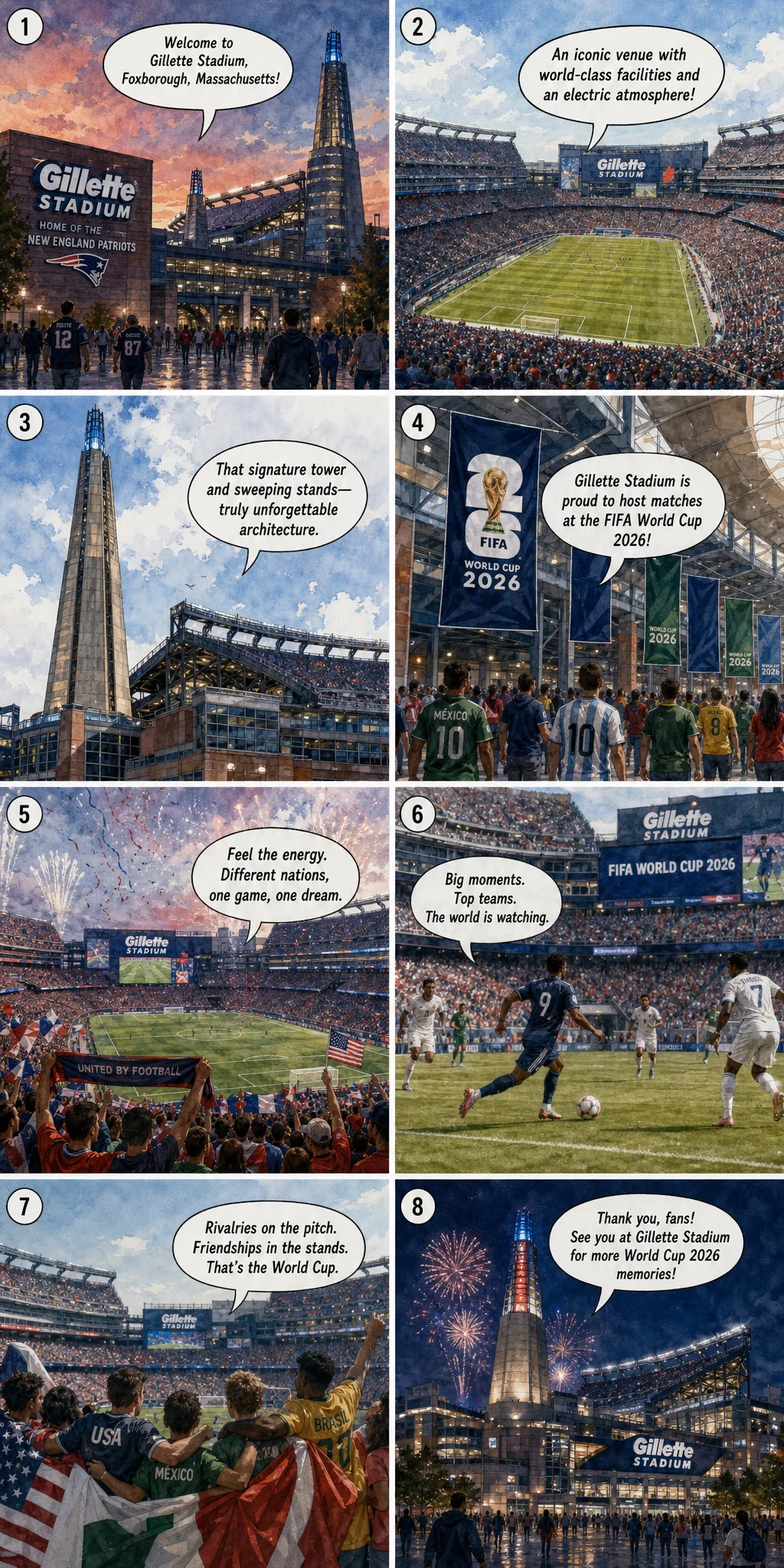
Now: the World Cup. Seven matches. Including a quarterfinal on July 9, 2026.
FIFA will call it "Boston Stadium" because FIFA's naming-rights policy is a form of institutionalized fiction, and everyone who lives within fifty miles of Foxborough will spend the entire tournament correcting people. It's not in Boston. It's in Foxborough. Yes, it's the Boston stadium. No, you cannot take the T there. Yes, you will need a car. Yes, the traffic on Route 1 will be apocalyptic. Plan accordingly.
The teams that will play here: Haiti, Scotland, Iraq, Norway, Morocco, England, Ghana, France. Eight nations, four continents, one lighthouse. The England match will feel like a home game for the visiting team — New England's relationship with its colonial parent is complicated and mostly involves soccer fans wearing Three Lions shirts they inherited from grandparents who never quite forgave 1776. The France match will be poetry. Morocco's fans will turn Foxborough into a North African carnival. Norway — if Haaland is healthy — will bring the Viking thunder.
And the quarterfinal. July 9. The lighthouse beacon will cut through the summer night. The video board — all 22,000 square feet of it — will show every moment in detail so sharp it hurts. The bridge entrance will welcome the world. And somewhere in his suite, Robert Kraft — the man who said "not yet" two hundred times, who paid for this building with his own money, who almost lost his team to Hartford, who watched six Super Bowl banners rise and one quarterback redefine the sport — will watch the world's game being played in the building he built.
The distance between "CMGI Field" — the original name, sold to a dot-com sponsor that collapsed before the stadium even opened, forcing a last-minute rebranding scramble that is the most late-1990s thing that has ever happened to a sports venue — and "Boston Stadium" is the distance between an idea and a legacy. CMGI went bankrupt. The name lasted less than a year. Kraft bought the naming rights himself and called it Gillette Stadium, after the company where he made his fortune. He didn't need a sponsor. He was the sponsor.
The lighthouse still shines. It shines over Foxborough and Route 1 and Patriot Place, over the bridge entrance and the luxury suites and the 22,000-square-foot screen. It shines over the field where Brady threw his last pass as a Patriot and the concourses where 610,000 vaccine shots found their mark and the stands where 60,000 people came to hear a retirement speech on a Wednesday in June.
Two hundred design iterations. One man's checkbook. A dynasty's throne room.
The world is coming to Foxborough. The lighthouse will be watching.