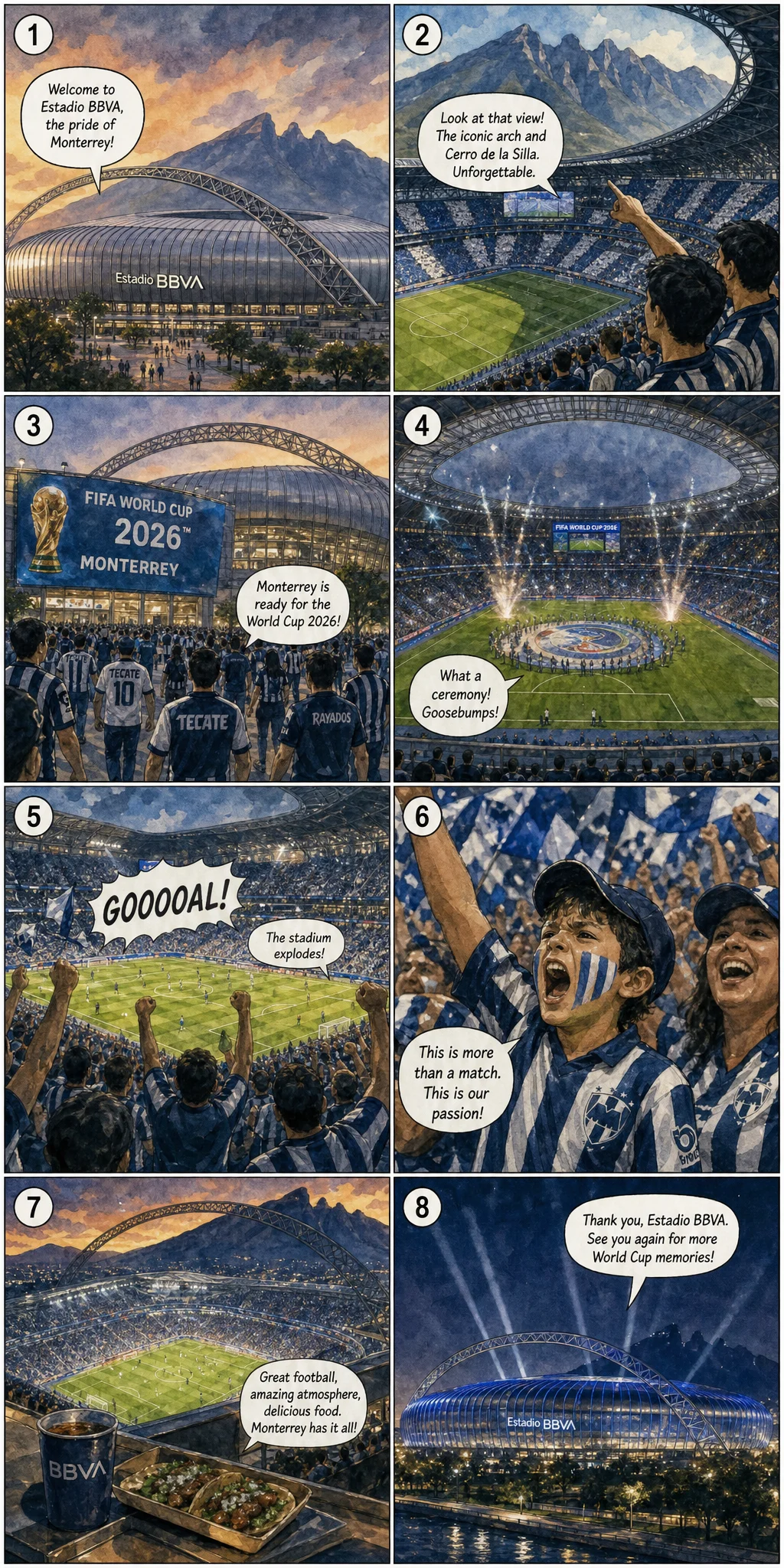
Estadio BBVA: The Steel Giant and the Saddle Mountain
El Gigante de Acero — Monterrey's $200M LEED Silver cathedral. The 34-degree grandstand, the most intimate sightlines in Mexico. Cerro de la Silla watches through the northwestern stands. The only Mexican World Cup venue where Mexico won't play — a neutral ground for global visitors.
Published: June 6, 2026
Estadio BBVA: The Steel Giant and the Saddle Mountain
Cerro de la Silla was there first.
Before the stadium. Before Monterrey. Before football. The mountain — four peaks forming the unmistakable silhouette of a saddle against the sky — has been watching this valley for thirty million years. It watched the Santa Catarina River carve its path through the Sierra Madre Oriental. It watched the foundries rise and the steel pour. It watched a city build itself from iron and ambition at its feet. And now, through the northwestern opening of Estadio BBVA, it watches football.
Every match at the Steel Giant begins with the mountain. You walk into the stadium, you find your seat, you look up — and there it is. Cerro de la Silla, framed by the gap in the steel exoskeleton, impassive and eternal. The architects at Populous knew what they were doing when they left that end open. You can roof over the stands, cantilever steel beams across the sky, build the most intimate sightlines in Mexican football — but you cannot compete with a mountain. So they didn't try. They let the mountain into the building.
This is the story of a stadium that understood its place.
---
The numbers first, because Monterrey is a city that respects numbers. Built between 2011 and 2015. Opened August 2, 2015. Two hundred million dollars. Designed by Populous and VFO — the studio of Federico Velasco, a man who understood that a stadium in Monterrey must speak the language of steel. Fifty-three thousand five hundred twenty-nine seats, expanded from the original 51,000 in 2016. The first football stadium in North America to earn LEED Silver certification. Over one-third of the land area dedicated to green space — native plants filtering rainwater, recharging the aquifer, the Rio La Silla flowing along the northern boundary.
But the number that matters most is thirty-four.
Thirty-four degrees. That is the angle of the grandstand incline. The steepest in Mexican football. The seats are positioned at FIFA's minimum allowable distance from the pitch. From the upper deck, you are not watching the match — you are falling toward it. The players are close enough to see the expressions on their faces, close enough to hear a striker curse when a shot goes wide, close enough to feel the vibration of a tackle through the concrete. Populous designed this incline with one instruction: make it intimate. Make it feel like the crowd is on top of the players. In a city that built its identity on industrial precision, the 34-degree stand is engineering as emotion — a structural decision that transforms watching into feeling.
The steel roof cantilevers overhead, painted white, a web of trusses that seems to float. The exoskeleton wraps the exterior in bands of silver-gray, catching the late-afternoon sun and glowing amber at golden hour. This is why they call it "El Gigante de Acero." The Steel Giant. Not a nickname invented by a marketing department — a name that emerged from the city itself, because Monterrey knows steel the way Venice knows water.
---
Before the Giant, there was the Tec.
Estadio Tecnologico served CF Monterrey for sixty-three years. Opened in 1950, a modest concrete bowl tucked into the campus of the Monterrey Institute of Technology. It held 32,000 people on good days. It hosted World Cup matches in 1986. It saw Rayados win league titles and lose them. It was loved, the way old things are loved — not for what they are, but for what happened inside them.
But sixty-three years is a long time. The concrete cracked. The facilities aged. The sightlines — well, nobody talked about sightlines in 1950. By the 2000s, the Tec was a memory wearing a stadium's clothes. Rayados needed a new home. Not just a bigger one. A better one. A building that could stand alongside the mountains and not feel small.
In 2015, the walk began. Rayados fans — los Rayados, the Striped Ones, blue and white everywhere — made the pilgrimage from the old stadium to the new one. Eight kilometers east, toward the foothills of the Sierra Madre. Some of them had been going to the Tec for fifty years. Their fathers had taken them. Their grandfathers had taken their fathers. Walking away from that history, toward a building made of steel and glass and ambition, must have felt like betrayal and rebirth at the same time. Monterrey understands this feeling. The city has been rebuilding itself for a century.
---
The Clasico Regiomontano is not a football match. It is a civil war contained within ninety minutes.
Rayados versus Tigres UANL. Blue-and-white against gold-and-blue. The stadium splits down the middle, two colors that cannot coexist. Families divide. Brothers choose sides. A father in a Rayados jersey watches the match next to his son in Tigres gold, and for two hours they are not family — they are geography, they are history, they are the north of Mexico refusing to agree with itself.
When the Clasico comes to the Steel Giant, the building shakes. Literally. Fifty-three thousand people jumping in unison on a 34-degree incline generates the kind of structural stress that engineers calculate and fans experience as religion. The noise does not rise — it descends. It comes down from the steel roof, bounces off the concrete, and settles in your chest. The first time you experience it, you understand why they built the Giant out of steel. Anything less would have collapsed under the weight of this derby.
The rivalry between Rayados and Tigres is one of the fiercest in the Americas. Tigres play at Estadio Universitario, a few kilometers away. They are the university team, the establishment, the gold-and-blue aristocracy. Rayados are the people's team, the industrial team, the team of the steelworkers and the foundry men. When they meet, Monterrey stops. The factories go quiet. The traffic disappears from the Avenida Eugenio Garza Sada. A city of five million people holds its breath and chooses sides.
---
Then there is the green.
In a city defined by steel and concrete, Estadio BBVA made an unlikely promise: more than one-third of the site would be green space. Not decorative landscaping — functional ecology. Native plants filter rainwater before it reaches the aquifer. The Rio La Silla flows along the northern boundary, a thin ribbon of water that remembers the mountains. The stadium earned LEED Silver certification in 2015 — the first football stadium in North America to do so. In a region where water is precious and the desert is always waiting, this is not marketing. This is survival thinking, translated into architecture.
The green spaces wrap the stadium on three sides. On match days, fans walk through gardens to reach the gates. Children play on grass that captures rainwater. The Steel Giant does not sit on the land — it participates in it. Federico Velasco, the local architect who worked alongside Populous, insisted on this. He understood that a stadium in Monterrey must respect the ecology of the valley, or the valley would eventually take it back.
---
July 18, 2022. The CONCACAF W Championship final. United States versus Canada.
Seventeen thousand two hundred forty-seven people filled the lower bowl of the Steel Giant. Not a capacity crowd — not close — but a crowd that mattered. The USWNT, already the most dominant program in women's football history, faced a Canadian team that had taken Olympic gold the year before. Alex Morgan scored the only goal from the penalty spot. One to nothing. The American women lifted the trophy under the steel beams, and for ninety minutes, women's football held the center of the sporting universe in Monterrey.
The match was a preview. Two years before the World Cup would arrive, the Steel Giant demonstrated that it could host the biggest moments in the sport. The pitch — a GrassMaster hybrid surface, natural grass reinforced with synthetic fibers — held perfectly. The sightlines, those 34-degree sightlines, made 17,000 feel like 50,000. The mountain watched through the northwestern opening, as it always does, impassive and eternal.
---
The Steel Giant has hosted other gods.
Coldplay came for two nights in 2022. One hundred twelve thousand two hundred sixty-two people across the two shows. Chris Martin at the piano, the wristband lights transforming the bowl into a galaxy of color, the steel beams catching the light and throwing it back in patterns no architect could have designed. Bad Bunny came next — ninety thousand eighty-four across two nights, seventeen point four million dollars in revenue. Then Shakira — eighty-eight thousand two hundred one, twelve point four million. The Steel Giant proved it could shapeshift. One night a football cathedral. The next night a concert arena. The steel does not care what you worship, as long as you fill the space with noise.
But the concerts also revealed something about the building's design. The open northwestern end — the gap that frames Cerro de la Silla — becomes a window to another world during a concert. The mountain sits there in the darkness, a blacker shape against the black sky, watching the tiny humans below fill the air with light and sound. The stadium's architects could have closed that end. They chose not to. They understood that a stadium without a view is just a container. A stadium with a mountain is a conversation.
---
June 14, 2026. The World Cup arrives at the Steel Giant.
FIFA will call it "Estadio Monterrey." The name change is required — no commercial sponsors during the tournament. The BBVA logo will be covered. The stadium, for four matches, will belong to no bank and no corporation. It will belong to the world.
Sweden versus Tunisia. The first World Cup match ever played in the Steel Giant. The stands will be a mosaic of yellow-blue and red-white. The Cerro de la Silla will wear a crown of clouds, as it often does in June, when the rainy season begins and the mountains breathe moisture into the sky. The Swedish fans will have traveled far. The Tunisian fans will make more noise. And somewhere in the stands, there will be people from Monterrey — not cheering for either team, not wearing either color, but present. Because this is their stadium. Their steel. Their mountain.
The schedule is peculiar. Three group matches: Sweden versus Tunisia on June 14, Tunisia versus Japan on June 20, South Africa versus South Korea on June 24. Then a Round of 32 match on June 30. Four matches total. And here is the fact that still catches in the throat of every Rayados fan, every Monterrey native, every Mexican football lover who walks through those gates:
Mexico will not play here.
The only Mexican World Cup venue where El Tri will not set foot. Azteca gets the opening match. Akron gets group matches. BBVA — El Gigante de Acero, the most modern football stadium in the country, the building that Populous designed to host the biggest moments in sport — will welcome Sweden, Tunisia, Japan, South Africa, and South Korea. But not Mexico.
The irony is sharp enough to cut steel. Mexico built this cathedral. Mexico filled it with the noise of the Clasico Regiomontano. Mexico made it shake. And now, during the World Cup on Mexican soil, the national team will play everywhere except here. The scheduling logic is sound — travel distances, group placements, broadcast windows. But logic does not heal pride. Monterrey will host the world, and Monterrey will do it without seeing its own flag on the pitch.
Perhaps that is the point. Perhaps the Steel Giant, in its final and most important role, becomes neutral ground. A place where the world comes to play, not to take sides. A stadium so good, so intimate, so perfectly balanced between mountain and steel, that it doesn't need Mexico to be meaningful. The world will come to Monterrey. The world will sit in those 34-degree seats and feel the incline pull them toward the pitch. The world will look up through the northwestern opening and see Cerro de la Silla watching, as it has watched for thirty million years.
The mountain was there first. The mountain will be there after. And for four matches in June 2026, the mountain and the steel will hold the world between them.