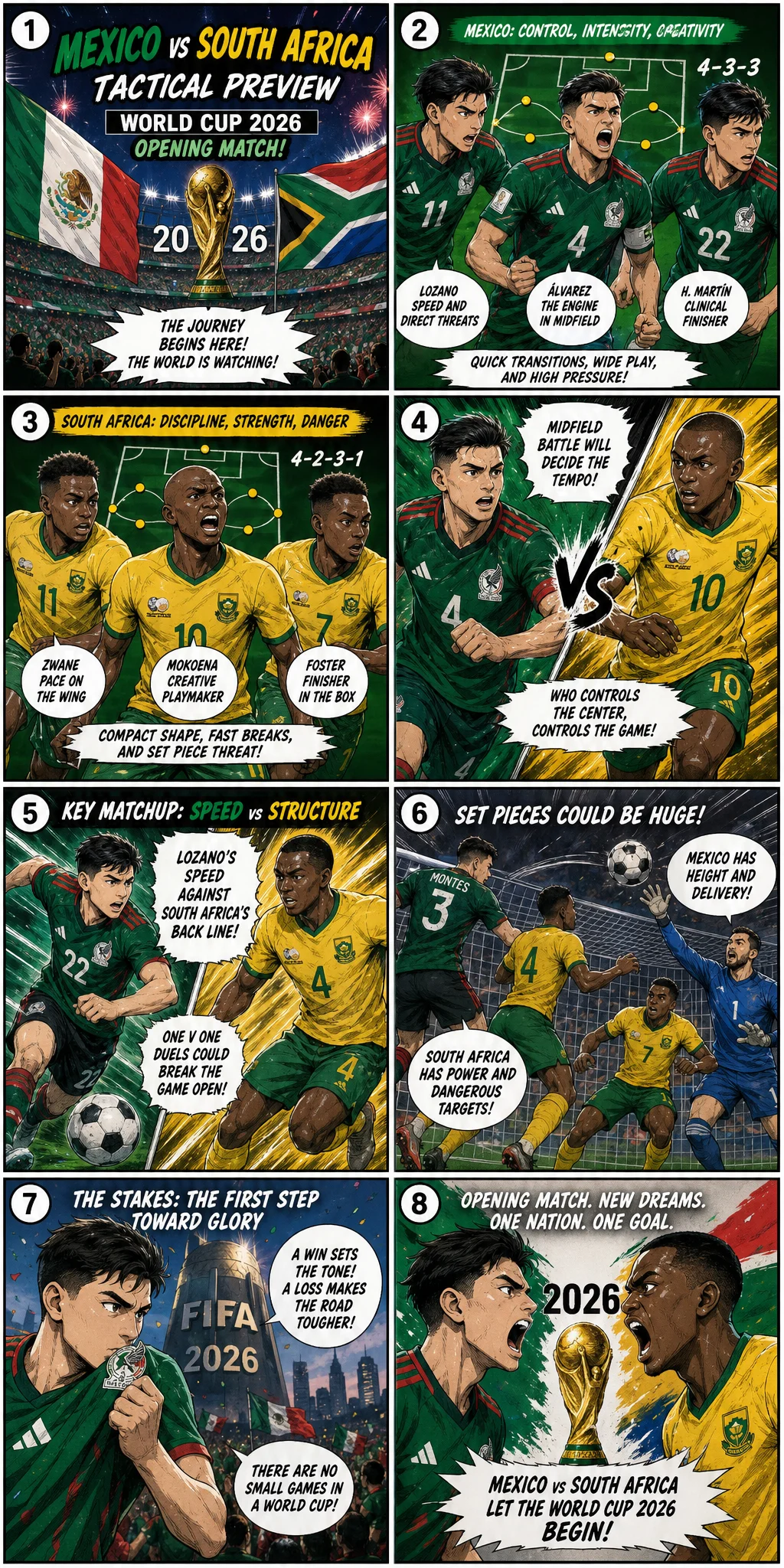
Mexico vs South Africa: Tactical Preview — World Cup 2026 Opening Match
2026 FIFA World Cup opening match tactical preview — Mexico vs South Africa, Group A, Estadio Azteca. Analysis of formations, key player matchups (Alvarez vs Mokoena, Vasquez-Montes vs Appollis), coaching philosophies (Aguirre vs Broos), and the historical echo of the 2010 opener (1-1). Prediction: Mexico favorites but opening-match history warns against certainty.
Published: June 6, 2026
Mexico vs South Africa: The First Test at Altitude
Seven days until the whistle. In the thin air of Mexico City — two thousand two hundred metres above sea level — you can already smell the World Cup: grilled corn, chili powder, and thirty-six years of pent-up expectation.
This is not the first time Mexico has hosted the World Cup, but it is the first time they enter as true hosts from the start. In 1970, they were the debutant organiser. In 1986, they stepped in when Colombia withdrew. This time, the tournament belongs to them from the opening ceremony onward. June 11. Estadio Azteca. Group A opener. The opponent: South Africa. Sixteen years ago, these two teams played the same fixture — the opening match of the 2010 World Cup in Johannesburg. The score that day: 1-1. Siphiwe Tshabalala's curling shot into the top right corner made an entire continent tremble.
Now they are back. And the questions are real.
Mexico: The Weight of Seven Round-of-Sixteens
Javier Aguirre is in his third spell as Mexico manager. That fact alone tells you something: the federation did not want a tactical revolutionary. They wanted a man who could make this team difficult to play against. Aguirre's 4-3-3 often resembles a 4-4-2 defensive variant. The midfield three is anchored by captain Edson Alvarez — when both full-backs push forward, Alvarez drops between the two centre-backs to form a back three in possession, giving Mexico numerical superiority in build-up.
Defensively, Mexico's strongest unit is the centre-back pairing. Johan Vasquez started thirty-six matches for Genoa in Serie A this season — he has developed into one of the most reliable defenders Mexico has produced in a generation. Beside him, Cesar Montes provides aerial dominance from his time at Lokomotiv Moscow. The goalkeeper situation is an open race: Luis Malagon lost form and confidence during the spring; Raul Rangel — better with the ball at his feet — may get the nod. Forty-year-old Guillermo Ochoa will be on the bench, waiting for his record sixth World Cup.
Up front, thirty-five-year-old Raul Jimenez remains the undisputed focal point. His 2025-26 Premier League campaign at Fulham produced nine goals and three assists — for a man whose career was nearly ended by a skull fracture in 2020, every goal is an act of defiance. He accounts for roughly half of Mexico's goals under Aguirre. But the wingers are the biggest question mark. Alexis Vega has been the best attacker in Liga MX at Toluca, yet he has never translated that form consistently to the national team. Hirving Lozano — whose goal against Germany in 2018 literally registered on seismographs — now plays for San Diego FC, his role reduced from talisman to rotation option. The creative spark comes from seventeen-year-old Gilberto Mora, the youngest senior international in Mexico's history. His close control and vision may be El Tri's only reliable method of unlocking a compact defence.
Here is a number that haunts this team: Mexico have been eliminated in the Round of 16 at seven consecutive World Cups. 1994, 1998, 2002, 2006, 2010, 2014, 2018, 2022 — the streak actually spans eight tournaments. The quinto partido — the fifth match, the quarter-final — is the wall they cannot break through. On home soil, the wall must fall.
South Africa: Sixteen Years of Silence, Then a Storm
Hugo Broos talks like dry cement and builds teams the same way. Over five years, the Belgian has turned Bafana Bafana into something that is, in his own words, "hard to break down." That sounds like faint praise. It is actually the only survival strategy available to them at this tournament.
Broos's system rests on a foundation of defensive discipline: a compact 4-4-1-1 shape in which the distance between the two banks of four rarely exceeds eight metres. Against superior opponents, South Africa will willingly concede possession — not because they cannot pass, but because they prefer to wait in their own half for the counter-attacking gap. Central midfielder Teboho Mokoena is the first screen in front of the back four and the biggest threat from set pieces — his long-range shooting and free-kick precision decided multiple qualifiers during the African campaign. Goalkeeper Ronwen Williams, the captain, is one of Africa's finest — his performances at the 2024 Africa Cup of Nations forced European scouts to reassess South Africa's defensive infrastructure.
In attack, South Africa's weapons are concentrated on the left flank. Oswin Appollis recorded the highest dribble accuracy, most chances created, and most goals of any Bafana player during qualifying. His inside-cutting runs from the left, combined with the overlapping surges of left-back Aubrey Modiba, form the most dangerous attacking pattern Broos possesses. Behind them, twenty-one-year-old Relebohile Mofokeng is the nation's greatest hope — a number ten capable of finding passing lanes in spaces that do not appear to exist, described by South African media as having "the world at his feet." Striker Lyle Foster endured a quiet season at Burnley, but he remains the only genuine target-man in Broos's squad.
South Africa last played a World Cup match in 2010. Sixteen years ago. Their qualifying campaign carried a distinctly South African kind of drama: they were deducted three points for fielding an ineligible player, and still topped their group ahead of Nigeria. This team is accustomed to being underestimated.
The Key Battles
This match will be decided not in either penalty area, but in the question of whether Mexico's press can puncture South Africa's double defensive block. Aguirre's pressing system relies on midfield running volume — Alvarez and Erik "The Pitbull" Lira need to apply pressure during South Africa's build-up phase, forcing turnovers in dangerous areas. If Mexico can score within the opening twenty minutes, the Azteca's eighty-three thousand will make every South African touch feel like breathing underwater.
But if the score stays level — if the clock ticks past thirty minutes, then forty, then half-time — altitude becomes a double-edged sword. Mexican players are certainly acclimatised. But South Africa's compact defensive shape does not require much running. They will let the ball move, not the men. Then, after the sixtieth minute, they will use Appollis's speed and Mofokeng's creativity to search for the one gap behind Mexico's back line.
There is another variable that cannot be accounted for in any tactical blueprint: the weight of an opening match. World Cup history is littered with host nations stumbling out of the gate. Mexico themselves drew 0-0 with the Soviet Union in 1970 — at this very stadium. Italy needed a dubious penalty to beat Austria 1-0 in 1990. South Africa's famous 1-1 in 2010 was fuelled not by superior talent but by pure adrenaline. Standing on the Azteca grass are not just eleven footballers. They are standing on the dreams of a hundred and thirty million people. That kind of weight can crush you, or it can carry you to the altar.
Prediction
Mexico should win. The gap in quality and experience is too wide — Jimenez is a Premier League-calibre striker, Alvarez a Champions League-calibre defensive midfielder, Vasquez has proven himself in Serie A. South Africa's best two or three players — Williams, Mokoena, Appollis — might struggle to make Mexico's substitutes' bench.
But football is not arithmetic. If South Africa can survive the opening thirty minutes. If Ronwen Williams produces the kind of saves he made at the Africa Cup of Nations. If Relebohile Mofokeng gets one counter-attacking opportunity in the seventy-fifth minute — then this afternoon is far from a Mexican coronation.
The rational prediction is Mexico to win by two goals to nil. The Azteca will not allow its opening match to become a tragedy. But opening matches are never about rationality. They are about a moment — a curling shot into the top right corner, a green sea pouring down from the stands, four seconds in which a world holds its breath. It happened in Johannesburg in 2010. It could happen again in Mexico City in 2026.
Nobody really knows. That is why we are here.