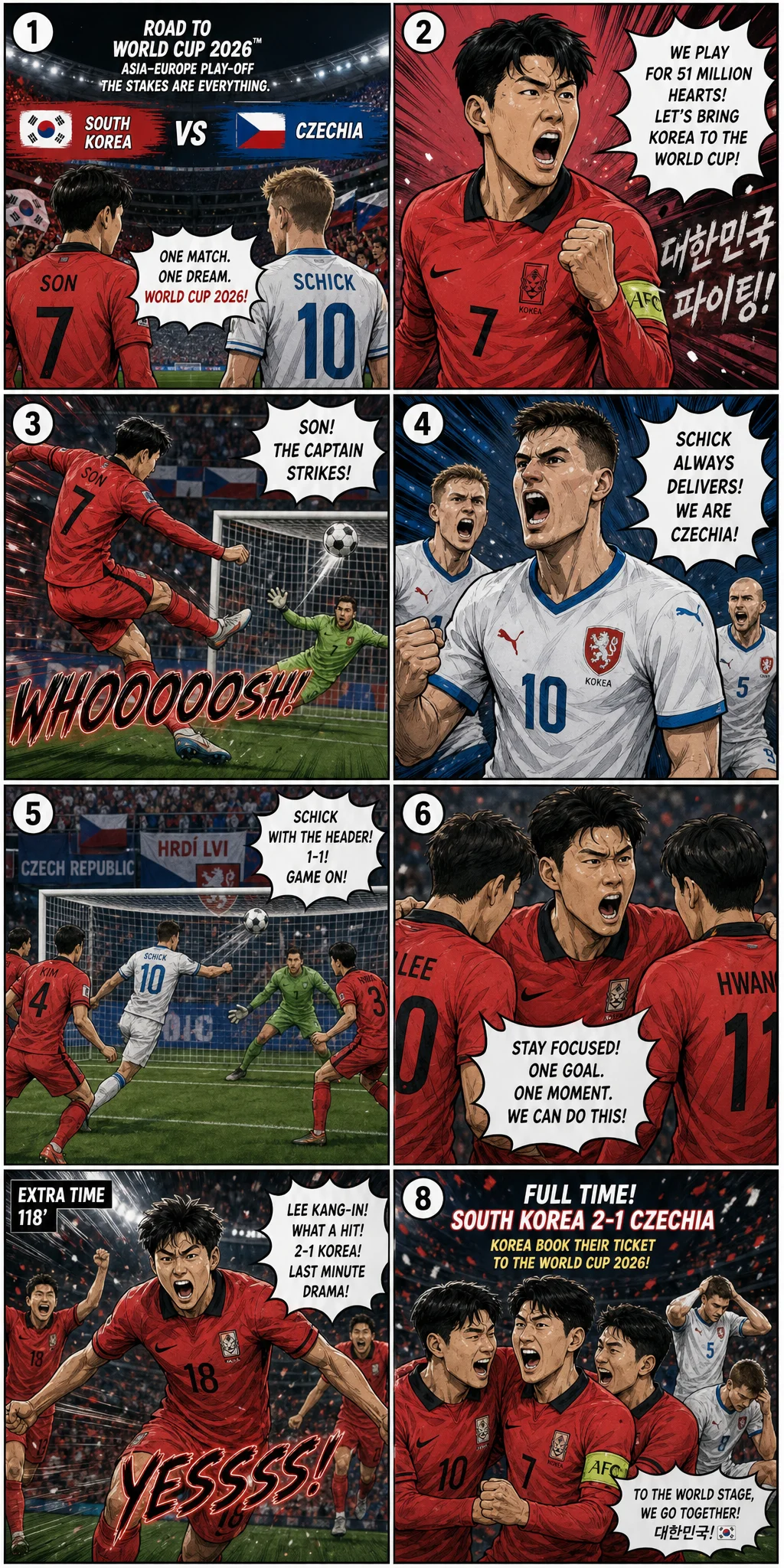
South Korea vs Czechia: Hong Myung-bo's Back-Three Gamble Meets Koubek's Aerial Arsenal
Group A opener at Estadio Akron, Guadalajara. South Korea's uncertain 3-4-3 faces Czechia's physically dominant direct-attacking system in a clash of contrasting tactical philosophies.
Published: June 6, 2026
# South Korea vs Czechia: Hong Myung-bo's Back-Three Gamble Meets Koubek's Aerial Arsenal
## The Opening Question
Why would a manager who went unbeaten through sixteen World Cup qualifiers—scoring 40 goals and conceding just eight—decide, six months before the tournament, to dismantle his back four and start again?
Hong Myung-bo's switch to a 3-4-3 is not a tweak. It is a reconstruction. And the evidence from South Korea's pre-tournament friendlies is not encouraging: a 4-0 defeat to Cote d'Ivoire, followed by a 5-0 shellacking against Brazil. Hong's response was unnervingly sanguine—he said the heavy defeats "taught us a lot." The question is whether those lessons can be applied in time for the 90 minutes against Czechia on June 12.
South Korea's tactical uncertainty is the single biggest variable in this Group A opener. On the other side of the pitch, Czechia might be the least mysterious team at this World Cup. They do not hide what they are. They do not need to.
## Formation Matchup: 3-4-3 vs 3-4-2-1
The core of Hong's experiment is positioning Son Heung-min at the tip of a front three, with Lee Kang-in and Hwang Hee-chan drifting into the half-spaces, while Jens Castrop (Borussia Monchengladbach) and Seol Young-woo (Red Star Belgrade) operate as wing-backs.
The logic of this 3-4-3 is clear: maximise the individual quality of South Korea's front four. Son, Lee, Hwang Hee-chan, and Hwang In-beom—any one of these four receiving the ball in transition can manufacture a shot within five seconds.
The defensive cost is equally clear. In the Brazil friendly, the space behind Korea's wing-backs was exploited repeatedly. Castrop is a midfielder by trade, shoehorned into a wing-back role, and his inclination to push forward far exceeds his recovery discipline. Miroslav Koubek will have taken note.
Koubek's 3-4-2-1 is a different beast entirely. It is not designed for possession; it is designed for vertical destruction. Patrik Schick (Bayer Leverkusen) is the first contact point. Tomas Soucek (West Ham United) surges from midfield for the second ball. Pavel Sulc (Olympique Lyonnais) scavenges in the gaps between them. Czechia's attacking sequence can be drawn with a straight line: centre-back long ball → Schick flick-on → Sulc/Soucek arriving shot.
## The Key Duel: Kim Min-jae vs Patrik Schick
This is the individual matchup worth the price of admission.
Kim Min-jae has seen his minutes at Bayern Munich squeezed by the Tah-Upamecano partnership, but in the national team shirt, he remains the irreplaceable defensive anchor. His aerial duel success rate in Asian qualifying was 74.4%—a number that would rank as elite in any European top division.
Schick scored 16 Bundesliga goals for Leverkusen in 2025-26 and added five more in qualifying. His height (1.91m) essentially matches Kim's (1.90m), but his movement intelligence goes far beyond that of a conventional target man. He likes to peel into the left half-space to receive, then cut inside on his right foot—precisely the zone Kim is required to cover in the back three.
If Kim is drawn out by Schick's movement, South Korea's other centre-backs—likely Lee Han-beom (Midtjylland) and Lee Ki-hyuk (Gangwon FC)—will have to deal with Soucek's late arrivals into the box. At 1.93m, with Premier League-level box instincts, Soucek is the primary target for Czechia's set-piece routines, which are built almost entirely around him and captain Ladislav Krejci (Wolverhampton Wanderers).
## The Midfield Equation: Hwang In-beom's Fitness Is Korea's Lifeline
South Korea's biggest concern is not Son Heung-min's goal drought—he has gone 13 MLS matches without scoring for LAFC, but provided nine assists, transitioning into a creator role that, paradoxically, suits the national team's current attacking configuration better. The real problem is Hwang In-beom.
The Feyenoord midfielder is the only player in the Korean squad capable of all three of the following: receiving and turning under pressure, controlling tempo with both short and long passing, and providing defensive coverage. An ankle injury in March 2026 raised fears he might miss the tournament entirely. If he is not at 100%, the drop-off to replacement Paik Seung-ho (Birmingham City) in passing range and game-reading is significant.
For Czechia, Soucek's presence means Hwang In-beom loses every aerial contest by default. But Czechia's true tempo controller is 35-year-old Vladimir Darida (Hradec Kralove). At 1.71m, he looks incongruous in a squad that averages over 1.87m, but he compensates with passing intelligence—he is Czechia's Modric, capable of finding a lane through a crowded midfield that only he can see.
## Historical Context
The two nations have met only once—on June 5, 2016, when South Korea beat Czechia 2-1 in Prague. But that was a friendly, under a different Czech coach (Pavel Vrba), and it bears no relation to the battle-hardened Czechia that emerged from Koubek's playoff crucible, beating Ireland and Denmark on penalties to end a 20-year World Cup absence.
This Czech side was forged in the fires of humiliation—a 2023 defeat to the Faroe Islands cost Ivan Hasek his job. Koubek took over and transformed the team into a counter-attacking machine. They are perfectly comfortable with 35% possession because, within five seconds of winning the ball back, it is sailing toward Schick's head.
## Prediction
Hong Myung-bo's back-three gamble may eventually pay dividends against South Africa in the third group game. But for the opener against Czechia, the timing looks off. The defensive frailties exposed in the warm-up friendlies are not accidental—they are systemic, stemming from the mismatch in wing-back personnel and the collective movement patterns that a back three demands, patterns South Korea have not had time to bed in.
Czechia's game plan does not require flawless execution to be effective. Long balls to Schick, set-piece bombardment, midfield strangulation—Koubek has been drilling these three things for a full year. If South Korea cannot disrupt Czechia's rhythm with possession and pressing in the opening 20 minutes, Czechia will grow into the game, and eventually settle it from a set piece or a transition moment.
Prediction: Czechia 2-1 South Korea. Schick opens the scoring with a header, Son equalises on the counter, and Soucek bundles home the winner from a 75th-minute corner.