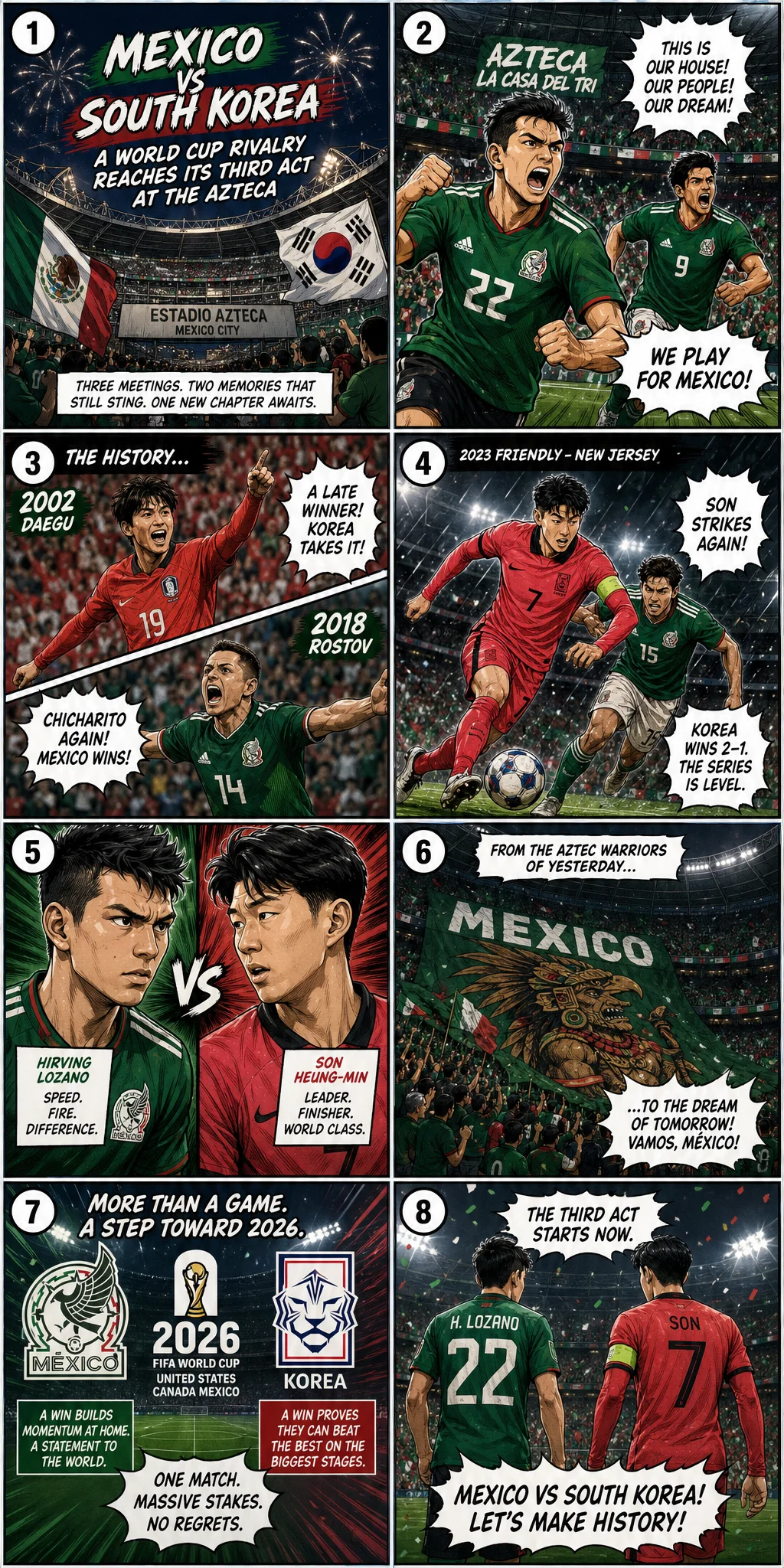
Mexico vs South Korea: A World Cup Rivalry Reaches Its Third Act at the Azteca
Group A clash at Estadio Akron. Mexico's pragmatic 4-3-3 under Javier Aguirre faces South Korea's tactically uncertain 3-4-3, with the ghosts of 1998 and 2018 2-1 scorelines looming over this third World Cup meeting.
Published: June 6, 2026
# Mexico vs South Korea: From 1998 to 2026, a World Cup Rivalry Reaches Its Third Act
## A Historical Pattern That Demands Attention
Mexico and South Korea have met twice at the World Cup, and both matches ended 2-1 to Mexico. In Lyon in 1998, Luis Hernandez scored twice in the final 15 minutes to deny South Korea their first-ever World Cup victory—a quest that had begun in 1954 and would not be fulfilled until 2002, on home soil, against Portugal, amid circumstances that still provoke debate. In Rostov-on-Don in 2018, Carlos Vela converted a penalty and Javier Hernandez struck his 50th international goal before Son Heung-min's magnificent stoppage-time curler provided nothing more than a footnote to another 2-1 Mexican victory.
But between these two World Cup bookends lies a counter-narrative. At the 2001 Confederations Cup, South Korea beat Mexico 2-1 in the group stage—a result that meant little at the time but, viewed through the long lens, hints at a pattern: these two nations trade victories with metronomic precision, each winning on the stage that matters most to them. The Confederations Cup for Korea. The World Cup for Mexico.
The 2026 meeting—their third in this tournament, and on Mexican soil—will either extend Mexico's World Cup hegemony or break the pattern entirely. It is a match freighted with three decades of shared history, contested between two nations whose footballing identities are, in very different ways, in crisis.
## The Host's Burden
Mexico's history as a World Cup host is a history of national expectation crushing national performance. In 1970, they reached the quarter-finals—still the country's best-ever finish, equaled in 1986 when they hosted again. Both times, the achievement was celebrated as triumph and mourned as missed opportunity in equal measure. Mexico has never played a World Cup semi-final. The phrase "el quinto partido"—the fifth game—has become a national neurosis, a shorthand for the glass ceiling that no generation of Mexican footballers has been able to shatter.
Javier Aguirre, now in his third stint as national team manager, understands this history intimately. When he returned in 2024, he offered a statement of philosophy that doubled as a diagnosis: "At a World Cup, the team that plays the prettiest football does not always win. The team that knows how to compete does." This is Aguirre distilled—pragmatic to the point of severity, a manager who builds systems rather than showcases individuals.
His 4-3-3 is anchored by what the Mexican press calls the "Triangulo de Confianza" (Triangle of Trust): Edson Alvarez (Fenerbahce), Cesar Montes (Lokomotiv Moscow), and Johan Vasquez (Genoa). Alvarez, the captain, is a duel-winning midfielder who can drop into central defence when required—a tactical flexibility that allows Aguirre to shift between a back four and a back three mid-game without substitution. Vasquez, developed in Serie A's unforgiving school of defensive positioning, provides the left-footed balance that the right-sided Montes lacks.
The attack revolves around Raul Jimenez (Fulham), whose nine Premier League goals and three assists in 2025-26 represent a triumph of will as much as skill. The skull fracture he suffered in 2020 should have ended his career; instead, he arrives at his fourth World Cup as Mexico's emotional leader and primary goal threat. Behind him, the 17-year-old Gilberto Mora (Tijuana)—the youngest player at this World Cup—offers the creative unpredictability that Mexican football has historically prized and recently lacked.
## South Korea's Tactical Identity Crisis
Hong Myung-bo's squad contains, player for player, more individual quality than any other in Group A. Son Heung-min, Kim Min-jae, Lee Kang-in, Hwang Hee-chan—four players who have proven themselves at the highest level of European club football. Their combined talent exceeds that of Mexico, Czechia, or South Africa. But football is not an individual sport, and the fundamental dilemma Hong faces is this: his team does not know who they are.
The 4-2-3-1 that carried South Korea through an unbeaten 16-match qualifying campaign—40 goals scored, eight conceded—was a known quantity. It maximized Son's ability to cut inside from the left, gave Hwang In-beom a stable platform to dictate tempo, and provided Kim Min-jae with a familiar defensive structure. Then Hong dismantled it.
The switch to a 3-4-3 is an attempt to solve a problem that has haunted Korean football since 2002: the inability to maintain structural discipline against elite opposition. A back three theoretically provides greater defensive security. But it demands wing-backs who can simultaneously provide attacking width and defensive cover—and herein lies the flaw. Jens Castrop (Borussia Monchengladbach) is a central midfielder deployed as a wing-back. Seol Young-woo (Red Star Belgrade) is a full-back accustomed to a back four. Neither is a natural fit for the roles Hong now asks them to play.
Against Mexico, these structural vulnerabilities will be tested in ways that Czechia—with their more direct, less nuanced attack—could not replicate. Aguirre's system creates an asymmetric 3-2-5 in possession, with right-back Israel Reyes tucking inside to form a back three while left-back Jesus Gallardo pushes high. This overloads precisely the channel between Korea's wing-back and outside centre-back that the pre-tournament friendlies against Ivory Coast and Brazil exposed so brutally.
## The Ghosts of '98 and '18
The 1998 match in Lyon contains a moment that, even 28 years later, Korean football has not fully metabolized. Ha Seok-ju scored a magnificent free-kick in the 27th minute to give South Korea a 1-0 lead. Three minutes later, he was sent off for a tackle from behind. Mexico, against ten men, scored three unanswered goals. The sequence—hope, self-destruction, defeat—became a template for Korean World Cup disappointments that persisted until Guus Hiddink's 2002 revolution temporarily broke the cycle.
In 2018, Son Heung-min's 93rd-minute curler was the most beautiful goal scored against Mexico in that tournament. It was also completely meaningless. Mexico were already 2-0 up and cruising. The goal was a reminder—as if any were needed—that Korean football produces moments of individual brilliance that its collective structures cannot support.
The 2026 meeting brings these two histories into collision. Mexico, on home soil, carry the weight of a nation that has waited 40 years—since 1986—to host the World Cup and hopes this time, finally, to play that fifth game. South Korea carry the weight of a different kind: the knowledge that their greatest World Cup achievement, the 2002 semi-final, is now as much burden as inspiration, a benchmark that every subsequent generation has failed to approach.
## Prediction
This is a match that resists confident prediction precisely because South Korea are unknowable. If Hong's 3-4-3 clicks—if Castrop and Seol find the discipline their roles demand, if Hwang In-beom is healthy and controlling tempo, if Son's creative reinvention liberates Lee Kang-in and Hwang Hee-chan—South Korea are capable of beating Mexico on Mexican soil.
But history's weight tilts toward Mexico. Aguirre's pragmatism is built for World Cup football in a way that Hong's late-stage experimentation is not. The pattern holds. The score is 2-1.
Prediction: Mexico 2-1 South Korea. Jimenez heads the opener, Hwang Hee-chan equalises on the counter, and Alvarez bundles home a late winner from a set piece.