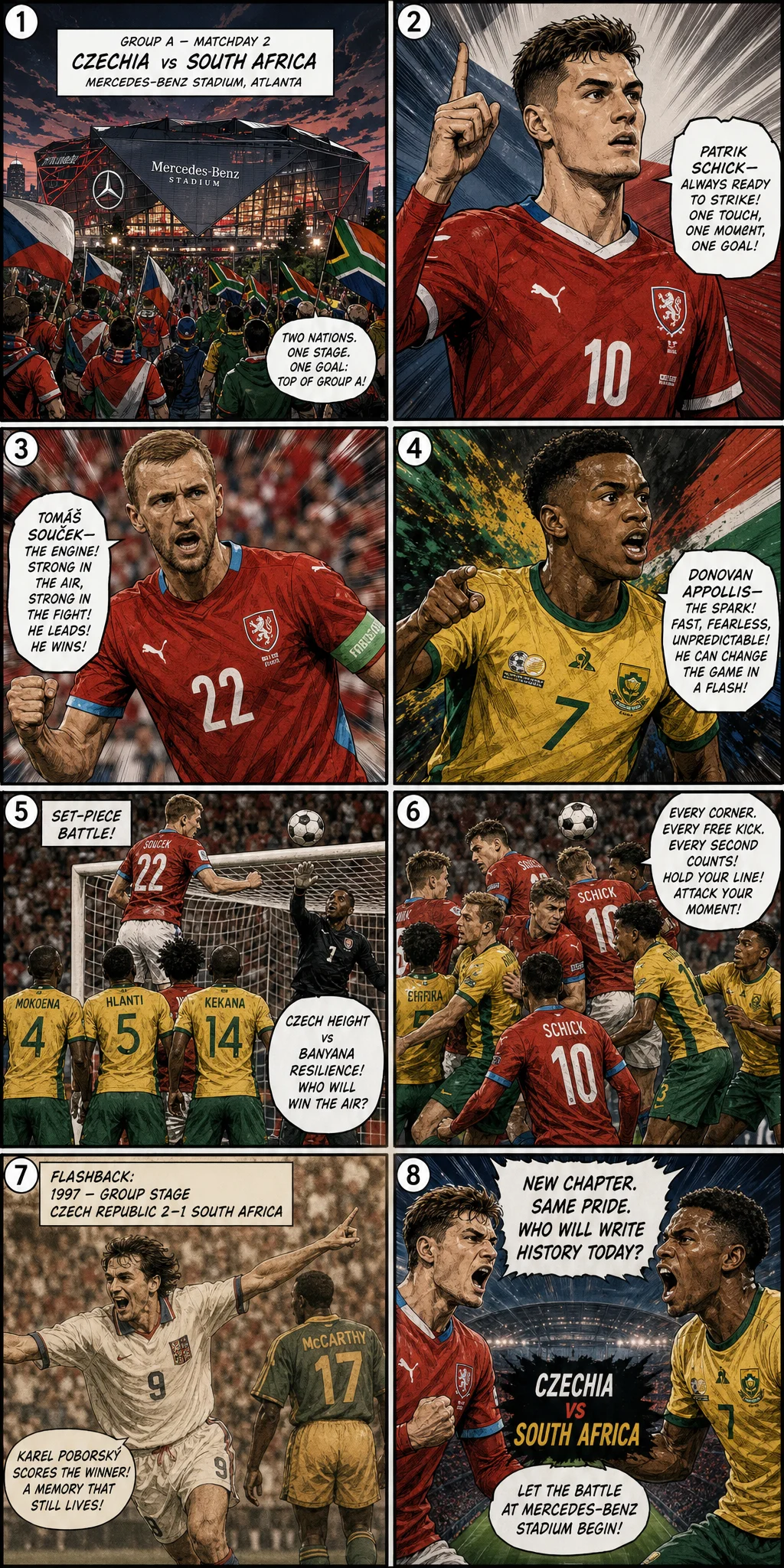
Czechia vs South Africa: When Two Counter-Attacking Teams Collide in Atlanta
Group A battle at Mercedes-Benz Stadium. Both teams prefer to attack without the ball—Czechia's aerial set-piece dominance against South Africa's left-flank counter-attacking speed in a meeting with only one precedent, a 1997 Confederations Cup draw.
Published: June 6, 2026
# Czechia vs South Africa: When Two Counter-Attacking Teams Meet, Who Blinks First?
## The Tactical Paradox
This match presents a fascinating tactical paradox: both teams prefer to attack without the ball. Czechia averaged 38% possession in their UEFA playoff ties—they beat Ireland and Denmark not through passing domination but through vertical counter-attacks executed within five to seven seconds of winning possession. South Africa, under Hugo Broos, have built an almost identical philosophy: compact 4-4-2 defensive shape, win the ball, and release immediately to Oswin Appollis (Orlando Pirates) on the flank or Lyle Foster (Burnley) through the middle.
So what happens on June 18 at Mercedes-Benz Stadium in Atlanta when two teams that neither want nor expect to control possession face each other?
The answer: one of them will be forced to do something it is not comfortable doing. And whichever side adapts more effectively to operating outside its preferred mode will determine this contest.
## Czechia's Aerial Blueprint
Miroslav Koubek's Czechia might be the most tactically transparent team at this World Cup. Their attacking script can be summarized in under one hundred words: centre-back launches toward Patrik Schick's (Bayer Leverkusen) head, Schick flicks the ball into the path of Pavel Sulc (Olympique Lyonnais), and Sulc exploits the space between the lines for a shot or a lay-off. If the first wave is cleared, Tomas Soucek (West Ham United) arrives from deep midfield to contest the second ball.
This script's effectiveness depends not on complexity but on the physical attributes of its executors. Czechia's average height exceeds 1.87m, making them one of the tallest squads at the tournament. Their set pieces—corners, free-kicks, long throws—are a recurring nightmare for opponents. When Soucek (1.93m), Ladislav Krejci (Wolverhampton Wanderers, 1.91m), and Schick (1.91m) simultaneously attack the six-yard box, few defensive units can handle three aerial threats of that magnitude arriving at once.
But Czechia's creativity has a clear bottleneck: if Sulc is neutralised, the team's imagination in settled possession plummets. Sulc is coming off a breakout season at Lyon—15 goals and 10 assists across all competitions—and his ability to receive and turn between the lines represents Czechia's only reliable creative output. The 35-year-old Vladimir Darida (Hradec Kralove) can provide tempo control, but his physical limitations in high-intensity contests are a genuine concern.
## South Africa's Defensive Resilience and Counter-Attacking Speed
Hugo Broos enters his fourth year in charge of Bafana Bafana, and he has defined this team's identity with almost stubborn clarity: defensive solidity, rapid transitions, and reliance on the individual quality of a handful of key players.
Goalkeeper and captain Ronwen Williams (Mamelodi Sundowns) is the foundation—not only an excellent shot-stopper but the starting point for South Africa's build-up play. In midfield, Teboho Mokoena (Mamelodi Sundowns) provides duels, long-range shooting, and set-piece delivery—he is arguably the most complete central midfielder operating in African club football.
But South Africa's true weapon is the left flank. Left-back Aubrey Modiba (Mamelodi Sundowns) overlapping with left-winger Oswin Appollis cutting inside—Appollis was Bafana's most effective dribbler and chance creator in qualifying—forms what Broos has identified as the team's primary attacking corridor. Behind them, 21-year-old talent Relebohile Mofokeng (Orlando Pirates) operates as the No.10, his fearlessness and creativity injecting unpredictability into South Africa's forward play.
South Africa's vulnerability lies in their goal-scoring output. Lyle Foster's struggles at Burnley are a concern, and alternative Iqraam Rayners (Mamelodi Sundowns) has yet to demonstrate consistent output at international level. Their opening match against Mexico will be a crucial indicator of Bafana's attacking capability—if they fail to create clear chances in that fixture, the pressure against Czechia will intensify significantly.
## The Key Duel: Soucek vs Mokoena
This is a collision between Premier League-level physicality and the most powerful engine in African club football.
Soucek's box instincts, honed through years of high-intensity Premier League football at West Ham, make him a dual threat in both open play and set pieces. His 2025-26 Premier League numbers may have dipped slightly, but at international level, he remains the player who appears in the right place at the right moment—his playoff performances proved as much.
Mokoena is a different type of midfielder. He is better at initiating attacks from deep, his shooting range extends to 30 metres, and his set-piece delivery is one of South Africa's most reliable scoring avenues. If Mokoena can physically impose himself on Soucek—particularly in aerial duels—South Africa will gain midfield control, precisely the scenario Czechia least wants to encounter.
## History: The 2-2 Draw of 1997
The two nations have met only once: a 2-2 draw in the 1997 Confederations Cup group stage in Riyadh, Saudi Arabia. It is a match with no sequel in nearly three decades, and therefore almost no historical weight. But if you view this from another angle—the fact that neither nation considered the other worth arranging a friendly against in 29 years—you realise this is a genuine unknown. There is no precedent to consult.
## Prediction
This match will likely be decided by a single set piece. Both teams have clear limitations in settled possession creativity, and defensive organisation is the quality both managers prize most. In such circumstances, corners and free-kicks often become the only avenue to break the deadlock—and Czechia's aerial superiority gives them a distinct advantage in this realm.
If South Africa can take points from Mexico, their approach to this match may become even more conservative—a draw would be an acceptable result for Broos, given their final group game is against South Korea. But Czechia cannot afford a draw: their third match is against host nation Mexico at the Estadio Azteca, which will be the most challenging fixture in the entire group.
Prediction: Czechia 1-0 South Africa. Soucek heads home from a corner in the 60th minute. One clear chance all match, converted into the winning goal.