Qatar: Journey to 2026
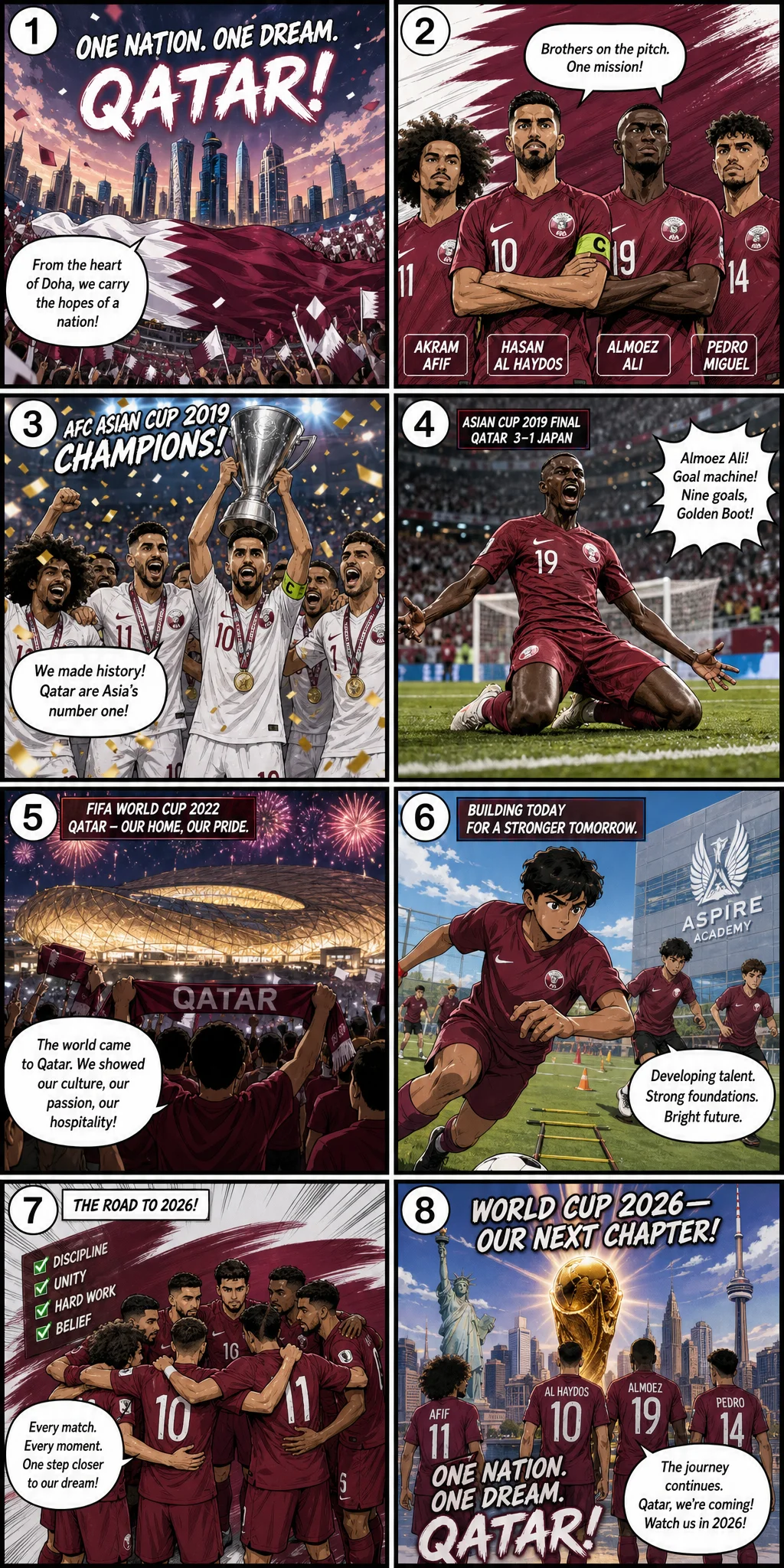
8-panel comic about Qatar national football team and their journey to the 2026 FIFA World Cup.
Published: June 5, 2026
Qatar National Football Team: The Maroon Wave Rising
The Qatar national football team, known as "Al-Annabi" — The Maroons — carries the ambitions of a small Gulf nation that has invested massively in football as a vehicle for national transformation and global recognition. Having hosted the 2022 FIFA World Cup — the first Arab nation to do so — Qatar now enters the 2026 tournament as a competitive participant rather than an automatic host, seeking to prove that its football development project can produce sustained success on the world's biggest stage.
HISTORICAL FOUNDATIONS
Football arrived in Qatar in the mid-twentieth century, introduced by British oil workers who brought the game to the Arabian Peninsula's coastal communities. The Qatar Football Association was founded in 1960, and the country joined FIFA in 1970, beginning its journey from obscurity toward international relevance. For decades, Qatari football operated in the shadow of larger regional powers — Saudi Arabia, Iran, Iraq — with modest results and limited global recognition.
The transformative moment came in the early 2000s, when Qatar's leadership made a strategic decision to invest in football as part of a broader national vision. The Aspire Academy, founded in 2004, became the centerpiece of this strategy — a state-of-the-art talent development facility that combined world-class coaching, sports science, and education. The academy scouted young athletes across Qatar and, through strategic partnerships, identified talent from Africa, Asia, and beyond to train alongside Qatari prospects.
Qatar's hosting of the 2011 Asian Cup and the successful bid for the 2022 World Cup accelerated the nation's football development. The national team won the 2019 Asian Cup, defeating regional heavyweights Saudi Arabia, South Korea, and Japan in a stunning campaign that produced 19 goals and conceded only one. The final against Japan in Abu Dhabi, a 3-1 victory, announced Qatar as a genuine continental power. This golden generation, developed almost entirely through Aspire Academy, had proven that Qatar's long-term investment was yielding results.
THE 2022 WORLD CUP EXPERIENCE
Hosting the 2022 World Cup brought unprecedented scrutiny and pressure. Qatar became the first host nation to lose all three group-stage matches — defeats to Ecuador, Senegal, and the Netherlands — a disappointing outcome that obscured the profound organizational achievement of hosting a compact, well-run tournament. The experience, while painful on the pitch, provided invaluable exposure for Qatari players competing against elite opposition in matches of genuine consequence.
The tournament's legacy extends beyond results. Qatar's football infrastructure — eight climate-controlled stadiums, world-class training facilities, and an enhanced domestic league — provides a foundation for sustained development. The experience of competing under the global spotlight, facing the world's best in matches that mattered, cannot be replicated in training.
LEGENDS AND MODERN PIONEERS
Almoez Ali stands as the defining figure of modern Qatari football. His nine goals at the 2019 Asian Cup broke the tournament's single-edition scoring record, and his overall international tally places him among Asia's most prolific active goalscorers. Ali's combination of physical presence, intelligent movement, and clinical finishing makes him the focal point of Qatar's attack. Born in Sudan, he moved to Qatar as a youth and represents the Aspire Academy's most successful product — a symbol of the system's capacity to identify and develop elite talent.
Akram Afif, the creative force behind Qatar's Asian Cup triumph, possesses the flair and vision to unlock defenses at the international level. His journey through European academies — including Villarreal and Sporting Gijon in Spain — broadened his football education before he returned to Al-Sadd, Qatar's most decorated club. Afif's partnership with Almoez Ali forms the attacking core around which the national team is built.
Hassan Al-Haydos, the long-serving captain, has earned over 170 caps in a career spanning more than a decade. His leadership, versatility, and set-piece delivery have made him the team's steadying presence through multiple eras. Saad Al-Sheeb, the goalkeeper whose penalty saves were crucial to the 2019 Asian Cup campaign, provides experience and reliability at the back.
THE MODERN FOOTBALL SYSTEM
Qatar's football project extends beyond the national team to encompass a comprehensive development ecosystem. The Aspire Academy continues to produce technically proficient, tactically educated players who have grown up together in a professional environment. The Qatar Stars League, while not among the world's strongest domestic competitions, has attracted international playing and coaching talent that raises standards.
The naturalization strategy that supplemented Qatar's talent pool — recruiting promising young players from other nations who moved to Qatar at a young age and developed through Aspire — has generated debate about national team identity. Qatar's approach, however, follows a path taken by many nations with small populations, and the FIFA eligibility framework provides the rules within which all nations operate.
Qatar's youth national teams have achieved strong results in Asian competitions, suggesting that the pipeline of talent continues to flow. The Under-19 team's performances, in particular, indicate that the Aspire model is producing sustainable results rather than a single exceptional generation.
FOOTBALL AND QATARI CULTURE
Football's role in Qatari society has been transformed by the World Cup hosting project. The sport has become a central element of national identity and a vehicle for projecting a modern, globally engaged image. Stadium attendance and grassroots participation have increased, and the domestic league enjoys stronger support than at any point in its history.
The relationship between football and Qatari culture is evolving as the country navigates rapid social and economic change. Traditional majlis gatherings now feature football debates alongside discussions of business and politics. The success of the national team, particularly during the 2019 Asian Cup, created moments of genuine national celebration that transcended the country's demographic divisions — citizens and expatriate residents celebrating together.
The women's game has also received investment, with the Qatar women's national team growing in competitiveness and participation. This development, while still in its early stages relative to the men's game, reflects broader social changes within Qatari society.
THE PATH FORWARD
Qatar enters the 2026 World Cup with automatic qualification as the defending Asian Cup champion and a host nation seeking redemption. The experience of 2022, while disappointing in results, has prepared this team for the intensity, pressure, and tactical demands of World Cup competition. The players who faced Ecuador, Senegal, and the Netherlands are battle-tested in ways that theoretical preparation cannot replicate.
The tactical approach emphasizes possession-based attacking football, with Afif orchestrating from wide positions and Ali providing the finishing touch. The team's technical quality on the ball, developed through years of Aspire Academy training, allows them to control matches against many opponents. The challenge at World Cup level is maintaining that control against superior athletic and tactical opposition.
For Qatar, the 2026 World Cup is an opportunity to demonstrate that 2022 was not the endpoint of its football journey but a foundation. The Maroons carry the aspirations of their nation into the tournament and the football world's curiosity about whether a small Gulf state's ambitious project can compete at the sport's highest level. The answer begins in North America.