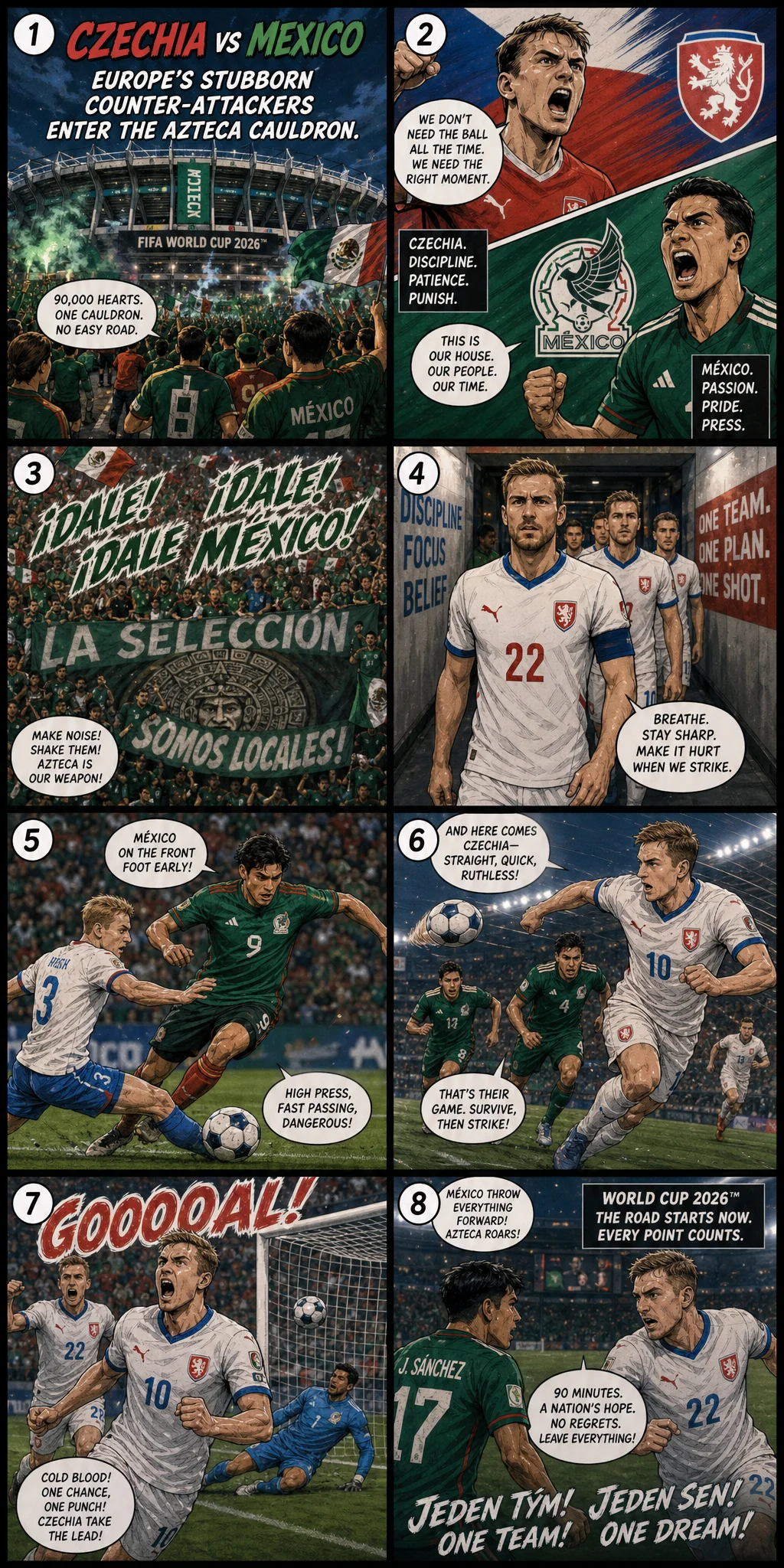
Czechia vs Mexico: Europe's Stubborn Counter-Attackers Enter the Azteca Cauldron
Group A showdown at the legendary Estadio Azteca. Czechia's tallest squad meets Mexico's home-soil intensity at 2,240 metres altitude, where the thin air and 83,000 fans create the most hostile environment in world football.
Published: June 6, 2026
# Czechia vs Mexico: When Europe's Most Stubborn Counter-Attacking Machine Rolls Into the Azteca Cauldron
## Altitude, History, and Fear
The first time I walked into the Estadio Azteca, the air at 2,240 metres pressed against my chest like an invisible wall. A local told me that European teams coming here to play always suffer a very specific kind of pain in the first 20 minutes—not the pain of tired legs, but of lungs that cannot keep up with thoughts. Your brain says "push up." Your lungs say "don't even think about it."
Czechia will feel this on June 24. Their manager Miroslav Koubek is 73 years old—a man who has lived through communist Czechoslovakia, the Velvet Revolution, the dissolution and rebirth of a nation—but he has never managed a match above 2,000 metres. When I picture this, I do not think about tactics. I think about a man standing on the touchline, feeling the breath of 83 million Mexicans on the back of his neck.
This is not a match that should be written about as just a football match. It is about altitude. It is about the soul of a stadium—the Azteca is one of the few places in football that genuinely deserves the word "temple." Maradona produced the Hand of God and the Goal of the Century here. Pele lifted his last World Cup here. It is also about the collision of two football cultures: a small Eastern European nation that crawled through the playoff fires to get here, and a North American giant carrying the weight of a host nation's destiny.
## Javier Aguirre: A Man Who Knows How to Survive
Javier Aguirre's life is a survival manual. Third stint as Mexico manager, each time recalled in crisis—2001 to replace the sacked Enrique Meza, 2009 to replace Sven-Goran Eriksson, 2024 to replace Jaime Lozano. He is Mexican football's emergency contact, permanently listed at the top of the phone book.
His teams do not chase beauty. He once said something that I keep coming back to: "At a World Cup, the team that plays the prettiest football does not always win. The team that knows how to compete does." Inside that sentence is a profound understanding of Mexican football's essence—this country has never lacked technical talent. What it has lacked is the ability to convert that talent into results in the 90 minutes that matter most.
Raul Jimenez (Fulham) is Aguirre's perfect striker—not because he scores the most goals, but because he has survived something no one should have to survive. That 2020 match against Arsenal, when David Luiz's head collided with his skull, the fracture fragments millimetres from his brain. Doctors told him he might never play again. Six years later, he stands on a World Cup pitch for his fourth tournament. Every time I see him jump for a header, I involuntarily hold my breath.
## Czechia: A Team That Does Not Need the Ball
Koubek's Czechia reminds me of those old chefs in rural Italian trattorias—the menu has three pages, but every dish is executed with precision. Their game plan is exactly that: back three, two wing-backs (Coufal and Jurasek/Zeleny), Schick at the tip, Soucek surging from midfield, Sulc scavenging in the gaps.
They do not need the ball. In the playoffs, they averaged 38% possession and killed Ireland and Denmark with five-second vertical counters. I have never seen a team so serene about accepting they will not control a match—and that serenity is itself a weapon.
Patrik Schick (Bayer Leverkusen) scored 16 Bundesliga goals in 2025-26 and five more in qualifying. His talent requires no further proof—that halfway-line lob at Euro 2020 remains one of the most replayed football clips on YouTube. But at the Azteca, he faces a more cunning opponent: altitude. The ball moves differently in thin air—it travels faster, drops more unpredictably, even goalkeepers' clearances mysteriously sail out of play. For a team built around long balls and headers, this is a potentially catastrophic variable.
## The Midfield Boxing Match: Alvarez vs Soucek
The duel between Edson Alvarez (Fenerbahce) and Tomas Soucek (West Ham United) is the kind of matchup that makes old-school football fans slap the bar in excitement. Neither is the type of player who gets into a Team of the Year. But their managers wake up at 3am thanking God they exist.
Alvarez is the core of Mexico's "Triangle of Trust"—he can play holding midfield or drop into centre-back. His tackles are unglamorous but effective, his passes unspectacular but safe. Soucek is a different kind of menace: 1.93m, having drowned countless defenders in Premier League penalty areas, his late arrivals into the box one of Czechia's most difficult weapons to defend.
But at the Azteca, physical expenditure changes everything. Soucek ran a full Premier League season, then flew across nine time zones to Mexico City to run on the least runner-friendly pitch in world football. Alvarez at least has teammates who are playing at home and understand what altitude does to the body.
## History
The two nations' only modern meeting was on February 8, 2000—Czechia beat Mexico 2-1 in Monterrey, a friendly, in weather much cooler than June. Go back further, and Mexico beat Czechoslovakia 3-1 in the 1962 World Cup group stage in Chile. So in a sense, they are one win apiece—if you permit the inheritance of Czechoslovakia's record by Czechia.
But these numbers tell a more interesting story: this is a match that has not happened in any meaningful context for nearly three decades. No psychological baggage. No historical animosity. Two strangers locked into a boxing cage at 2,240 metres. Whoever adapts first wins.
## Prediction
I cannot ignore the altitude. I have seen too many European teams struggle through the first 30 minutes in Mexico City like drowning men—not because they are not good enough, but because there is not enough oxygen. Mexico's plan will be intense pressing in the first 20 minutes, creating chaos before the Czechs can adapt, targeting an early goal.
If Czechia can survive the first half, the match will slowly tilt in their favour—their set-piece threat is precisely the type Mexico's defence is least equipped to handle. But the 83,000 at the Azteca will not allow the game to proceed quietly. Every Czech touch, every Czech foul, the wall of whistles will make the stadium floor vibrate.
This is the closest thing to football hell. And the Czechs are about to walk in.
Prediction: Mexico 2-1 Czechia. Jimenez heads home a Gallardo cross in the 18th minute, Schick equalises from a free-kick in the 55th, and 17-year-old Gilberto Mora scores the winner from outside the box in the 77th—a child's goal, forged in the Azteca furnace.