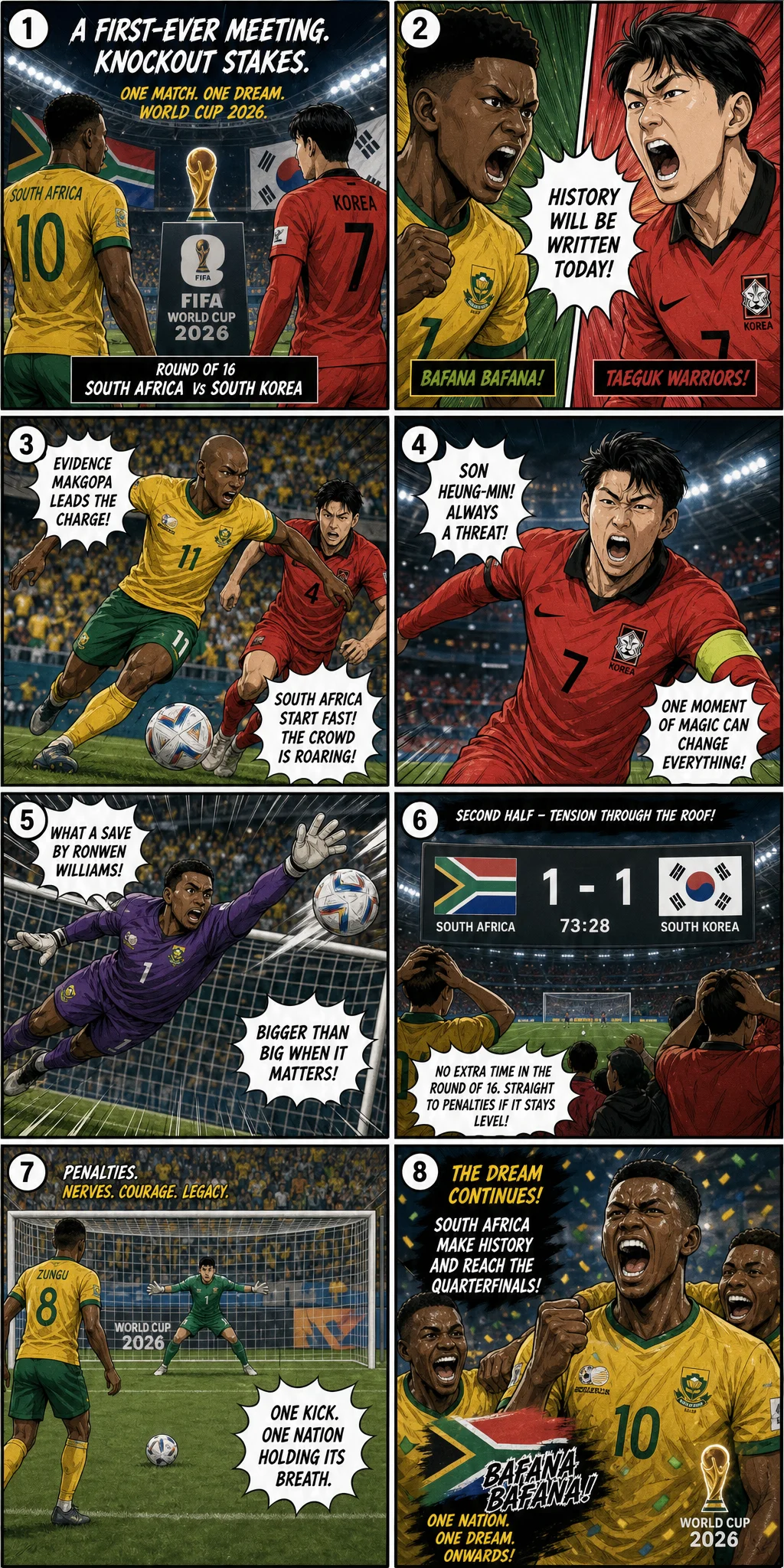
South Africa vs South Korea: A First-Ever Meeting with Knockout Stakes
Group A finale at Estadio BBVA, Monterrey. The first senior meeting between these nations—South Africa's defensive resilience versus South Korea's individual brilliance, with a place in the Round of 32 likely on the line.
Published: June 6, 2026
# South Africa vs South Korea: A Match That Has Never Happened, and What That Tells Us
## Zero
South Africa and South Korea have never played each other in men's international football. In a century of the sport, across all competitions and all continents, these two nations have never shared a pitch.
In an era saturated with data, in which any pairing of national teams can be instantly searched for head-to-head records, "zero" is a fascinating number. It means there is no precedent. No script. No pattern of matchups that analysts can pull from the archives. On June 24 at Estadio BBVA in Monterrey—53,500 seats, carved into the industrial heart of northeastern Mexico—two teams will walk onto a pitch knowing almost nothing about each other.
But zero is also a dangerous number. It brings to mind a line from Eduardo Galeano's "Football in Sun and Shadow": "The history of football is a sad voyage from beauty to duty." The zero meetings between South Africa and South Korea are an illusion—because the footballing trajectories of these two nations have, in fact, been running in astonishing symmetry.
## Parallel Solitudes
The story of South Korean football in the World Cup context is always reduced to a single number: 2002. That year, at home, amid controversial refereeing decisions that still agitate conversations two decades later, Hong Myung-bo's Taeguk Warriors reached the World Cup semi-finals. It remains the greatest achievement in Asian football history, a benchmark that no Asian nation has since approached—and a ghost that South Korean football has been unable to exorcise for 24 years. Every generation of Korean players is asked the same question: can you do it again? The answer, so far, has been a sustained silence.
South African football has a comparable totemic moment, but inverted. In 2010, they became the first African nation to host a World Cup—and the first host nation to be eliminated in the group stage. That opening match against Mexico—Siphiwe Tshabalala's thunderous strike, that iconic dancing celebration—remains the most vivid image in South African World Cup memory. But they never returned to the tournament, until Hugo Broos took charge in 2022 and began a quiet, almost unnoticed revolution.
The trajectories form a symmetrical paradox: South Korea reached an improbable height at home and has since been crushed by unattainable expectations; South Africa suffered an improbable humiliation at home and has since been forgotten at the World Cup's margins. In 2026, in Monterrey, these two lines finally intersect.
## The Broos Blueprint
Hugo Broos is an interesting man. Belgian, in his seventies, unfiltered in his speech—his first year in charge of South Africa was marked by controversy after he publicly criticised the standard of the domestic league. But four years later, no one questions his results: he has built the most defensively solid team in African qualifying, a team that knows exactly who it is and does not pretend to be anyone else.
The Broos system rests on a core paradox: a defense-first team that possesses two of Africa's most exciting young attackers. Oswin Appollis (Orlando Pirates) was Bafana's most effective dribbler and creator in qualifying—not a name that gets repeatedly mentioned in European top-division conversations, but in the African game his ability to cut inside and shoot makes him stand out in a tactically uncomplicated system. The 21-year-old Relebohile Mofokeng (Orlando Pirates) is a different kind of talent: a traditional No.10, fearless, whose close control in tight spaces evokes memories of a young Jay-Jay Okocha—not because their styles are similar, but because they share that quality of "I don't know what I'm going to do next, and the defender knows even less."
But South Africa's goal-scoring problem is real. Lyle Foster's (Burnley) record in England is concerning, and Iqraam Rayners' (Mamelodi Sundowns) sample size at international level is too small to draw conclusions. Broos's system can keep South Africa alive in matches, but winning them depends on converting a small number of chances—a question that will be more clearly defined after the Mexico and Czechia fixtures.
## Hong's Last Stand
South Korea's situation is entirely different. Their problem is not creativity—Son Heung-min, Lee Kang-in, Hwang Hee-chan, and Hwang In-beom, the creative output of these four exceeds anything else in the group. Their problem is structure.
Hong Myung-bo's back-three gamble will face its most rigorous examination after the first two matches. If South Korea have exposed the space behind their wing-backs against Czechia and Mexico—which seems almost certain—then the South Africa match represents his final opportunity to prove that this system is not a catastrophic error.
It is worth remembering who Hong Myung-bo is. He was the greatest defender in South Korean football history. Captain of the 1994 and 2002 World Cup teams, his understanding of defensive organisation should run deeper than any Korean coach's. His failure at the 2014 World Cup—one draw, two losses in the group stage—is the largest stain on his coaching record, and 2026 may be his last chance to erase it.
## The Match Within the Match: Appollis vs Korea's Right Side
If South Africa are to win this match, their attacking threat will almost certainly concentrate on the left flank. Appollis cutting inside from the left wing, combined with left-back Aubrey Modiba's (Mamelodi Sundowns) overlapping runs, represents what Broos has identified as the team's "primary attacking corridor." This directly attacks the most vulnerable zone in South Korea's 3-4-3—the channel between the right wing-back (likely Jens Castrop) and the right-sided centre-back, a space that was exploited repeatedly in the pre-tournament friendlies against Brazil and Ivory Coast.
If Hong has enough self-awareness to revert to a more conservative shape—a 4-2-3-1, for instance, with Seol Young-woo returning to his natural left-back role—South Korea will be far better equipped to contain Appollis. But if he persists with the 3-4-3, this match could become Appollis's breakout performance on the global stage.
## Prediction
This is the most difficult match in Group A to forecast, partly because these teams have never met, and partly because its stakes can only be fully understood after the first two rounds of fixtures have concluded. If South Korea have already taken sufficient points from Czechia and Mexico, Hong may revert to his more familiar defensive system and control the match safely. If South Africa need a victory to progress, Broos may be forced to do the thing he likes least: push his team forward to attack.
In an ideal world, this match would be Son Heung-min's World Cup farewell dance—a tournament that has not gone entirely to plan, salvaged by a goal and an assist in the final group game that carries his nation through. But football's ideal worlds rarely overlap with reality.
Prediction: South Korea 2-1 South Africa. Mofokeng creates a surprise lead for South Africa in the first half, but Son equalises with a free-kick in the second, and Hwang Hee-chan scores the winner on the counter-attack in the 82nd minute—South Korea squeeze through to the knockout stage.