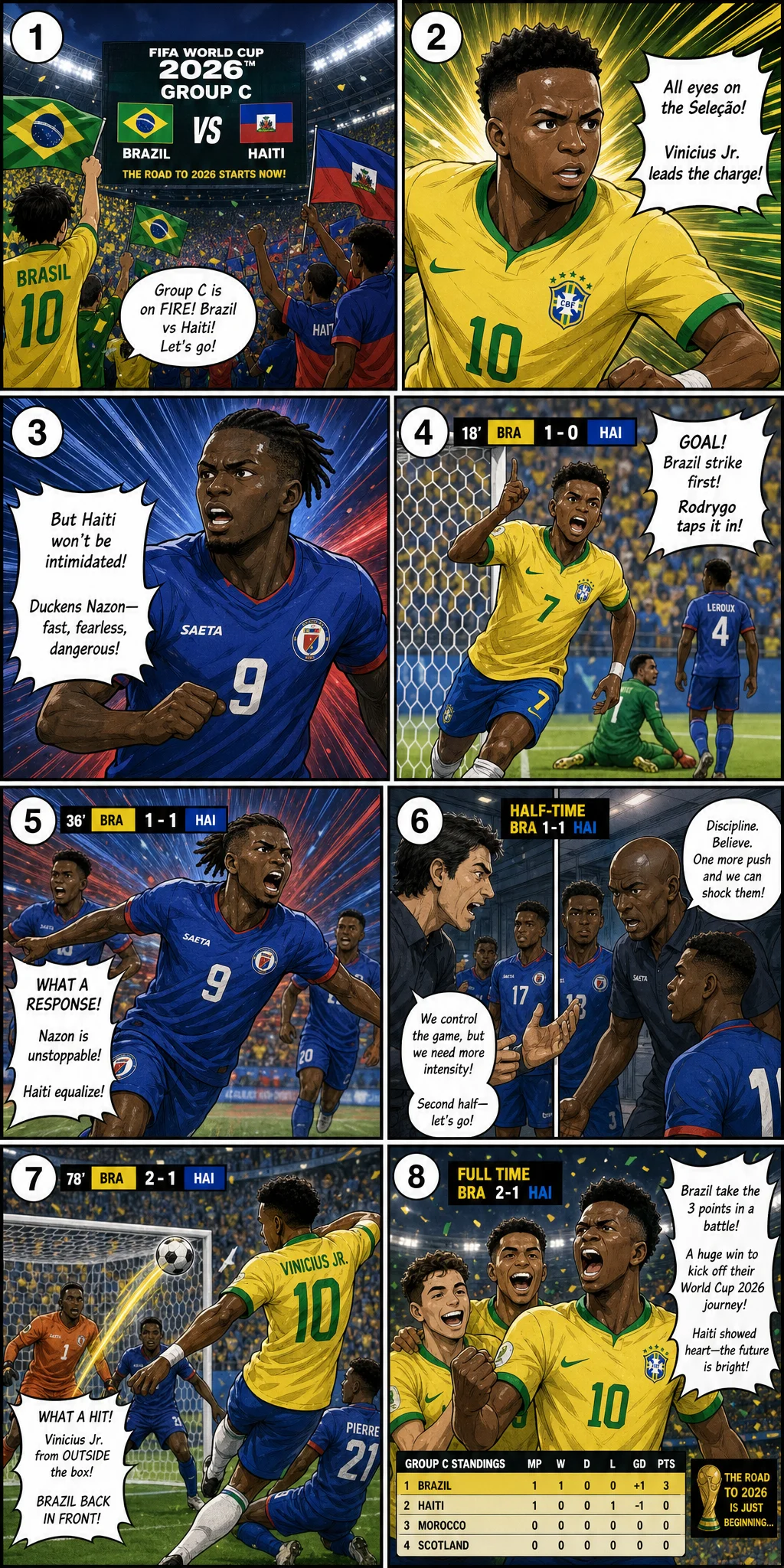
Brazil vs Haiti - Group C Preview
2026 World Cup Group C: Brazil vs Haiti at Lincoln Financial Field
Published: June 6, 2026
# Brazil vs Haiti: When the System Gap Becomes the Match Theme
The type of match that football tactical analysts dread writing about most is one where the disparity in quality is glaring on paper. But Brazil vs Haiti – this Group C second-round match – precisely offers a tactical proposition worth dissecting: when one side holds all the structural advantages, the outcome of the game depends on whether the weaker side can manufacture "miniature victories" in specific zones.
## Brazil's Positional Play: The Ultimate in Space Control
After Carlo Ancelotti's Brazil faced Morocco in the opener, the tactical focus for this match shifts from "breaking down defenses" to "systematically dismantling a low block." Haiti is expected to respond with a 5-4-1 low defensive shape – which means Brazil will need more elements of positional play.
The key lies in the positioning of Bruno Guimaraes (Newcastle). When Haiti compresses their defensive line, Guimaraes can advance into the opponent's half in zone 14 – the central area just outside the penalty box. His data at Newcastle shows a 43% success rate for through balls delivered from this zone, ranking in the top five among Premier League players in the same position. His half-space passing network typically displays a radial structure – evenly distributing passes from the center circle to the left, right, and forward channels – meaning Haiti cannot simply block one passing lane to limit him.
The positioning of the full-backs will also differ from the first match. Wesley's (Roma) underlap runs – diagonal movements from the flank towards the center – are far more effective against a low block than traditional overlaps. Vinicius Junior (Real Madrid) holds the width on the flank, while Wesley cuts in from the half-space. This "one wide, one narrow" flank structure appears repeatedly in Ancelotti's tactical playbook. On the left, Douglas Santos (Zenit) stays deeper to form a three-man defensive line, preventing Haiti's counter-attacks.
Up front, Raphinha's (Barcelona) cut-inside shots from the right flank are a classic weapon against low blocks – he scored 8 goals from such cut-ins from the right in the 2025/26 season for Barcelona (all competitions). Center-forward Igor Thiago's (Brentford) physical dueling ability will be a constant physical torment for Haiti's center-backs – he averages 5.3 aerial duels won per game in the Championship.
If Neymar (Santos) gets 30 minutes of playing time in the second half, he will face Haiti's defense at its most fatigued moment – when his tight-space creativity can be maximized. Ancelotti revealed in a pre-match interview that Neymar's fitness is "improving every day," hinting that he might receive more playing time in this match.
## Haiti's Survival Manual: Pressing Triggers and Transition Moments
Sebastien Migne's tactical plan has only one core: press at the right moments, counter-attack in the right spaces.
Haiti will not employ a high press across the entire pitch – that would be suicide. Their pressing trigger is likely set for when a Brazil center-back makes a lateral pass – when Marquinhos (PSG) passes to Gabriel Magalhaes (Arsenal), Duckens Nazon (Esteghlal) will initiate a curved pressing run, attempting to force the pass towards the center – precisely where Jean-Ricner Bellegarde (Wolverhampton Wanderers) and Danley Jean Jacques (Philadelphia Union) set their interception traps.
Danley Jean Jacques is the key to this defensive system – his interception data in MLS (2.8 successful interceptions per game) allows Haiti to quickly regain their defensive shape after losing possession. His partnership with Bellegarde is the only midfield combination in Haiti with top-flight league experience.
The counter-attacking routes are very clear: Wilson Isidor's (Sunderland) speed against the space behind Brazil's high defensive line. His sprint speed data in the Premier League (maximum 35.1 km/h) means any Brazil defensive error could be punished. Ruben Providence's (Almere City) 1v1 dribbling on the left flank is the second counter-attacking option – his successful dribbles per game in the Eredivisie (2.1) demonstrate his threat in open spaces.
Goalkeeper and captain Johny Placide (SC Bastia), 38 years old, will be Haiti's busiest player – he is expected to face 20+ shots. His save percentage in Ligue 2 (73%) will directly determine the scoreline. The defensive line led by Hannes Delcroix (FC Lugano) needs to maintain absolute concentration for 90 minutes – one lapse in focus could be punished by Brazil.
## Systematic Dismantling vs. Sporadic Counter-Attacks
The ultimate tension in this match lies in: can Brazil's systemic advantage consistently generate high-quality chances over 90 minutes – or will it fall into diminishing returns amidst heavy possession? Ancelotti frequently faced low blocks during his time at Real Madrid, and his solution was usually to create numerical overloads inside the penalty area – Casemiro's (Manchester United) late runs for headers and Lucas Paqueta's (Flamengo) long-range shots from the edge of the box will be key to breaking the deadlock.
From a tactical evolution perspective, this match is a classic asymmetric contest – possession could reach 75%-25%, but possession rate is never the sole variable determining the outcome. If Haiti can keep a clean sheet for the first 30 minutes, the psychological dynamics of the match will begin to tilt in an interesting direction.
Predicted score: Brazil 3-0 Haiti. Brazil's systemic pressure will eventually overwhelm Haiti's defensive structure – but the first half could be more tightly contested than many expect. Haiti's objective is not victory, but to prove in this match that they belong on this stage.